This article appeared in Mammal News, the newsletter of the Mammal Society in 2026. The Mammal Society’s “Searching for Shrews project”, now in its third year, has as its principal aim ‘to increase monitoring of small mammals in Great Britain, especially shrews’. Its secondary aim is to track the spread of the non-native, presumed invasive, greater white-toothed shrew (GWTS), Crocidura russula.
Non-native this species most certainly is, but its invasion strategy is a little perplexing. Since its discovery in 2022, it has popped its head up in a handful of widely dispersed locations across England with no hint of its presence in between, as if it’s playing
the soricid version of ‘whack-a-mole’ with us on a national scale. To date, it is only in County Durham (VC66), east of the A1M and north of Hartlepool, where it is known to have spread more widely than the location where it was first discovered.
It is important to assess the distribution of our native shrews – after all, we won’t know if the arrival of GWTS is affecting them in any way if we don’t know whether they were there to start with. In Ireland, the arrival of the GWTs resulted in competitive
exclusion of the native pygmy shrew Sorex minutus (formerly the only shrew species present. Prior to the launch of the Searching for Shrews project, the local environmental records centre had only four post-2012 records of pygmy shrew for the whole of County Durham. In the interim, this situation has subsequently been improved significantly by the acquisition of a substantial dataset of historical records (see map). Nevertheless, this still leaves a lot of blanks, and crucially it doesn’t tell us where the species has been looked for but not found.
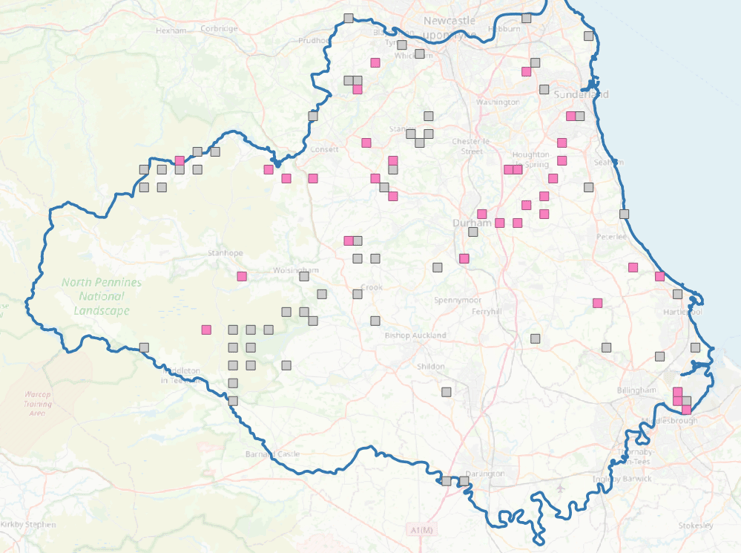
Pygmy Shrew distribution in County Durham. Grey squares are records from prior to 2022; red squares are from the Searching for Shrews project. (Map courtesy of the Environmental Records Information Centre North East)
Over the past three years, members of Northumbria Mammal Group have checked owl pellets from 54 locations across the county. Most of these samples were collected by one of the authors (TC) cold calling at farms to see if they had barn owls, which had the added benefit of increasing the records of barn owl roosts considerably. Sampling has been constrained by the available sources of owl pellets, with more effort concentrated in the east of the county where the GWTS is known to be present, to try and determine how far it has spread. Currently the answer would seem to be: not that far. While its
current known distribution in the county does cover some 70 square miles, it does not seem to be spreading at the rate it has in Ireland.
While we have learned a little more about the GWTS, the information on the other shrews has perhaps been even more interesting. Ignoring sites where the data on either pellets or remains wasn’t quantified, a total of 50 sites were analysed for the presence of each species, with 95% of these 50 sites having at least one native shrew species. A total of 1,297 pellets were examined which, between them, yielded 632 common shrews, 147 pygmy shrews, 61 water shrews, and 73 GWTS.
The number of pellets per location ranged from one to 158 and, unsurprisingly, the chances of finding a particular species of shrew varied with the number of pellets examined. The table shows the percentage of sites with each species in relation to the number of pellets analysed. Where at least 20 pellets were examined, 55% had all three native shrew species and each of the 12 sites with water shrew had both other native shrews. Of the 19 sites having common shrew, 16 (84%) had pygmy shrew and 12 (63%) had water shrew).
The percentage of sites with each of the shrew species
| Species | ≥ 1 or more pellets (50 sites) | ≥ 10 or more pellets (37 sites) | ≥ 20 pellets (20 sites) |
| Common Shrew | 86 | 92 | 95 |
| Pygmy Shrew | 58 | 70 | 80 |
| Water Shrew | 40 | 46 | 65 |
| GWTS* | 24 | 30 | 35 |
* More survey effort was concentrated in areas where GWTS was expected.
So, in terms of a baseline, it seems that common shrews are ubiquitous across much of the county. The only sample from which they were missing was at Cow Green Reservoir, which is at 500 m elevation in the North Pennines. Pygmy shrews were also widespread, being found in 80% of the larger samples, and given that their small size makes them more difficult to find in owl pellets, they are likely to be more widespread still. As might be expected, water shrews were less widespread, being more closely associated with a discrete habitat (wetlands) than the other two species. This association is illustrated by RSPB Saltholme, a very large wetland site: although only 12% of the total number of pellets came from this location, they accounted for 38% of all water shrew remains
across the county. Water shrews accounted for 15% of all shrews at Saltholme but just 7% across all samples.
Having established a provisional baseline of native shrew presence, what are our priorities now? One is to repeat surveys in areas known to have the GWTS, to see if it is impacting on native shrew species. However, this may take some time to determine, given the natural fluctuations in both shrew populations and the proportions of shrews
in owl pellets. For example, at RSPB Saltholme, which has so far been negative for GWTS, in a sample of 27 pellets from late winter 2024/2025 shrews accounted for 34% of all prey remains, whereas in 32 pellets from the same period in winter 2025/2026 shrews only formed 5% of prey remains. Perhaps just as important is to continue to monitor sites which are, so far, negative for GWTS but on the periphery of its known distribution,
to see if and when it turns up, thereby giving some indication of its rate of spread.
Finally, our maps have two very large blank areas, one in the North Pennine Uplands and the other in the Tees Lowlands. These blanks have been harder to fill due to the difficulty
of finding any accessible barn owl roosts. So to plug the gaps between the owls, perhaps our next strategy could be to recruit the pussycat for a ‘what the cat brought in’ survey.

