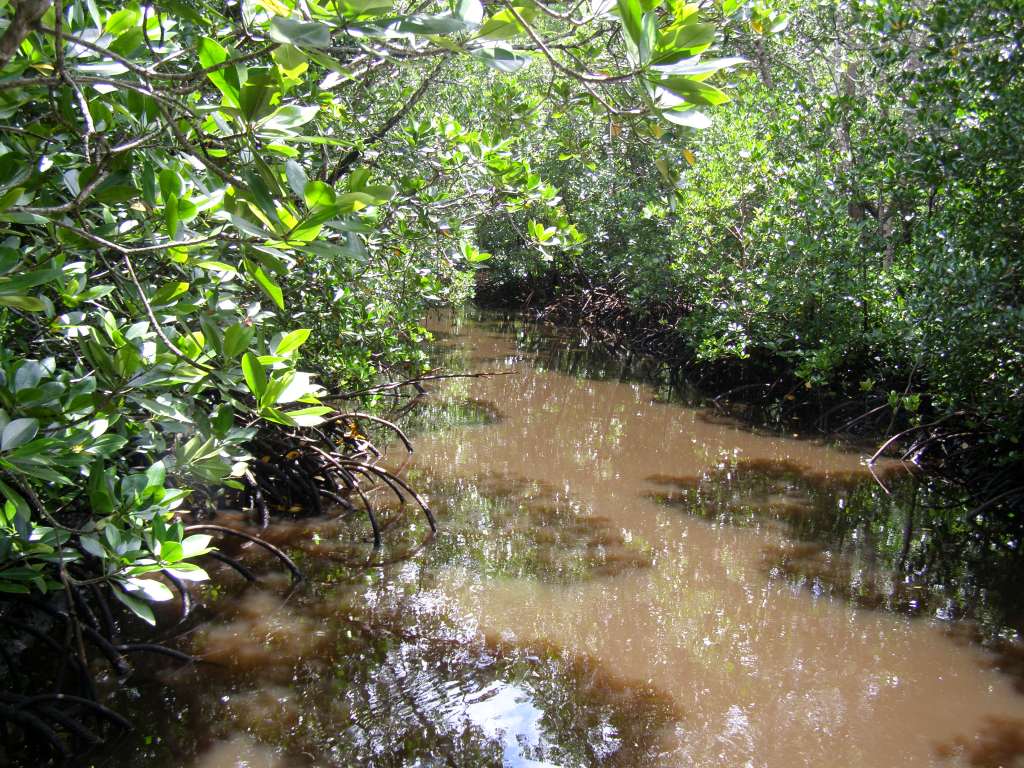
Zanzibar, the last leg of our safari. A place so exotic that it’s got two z’s in it. It apparently means black coast, which it most definitely wasn’t. (For the record it was mostly sparkly white, with little crabs popping up and walking sideways along the sand like they were in a ’50s Disney wildlife film). The main island where we were staying is called Unguja, which sounds much more African though I think you could still slip a z in there without losing the effect. Zanzibar had something that Selous and Ruaha didn’t – people. I’m not sure why this was a surprise to me, coming from a crowded island where people are everywhere and wildlife hangs on around the margins. But in the previous week or so the new normal had become large expanses where wildlife was everywhere and people kept to the margins. Zanzibar had lots of people, almost twice as many per square kilometre as England, and away from the coast I can’t recall seeing much wildlife at all, but it did have another “z” up its sleeve. About half way down where the island narrows is Jozani, the only national park on the island. As national parks go it’s tiny, something like 5km by 5km and is a mixture of forest and mangrove.
Jozani’s main claim to fame is as home to one of the most photogenic monkeys on earth, Kirk’s Red Colobus. Colobus monkeys are attractive anyway, but throw in a swathe of reddish fur, the maddest hair style in the animal kingdom and a penchant for posing for photos and they are simply captivating. It’s endemic to Zanzibar, thereby also making it one of the rarest monkeys on earth. It might not have been the rarest animal in Jozani though. Our guide, another Hussain, told us the obligatory tourist tale of the Zanzibar leopard. Once thought to be an endemic sub-species, Panthera pardus adersi, but now known to just be a variation on the leopard spotting pattern, it existed in myth as much as reality, with witches allegedly keeping them to punish people. No-one has seen one for a couple of decades but as Hussain conjectured with scarcely a hint of conviction, just maybe the local witch doctors still kept some.

I must admit I love the romance of cryptozoology, where no-one is sure if the animal is real or myth, dead or alive. The problem for the Zanzibar leopard is that a typical leopard territory would be about 5km by 5km. So while there could be room for a single one in Jozani, keeping the colobus on their toes, they would have a hard time hiding in the rest of Zanzibar. Sadly, I think I have solved Schrodinger’s big cat conundrum; the cat is definitely dead.
Zanzibar had another novel feature – the sea. The place where we were staying was fronted by a shallow reef. At low tide this turned several hundred metres of sea into a waist-deep paddling pool. The water was so clear it was only really apparent as water when something moved it and the sea floor was a minefield of sea urchins. Some were little volcanoes with streaks of flaming larva running down them, while others were circles of black, hypodermic needles. These were arranged in a patchwork stretching as far as we could see, like an infinite game of Connect Four. We picked our way, trying not to step on one of the red or black “mines” but then complacency got the better of us and so did one of the hypodermic needles. It didn’t hurt, at least not enough for me to remember that it hurt, but that afternoon I realised that my right, big toe had become numb. It stayed numb for the next five years.

We didn’t have a goal in mind, but we found one in the form of some blocks of limestone, each one the size of a dining table but spread out distantly just below the surface as if it were a café for submersible sociophobes. Each one was its own world, with all the fish you would expect to see in the more exotic pet shops orbiting as if stuck by gravity. If anyone wants to make a real-life version of “Finding Nemo”, this is the place to come. We went from table to table, our hunger for yet another new species never really satisfied, our snorkels masking the realisation that we were no longer waist-deep.
I hadn’t really thought about it in advance but the problem with reefs is that once the water has overtopped them then it comes in a rush. I really don’t like getting out of my depth. On my first swimming lesson, aged about eight, my foot slipped as I was over-confidently wading across the pool. I can still see the tiles on the side of the pool, rising and falling just out of reach as I rose and fell under the surface. I was going down for the third time before the instructor jumped in and pulled me out. I can swim fine now, but I’d rather not. The sea urchins just had to get out of the way on the return journey.
I really should have known better then, than to book a snorkelling trip, miles off shore, later in the week. It didn’t start well. Confident in my ability to use a snorkel gained a few days earlier, I did as everyone else did and jumped off the boat. The snorkel filled with water and I found myself choking with the sea bed a couple of body lengths below my feet. Fortunately one of the staff on the boat was in the water with a flotation aid, which I clung to for the first of several times that morning while I exchanged water for air. Eventually I relaxed and got the hang of it and floated over the shallow reef. This was the only the fourth time I’d ever stuck my head under the sea with a face mask. The first time, waist deep in the surf in Menorca, I’d spent a whole afternoon with a wrasse and four mullet. Other than seeing my children being born it was the most amazing experience I’d ever had; I felt like I was visiting another world. Now, floating over a full-blown coral reef in the Indian Ocean it was like I was in a distant galaxy far, far away. Here were things you’d never see in a fish tank. Fish, but not as we know them.
As far as I can remember, I didn’t swim anywhere. I can only imagine I must have drifted as when I looked up no-one was around and when I looked down I found myself staring into the abyss. That’s the actual abyss, not the one in the cliché, as the reef just dropped off into nothingness. Oddly, I felt peaceful rather than nervous. In fact, I found myself wishing that a big shark or some other monster of the deep would come sweeping up out of the darkness for me to see it. This is not something that Ian Bond would ever wish for. But then he/ I didn’t seem to be there; it was like I was viewing it through a body that I had borrowed. It is argued that the reason that we feel as if we have an inner self, a soul if you like, is because the world is largely channelled through the narrow prism of our eyes. Drifting there in my own sea of tranquillity, I realised that my face mask had turned up the volume on this phenomenon, presumably by blocking out all peripheral vision, to the point where I felt disembodied. This rationalisation reconnected me with my sympathetic nerve; the boat had drifted out of site; Michael was swimming over to retrieve me. I vowed to stick with being a timid traveller.
 Raven on the Wing