“Never again!” I’ve said that loads of times. I’ve said it at Christmas when I’ve watched the same movie for the umpteenth time; I’ve said it every single time I’ve driven down south on holiday and been stuck in traffic jams, and I’ve said it way too many times when deciding that I should give up eating cheesecake. But one, “never again” promise that I have kept for over 40 years so far is to never again do the Lyke Wake Walk.
To be honest, keeping that promise has been a piece of cake (not cheesecake you understand; oh go on then, but this is definitely my last). The Lyke Wake Walk is a west-east crossing of the North York Moors, or east-west if you prefer, or both if you are super human, lost or mad. My only crossing was back in the 70s as part of a sponsored walk with a Tae Kwondo club. My preparation was two hours sleep and a belly full of “stodgy mush” (my Dad’s term for the congealed lump of Weetabix, Cornflakes and warm milk that I ate by the bucketful as a teenager) and my sustenance for the route was half a bag of butties and a pack of glucose sweets.
Its 42 miles in total; back then we were told it was 44 but it was a long time ago, maybe the tectonic plates have moved a little closer in the meantime. For our attempt we’d divided the route into four sections. The first, what would have been easily the most attractive section, out of Osmotherley and over Carlton Bank and “The Three Sisters”, was done in the pitch dark. At the end of the second section I had what so far has been my only out of body experience. The third was a soul-sickening shuffle over miles of burnt heather and grey soil, as dreadful a landscape as I’ve ever encountered. I started the last section out of butties and down to my last three glucose sweets and by the end I swore that I would only do it again if someone’s life depended on it (and then only if it was mine!)

The Lyke Wake Walk was thought up by the late Bill Cowley who organised the first crossing of the now classic route back in 1955. Its name reflects the Lyke Wake Dirge, an ancient North Yorkshire song describing the soul’s passing from this life to the next, with the Lyke being the corpse. “When thoo fra hence away art passed, Ivvery neet an all, Ti Whinny Moor thoo cums at last, An Christ tak up thy saul.”
I was amazed to think, as we were led to believe at the time, that anyone could have carried a coffin the distance we had stumbled to the end of, ladened as we were merely with half a loaf of bread and a flask but in reality they probably never did. Nevertheless the North York Moors are one big cemetery. The high points of the moors are covered in bronze-age burial mounds, about 3,000 in all and notable ones such as Shunner Howe and Jugger Howe solemnly mark the route.
The aim of the walk is to do the crossing in 24 hours, which in the early days would have been much harder as it meant plowing your own furrow through the heather and one bit of heather can look much like another. These days the tracks have been well worn by legions of dirgers and witches, as men and women Lyke Wake Walkers were traditionally known and crossings tend to be a bit quicker. It had taken us a good 14 hours by the time we fell together in a heap near the Ravenscar hotel. Not a bad time but we couldn’t have crossed any faster. Some do though; some people actually run it!
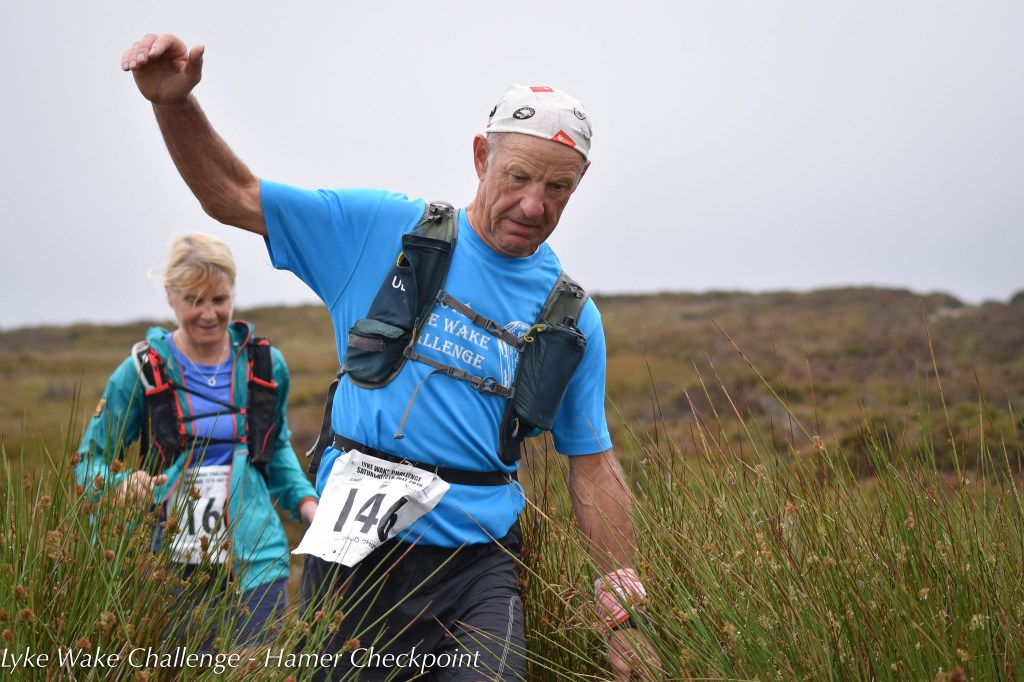
In order to cater for this very select sub-set of humanity, each year the Quakers Running Club organises the Lyke Wake Challenge. It’s essentially the same as the Lyke Wake Walk, only quicker; 12 hours quicker. The Challenge, in July each year, is open to anyone who thinks that they can run across an entire National Park in 12 hours or less. Participants have their start times staggered so that they should all finish at roughly the same time. Those who reckon on needing the full 12 hours will be set off at 4.15am (I’m probably not doing that good a job of selling this). The fastest runners get to lie in until 10am but only if they are confident that they can do it in six hours (I’m probably not making that sound a whole lot better, am I?). On the positive side there are marshalling points every few miles where it is simply impossible to drink too much coke or eat too many jelly babies.
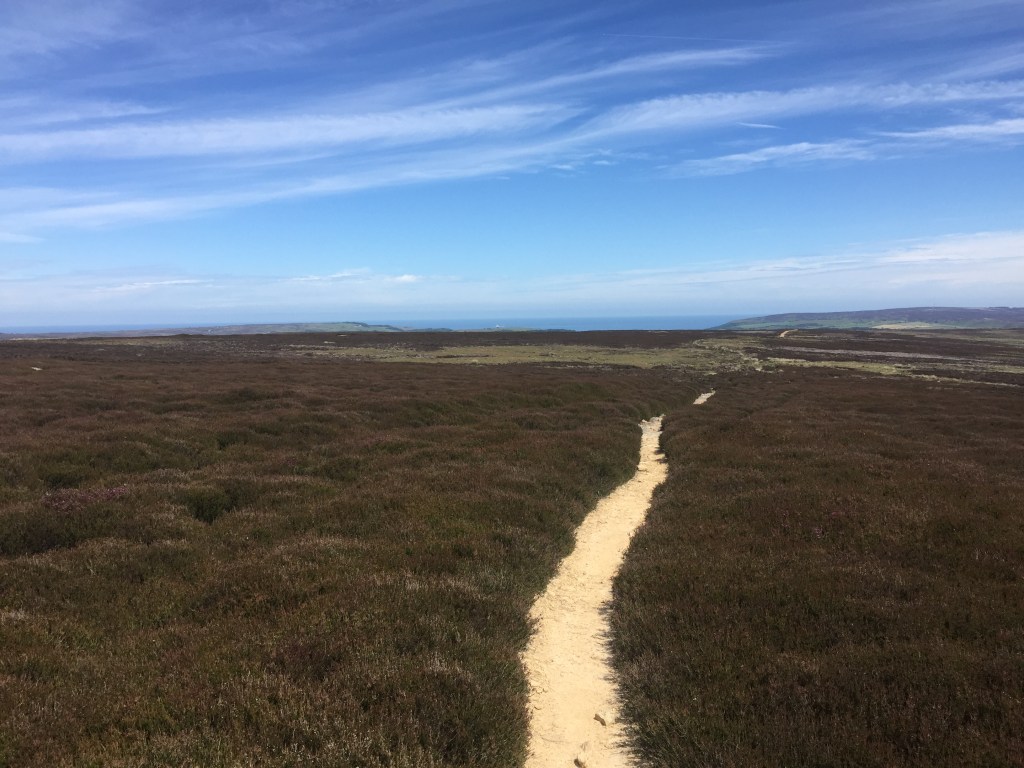
There are of course many other positives. I will have painted too grim a picture; I did it following the hellish moorland fires of the scorching summer of ’76 that cremated the heather and burnt the peat to its core; it felt like a wake for the moor itself. Forty years on, the Moors are famously beautiful again; gentle ripples of hills like someone had dropped a small pebble into molten rock, with valleys flowing like raindrops down a window. This is the largest expanse of heather moor in England. In spring the calls of curlew and lapwing both haunt and cheer the soul and in August the Moors are regally draped in purple and smell of honey. Look to the horizon and the Moors don’t ever seem to stop, they just become either sea or sky. This is a fine place just to sit and to be but I’ve always felt that it’s when you run through somewhere that you become part of the scenery itself. So maybe I should try it again, only this time a bit quicker and just maybe you should never say, “never again!”, especially if your name’s Bond.
 Raven on the Wing