INTRODUCTION
This article was first published in “Northumbrian Naturalist – the Transactions of the Natural History Society of Northumbria” in 2015. It describes the establishment and gradual increase in population and range of the species across the region up to that point. As predicted in the article, the species has continued to spread across the region and for example, has been regularly seen in certain parts of Stockton and Billingham for several years, with a suspected first breeding in Darlington occurring in 2021.
BACKGROUND
The Ring-necked or Rose-ringed Parakeet Psittacula krameri, has the widest distribution of any old world parrot species and comprises several subspecies. It occurs naturally across the width of Africa north of the moist forest zone, and across most of the Indian subcontinent as far north as southern Nepal and up to 2,000 metres above sea level. Its range has been extended by a number of introductions and it can now be found in a wild state in places as far apart as the USA, Hong Kong and several European countries, including Britain (Juniper and Parr 2003). In the wild it is typically found in open woodland or around human habitation. It is a highly gregarious species, particularly outside the breeding season, and flocks can be numbered in thousands. It is also noted as a sedentary species (Forshaw 1977). All these features of its behaviour seem to be well reflected in the main feral British populations.
ESTABLISHMENT OF RING-NECKED PARAKEET IN BRITAIN
The Ring-necked Parakeet is one of the longest established and most popular parrot species in aviculture, being bred in a wide range of colour morphs. As with any captive species there is always the possibility of escapees; for example, the author has seen five parrot-family species, other than Ring-necked Parakeet, on the loose in the Tees Valley area. Also prior to the advent of the Wildlife and Countryside Act in 1981 exotic birds could be kept as free-flying, semi-liberty colonies. Ring-necked Parakeet was first noted as breeding in the wild in Norfolk in the mid nineteenth century, though apparently without establishing a population. The current British population appears to have developed since 1969 when a family party was seen near Rochester in Kent and small groups were seen in the Surrey area. Nesting in the wild was first proven in Croydon in 1971 (Lever 1977). Recent studies have shown that the British population is comprised mainly of the most northerly subspecies Psittacula krameri borealis; this reflects the fact that the majority of imports for aviculture came from northern India, but perhaps also that this subspecies would be better suited to tolerate the UK climate (Jackson et al. 2015).
DISTRIBUTION IN THE WIDER UK CONTEXT
The UK breeding population as of 2012 was estimated at 8,600 pairs (Musgrove et al. 2013). Nationally the population is still concentrated in the Greater London area and east Kent, with a few outlying colonies in large urban conurbations such as Liverpool and Manchester. Most of Britain remains parakeet-free; the recent national bird atlas (Balmer et al. 2013) shows confirmed breeding in only 2% of hectads. In the areas surrounding the North East the atlas did not record any possible breeding in North Yorkshire, Cumbria or the whole of Scotland. The closest place to the North East where Ring-necked Parakeets are seen regularly is around Rotherham and Sheffield, where groups of up to five and three respectively have been reported, although there were no breeding records up to 2012 (Thomas 2013).
ESTABLISHMENT OF THE CLEVELAND POPULATION
Until recently there was no reason to assume that the situation with Ring-necked Parakeets in the North East was anything other than that of sporadic escapes or releases. In the historical Durham area there were only two records from the 1970s and three from the 1980s (Bell, C. in Bowey and Newsome 2012). The 1998 edition of Birds in Northumbria, the annual report of The Northumberland and Tyneside Bird Club, which listed historical records in Northumberland, only had a single report of an individual bird flying south over Hauxley in 1985 (Bowman and Hodgson 1999). Records became “almost annual” in the Durham Bird Club area from the 1990s and the first multiple record was of two birds in Peterlee in June 1996 (Bell, C. in Bowey and Newsome 2012) though there was still nothing to suggest that parakeets were established in the area. It was not until 2006 that the species became a North East breeding bird. A single female that had been frequenting Acklam Hall in Middlesbrough in 2005 was joined by a pair of birds in January 2006 and subsequently by a further male in May. Both pairs bred successfully at Acklam Hall that year, rearing three young between them (Joynt et al. 2008). Two adult females continued to be present at Acklam Hall until mid-March 2007, after which a single bird remained throughout the summer. Then in September 2007 four birds were present (an adult male, two adult females and a juvenile), suggesting that breeding had occurred locally, although not in Acklam Hall itself. Over the next few days the flock grew to seven birds but by the end of the month they had disappeared (Joynt et al. 2008). This proved to be the end of the story as far as the Acklam birds are concerned. Instead it was events further north in Hartlepool, also in 2006, which led to Ring-necked Parakeets becoming an established North East resident. Three birds were present there from early 2006, initially being seen quite regularly in the wood at Greatham but gradually becoming more settled in the town’s Ward Jackson Park. What were presumably the same three birds were still being seen around Ward Jackson Park in 2007; by the end of the year six were seen together on 22 October on Torquay Avenue (Joynt 2008), which is roughly midway between Ward Jackson Park and Greatham, and Derek Clayton had seen a party of a minimum of four and possibly six or eight in Greatham (Derek Clayton, pers. comm., April 2008). Derek Clayton also encountered a single parakeet on bird feeders at Thorpe Thewles village north of Stockton while undertaking a winter bird atlas survey in 2007. What was most likely the same bird was recorded at Stillington on 26 March 2007 (Environmental Records Information Centre data). The increase in population of the Hartlepool birds is well documented in the annual Cleveland Bird Reports, published by the Teesmouth Bird Club. In summary, numbers had risen from seven in January 2008 to 14 by August of that year, with numbers remaining around that level in 2009. The Cleveland Bird Report for 2009 (Joynt 2010) gives the highest recorded count of 15 birds seen on 18 August over Burn Valley 7 Gardens, and there was a report of 17 in the trees on Kingsley Avenue (David Harrison, pers. comm., February 2015), both locations being within 1 km of Ward Jackson Park. However in 2010 numbers increased dramatically with 29 birds counted in the Kingsley Avenue roost and two flocks, totalling 32 birds, seen over Burn Valley Gardens on 16 July (Joynt 2011). The numbers recorded in Hartlepool were lower in 2011, with a maximum count of 21 birds alongside the A689 near Blackfords Garden Centre in November. It was speculated that this might have been as a result of a lack of observer coverage rather than a decrease in the population (Joynt 2012). This suggestion was supported by a count of 32 on Throston Grange Lane in February 2013 (Joynt 2014), as the increase would not have been the result of breeding in the intervening winter months. By the end of 2013 numbers were up to the high 30s (David Harrison, pers. comm., February 2015) with subsequent maximum counts remaining around that level. The author observed two flocks, each of around 15 birds, fly south from Ward Jackson Park at dusk in October 2014, while at least another five birds remained in the park. The Cleveland Bird Report for 2014 (Joynt 2015, in prep.) details a regular winter roost by Rossmere School, Catcote Road at both ends of the year, peaking at 39 in November. The 2015 breeding season might be expected to produce an increase in numbers, although unless seen in flight it is virtually impossible to count the birds accurately while trees are in leaf. Ward Jackson Park continues to be the epicentre of Ring-necked Parakeet activity and it would be unusual to visit the park and not encounter parakeets. They continue to foray down to Greatham (Jamie Boddy, pers. comm., March 2015) and it is worth noting that with the exception of Throston Grange Lane which is 1.5 km to the north, each of the locations listed above is roughly between Ward Jackson Park and Greatham. Occasionally small numbers of birds are recorded outside of what is in effect a corridor along the town’s Catcote Road; for example two were recorded on Hartlepool Headland on 22 May 2012, and they are increasingly seen at Dalton Piercy, 3 km to the southwest of Ward Jackson Park. The only regularly recorded bird outside Hartlepool is of a single female in Marton, Middlesbrough, from mid 2011 and throughout 2012 (Joynt 2013), but there are no signs of a Middlesbrough breeding population re-establishing. This apparently sedentary behaviour may be due to the fact that the borough of Hartlepool has relatively poor tree cover for the most part, the majority being centred around the town’s west end and Ward Jackson Park.
ESTABLISHMENT OF THE NORTHUMBERLAND POPULATION
North of the Tyne, reports were sporadic in the early part of this century, with none in 1999, 2000 or 2003 and just one possible record in 2001. In 2002 there were two reports, both of singles at Big Waters and Westerhope in August. Also in that year, the Northumberland County Records Committee removed the species from the main list, as it was felt that the probability of escapes outweighed the possibility of birds from feral populations in the south occurring (Bowman and Holliday 2003). In 2004 there was just the one record, again of a single bird, which oddly was on the island of Brownsman in the Farnes for a couple of days in October (Francis et al. 2005). As with the situation in Cleveland, it was in 2005 that reports started to indicate residency with “a good series of sightings through the year” comprising Prestwick Carr (6 March), Big Waters (30 April), Darras Hall (22 August) and Ponteland in November and December (Fisher and Holliday 2006). In each case this was of a single bird. Single birds continued to be reported in The Northumberland and Tyneside Bird Club reports through to 2011, with Ponteland and Prestwick Village being the main haunts, although one individual was seen at Corbridge on 19 October 2007 and another seen to fly in from the sea at St Mary’s Island on 10 October 2007. So there will have been more than one bird present in the county at times during that period, even if only briefly. In 2011, the species was moved from the “Escapes” section of The Northumberland and Tyneside Bird Club reports to the “Birds of unknown origin” section. A single bird continued to be seen at Prestwick Village and Ponteland until 14 June of that year after which no further sightings were recorded for that location, although a single was subsequently recorded in Exhibition Park, Newcastle, in August and September. It was also in 2011 that more than one bird was reported for the first time when a pair was seen at Benton Metro Station on 16 September and another pair in Churchill Park, Whitley Bay, where they were seen prospecting a nest hole (Richardson 2012). A single, roving bird was again reported around Prestwick and Ponteland for much of 2012 with reports in January, March, May, October and November. A single bird, an adult female, was also photographed in a Gosforth garden in January and February of that year (Moira Gray, pers. comm., September 2015), and 2012 proved to be notable for the spread of records in the county. The Northumberland and Tyneside Bird Club had reports of singles at Earsdon Cemetery on 2 September; flying over a garden in Cramlington on 25 October, and in a Wallsend garden on 3 November (Richardson 2013). Further afield still, the Northumberland Gazette (7 July 2012) reported a sighting in a garden in Kirkwhelpington and that a pair had been frequenting a bird feeder in a garden in Alnwick for three months. A single bird that was seen at Clara Vale just south of the Tyne on 8 April may well have been the Ponteland bird. By 2013 numbers had increased slightly and in September two were seen at Richardson Dees Park in Wallsend and five at Heaton Park, the latter relocating to Gosforth Garden Village a few days later. Five were again seen at Denton Park in Newcastle on 31 October 2013 (Richardson 2014). An outlying record was a single photographed at Hauxley and posted on Facebook by John Davison, which drew the comment that one had been seen around the allotments there. This continuing spread of records led to Ring-necked Parakeet being accepted on to the Northumberland county list from 1 January 2014, so it is surprising that records in the Northumberland and Tyneside Bird Club’s monthly newsletters were relatively few in that year with no reports until the September edition, which reported four birds feeding on berries at the Ponteland Leisure Centre on 27 July. However there had been sightings on two dates in March at Exhibition Park, of one and three birds respectively (Chris Redfern, pers. comm., September 2015). Nevertheless the birds themselves were continuing to increase as eight had been reported at Ponteland Leisure Centre on “Bird Guides” (http:// http://www.birdguides.com/) on 25 June. Later in the year, six were at Heaton Park in September and several seen or heard in Walker on various dates in November, including six or seven on 6 and 7 November. A pair was also seen apparently prospecting a nest hole in Fenham in January 2014. The slow but steady increase appears to be continuing into 2015 with the Northumberland and Tyneside Bird Club June newsletter reporting a flock of nine seen flying northwest at Byker on two separate dates in late April. However the largest number to date appears to be flocks in the Fenham area where 12 were seen in February 2015 (Philip Jordan, pers. comm., February 2015) and 17 reported in spring the same year (Moira Gray, pers. comm., September 2015). The parakeets are regularly in gardens and on bird feeders (Figures 4 and 5) where they often go unreported. The situation on Tyneside differs from that on Teesside in that the Tyneside birds appear to be much more mobile; what are assumed to be the same birds were reported from Ponteland across to the east of Newcastle (Tim Dean, pers. comm., May 2015), although without more systematic recording it perhaps cannot yet be ruled out that there might be two separate, small flocks. Outside of Tyneside there is a scattering of reports of single or pairs of birds that may well be unconnected to the Tyneside birds. As yet these are confined to south Northumberland and it is noteworthy that up to the beginning of 2015 North Northumberland Bird Club had no reports of Ring-necked Parakeets from their area (John Lumby, pers. comm., February 2015).
ESTABLISHMENT OF SUNDERLAND/SOUTH TYNESIDE POPULATION
More recently, there are signs that South Tyneside and East Durham may be starting to be colonised. It is difficult to date precisely when this started but there were several reports of a single bird, noted in some reports as female, between mid-2008 and early 2009, mainly from the Hetton area but also with single records from Doxford Park and Marsden. Later two birds were in Mowbray Park on 3 March 2011 (Environmental Records Information Centre data). Two were seen at Temple Park, South Shields on 24 July 2012 and subsequently there were several sightings of pairs or singles in late 2012 and May 2013 in the Jarrow and West Boldon area. Then in late May/early June 2013 up to seven birds were at Temple Park. These birds subsequently disappeared although singles were recorded elsewhere that year in Durham City on 7 April, Horden on 14 September, Brasside 12- 15 November and Rainton Bridge on 30 November, with regular sightings of 1-2 birds at Hetton Bogs during the summer months (Durham Bird Club 2013). In 2014 sightings continued with one or two birds at Silksworth Lakes, West Boldon, Washington Wildfowl Park and Hetton Bogs in the period up to April, and at Hetton Bogs, Silksworth and Marsden Quarry in the last three months of the year. Two were seen at South Marine Park, South Shields during the summer, and of particular note were five seen flying south over Whitburn on several dates in September. A flock of five birds seen over Sedgeletch, Houghton le Spring on 15 October was possibly the same as the Whitburn flock (Charlton 2015). Five birds were reported in Backhouse Park, Sunderland in March 2015 and one or two birds were present in Westoe Cemetery, South Shields for an extended period in the early part of 2015, with breeding suspected in both locations. They have also been noted as spreading into Barnes Park, Sunderland (Durham Bird Club committee minutes, 29 April 2015). While it is not an unreasonable assumption that the increase in sightings in East Durham and indeed on Tyneside is due to dispersal of birds from Hartlepool, unfortunately no Ring-necked Parakeets have yet been ringed in the North East, so their origins remain unproven. It would be interesting if ringing of some birds could be achieved so that the movements of individual birds and the sources of any future expansions in their range can be established.
OUTLYING RECORDS
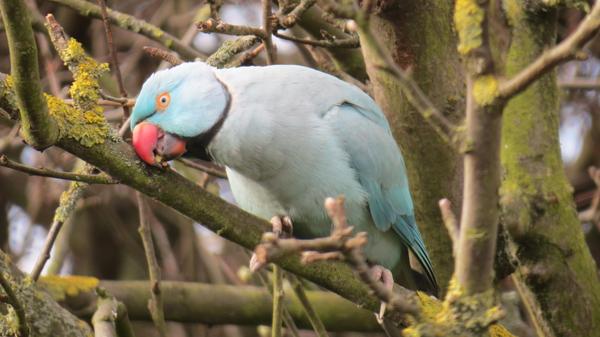
Outside of what might now be regarded as the core locations of West Hartlepool, Newcastle and Sunderland/South Tyneside there continue to be occasional records. For example three were seen near Darlington town centre on 8 March 2011 (Environmental Records Information Centre data) and a pair over the town’s West Park on 12 March 2015 (Vince Robertson, pers. comm., March 2015). A single was at Locke Park, Redcar 12 on 12 November 2011. A pair was seen at Yarm on 14 March 2015, while an anecdotal report of a single bird at Barnard Castle appears to be the furthest west in the North East that the species has been recorded so far. In Northumberland, a single adult female, photographed in a garden in Whitley Bay on Boxing Day 2014, was almost as unexpected as a pair of Turtle Doves. The photo originally published on the photographer’s blog (http://www.whitleybirder.blogspot.co.uk/2014/12/patch-and%5B1%5Dlocal-mega.html#comment-form), prompted the comment that a similar bird had been present at Earsdon Village for some weeks. Whether these are individuals dispersing from the core areas or further escapes is unclear. A blue morph bird that was photographed in a garden in Seaton Carew on 24 March 2015 would have been a recent escapee as no blue birds have been noted in the Hartlepool feral flock. It is very likely that this would be the same bird as that seen in a garden in Skelton on 5 April 2015 in spite of the sightings being some 16 km apart. So a single bird could give rise to sightings in widely spread areas. Nevertheless it is worth noting that some of these more widely dispersed reports may presage early colonisation of other areas, although as yet there is nothing to confirm this.
FUTURE PROSPECTS
Summing up the maximum counts in each of the three areas where Ring-necked Parakeets are establishing in the North East, the population as of early 2015 may be in the region of 60-70 birds, with around 40 of these on the western urban fringe of Hartlepool. This is an increase from a maximum of 10 birds in Cleveland in 2007. Nationally the population has increased by tenfold over the 15 year period from 1995- 2010 (RSPB 2012) so the North East population is roughly in line with that. A study of the establishment success of Ring-necked Parakeets across Europe found that parakeet occurrence was negatively correlated with the number of frost days (Strubbe and Matthyesen 2009). The species is also an early breeder, commencing with a single brood in February and March (Low 1988). These factors might be predicted to limit its spread north and it is worth noting that the Hartlepool birds are currently likely to be the most northerly proven breeding population in the world. The same study also found that parakeet density both in the native and in the introduced regions was positively associated with human population density. This association with human habitation has been noted in the national population (Balmer et al. 2013), and from the records to date appears also to be the case in the North East. In spite of this increase in population, breeding has so far rarely been proven, still less documented, with the notable exception of three pairs that nested in old woodpecker holes in a wooden sculpture in Ward Jackson Park in the same year (David Harrison, pers. comm., February 2015). A lack of trees with suitable cavities may well be a limiting factor in urban environments, as such trees are often felled on safety grounds, and this may be even more the case in the North East where urban tree cover is generally much lower than in their UK core range. It will be interesting to see if an increasing population starts to make use of buildings, as has been noted in some parts of their natural range (Forshaw 1977). A Ring-necked Parakeet was seen being ejected from a chimney pot by two crows in Hartlepool in early 2015, though there was no evidence that it was breeding there (Simon Lamplough, pers. comm., March 2015). Similarly there has been very little evidence regionally of Ring-necked Parakeets being predated, although a female Sparrowhawk was seen to take one as it flew in to roost at Blackford Nurseries garden centre in Hartlepool (David Harrison, pers. comm., February 2015). Whatever the ecological brakes on the population might be, the continued if apparently intermittent population growth in the North East would suggest that such factors are not a significant limitation. A further tenfold increase over the next 15 years, which is not an unreasonable assumption, would result in around 600 birds. It is unlikely that there is sufficient suitable habitat in their current locations to support such a population, which might be predicted to lead to them dispersing to parks and suburbs in other areas of the North East. What seems an even safer prediction is that Ring-necked Parakeets are here to stay.
ACKNOWLEDGEMENTS
In addition to those people who kindly provided their own observations, listed as pers. comm. in the text, I would like to thank David Sowerbutts and Peter Bell of Durham Bird Club for helping with information on the Sunderland/South Tyneside birds and Graeme Joynt for commenting on drafts of this article.
REFERENCES
DURHAM BIRD CLUB (2013). Birds in Durham 2013. Annual report of the Durham Bird Club. Durham.
BALMER, D, GILLINGS, S, CAFFREY, B, SWANN, B, DOWNIE, I and FULLER, R (2013). Bird Atlas 2007-11: the breeding and wintering birds of Britain and Ireland. Thetford.
BOWEY, K and NEWSOME, M (2012). The birds of Durham. Durham. BOWMAN, G and HODGSON, M S (editors) (1999). Birds in Northumbria 1998. Annual report of the Northumberland and Tyneside Bird Club.
BOWMAN, G and HOLLIDAY, S (editors) (2003). Birds in Northumbria 2002. Annual report of the Northumberland and Tyneside Bird Club.
CHARLTON, D (editor) (2015). The Lek. Newsletter of the Durham Bird Club February 2015.
JACKSON, H, STRUBBE, D, TOLLINGTON, S, PRYS-JONES, R, MATTYSEN, E, and GROOMBRIDGE, J J (2015). Ancestral origins and invasion pathways in a globally invasive bird correlate with climate and influences from bird trade. Journal of Molecular Ecology 24 (16): 4269-4285.
FISHER, I and HOLLIDAY, S (editors) (2006). Birds in Northumbria 2005. Annual Report of the Northumberland and Tyneside Bird Club.
FORSHAW, J M (1977). Parrots of the World. New Jersey. FRANCIS, M, KITCHING, M, and MOLLOY, J (editors) (2005). Birds in Northumbria 2004. Annual Report of the Northumberland and Tyneside Bird Club.
JOYNT, G (editor) (2008). Cleveland Bird Report 2007. Annual report of the Teesmouth Bird Club.
JOYNT, G (editor) (2010). Cleveland Bird Report 2009. Annual report of the Teesmouth Bird Club.
JOYNT, G (editor) (2011). Cleveland Bird Report 2010. Annual report of the Teesmouth Bird Club. 15
JOYNT, G (editor) (2012). Cleveland Bird Report 2011. Annual report of the Teesmouth Bird Club.
JOYNT, G (editor) (2014). Cleveland Bird Report 2013. Annual report of the Teesmouth Bird Club.
JUNIPER, T and PARR, M (2003). Parrots: A guide to the parrots of the world. London.
LEVER, C (1977). The naturalised animals of the British Isles. London. LOW, R (1988). The complete book of parrots. New York.
MUSGROVE, A, AEBISCHER, N, EATON, M, HEARN, R, NEWSON, S, NOBLE, D, PARSONS, M, RISELY, K and STROUD, D (2013). Population estimates of birds in Great Britain and the United Kingdom. British Birds 106: 64-100.
RICHARDSON, M (editor) (2012). Birds in Northumbria 2011. Annual report of the Northumberland and Tyneside Bird Club. RICHARDSON, M (editor) (2013). Birds in Northumbria 2012. Annual report of the Northumberland and Tyneside Bird Club.
RICHARDSON, M (editor) (2014). Birds in Northumbria 2013. Annual report of the Northumberland and Tyneside Bird Club. STRUBBE, D and MATTHYSEN, E (2009). Establishment success of invasive Ring[1]necked and Monk Parakeets in Europe. Journal of Biogeography 36: 2264–2278.
ROYAL SOCIETY FOR THE PROTECTION OF BIRDS (RSPB) (2012). The state of the UK’s birds. Sandy, Beds.
THOMAS, C (editor) (2013). Yorkshire Bird Report 2012. Annual report of the Yorkshire Naturalists Union
 Raven on the Wing