I’d only seen a Waxwing a handful of times before and then only a fleeting glimpse, a dark shape silhouetted in a winter’s dusk. A few of these exquisite birds arrive in Britain every winter and every few years they grace us with a “Waxwing Winter” when they arrive in their hundreds but, either way, these are birds of the wind and descend on a berry tree only to be whisked away before word gets round of their presence. The bird before me demonstrated why they have the power to change anyone with even the slightest interest in birds into a twitcher for a season. It was perfect; its unblemished plumage made grey the colour of beauty; its feather tiara was neatly understated and the wax-dipped red seals on its wings were surely never feathers. Sadly, an unseen window had determined that it would never rise from its sleeping beauty-like state. On its leg was a shiny ring, obviously newly fitted. It had been ringed as a first year male at Sansgard in Norway on 24th October; it had died, just 37 days later, some 904km south west in Seaham.
Waxwings are the most head turning of the bird species that come to the North East each winter but they are only one of many different species that seek refuge here. Some species, such as those northern thrushes, the Redwing and Fieldfare, and the Chaffinch’s ginger relative, the Brambling, are clearly not locals. What is less well known is that many of our regular birds have their numbers swelled each year by their relatives from Scandinavia and the Continent. From Blackbirds to owls, they come hear to escape the harshness of the winter further north and east and to look for richer pickings. In many years, the resident birds have stripped the berries before the winter immigrants arrive but even so the milder weather makes the living easier and the risk worth taking.
The relatively mild winter in Britain also makes the opposite strategy of staying put and knowing your surroundings a good bet and none plays this hand better than the Robin. Robins were voted Britain’s favourite bird and it’s not difficult to see why. For a start, they share our space. As a species adapted to the edges of woodland, their evolutionary history has preordained them for the rise of the suburban garden. Their numbers have increased accordingly by almost 50% since 1970 so that they now hold over five million breeding territories in Britain. They are also bold and will come right up to us in the hope of snaffling a morsel. One of oddest wildlife film sequences that I have seen involved a man holding mealworms in his mouth while a Robin came and snatched them from his lips; the Robin’s tameness being the less odd part of the sequence. But the Robin gets my vote for another reason entirely; it’s the only bird that can be relied on to serenade us through the winter and remind us that the darkness doesn’t last.
One of the few birds to hold a territory throughout the year, a Robin’s life revolves round its own little acre. Its song sounds like a watered-down thrush but it makes up for the lack of volume with sheer tenacity, singing from a prominent spot through the depths of winter and even through the night; many a presumed Nightingale was actually a Robin. Unlike most birds its bright colours aren’t there to attract a mate, in fact both sexes have the same colouration, instead its there to stake out a territory. Only in summer when breeding is over and the Robins moult their plumage does it’s red breast disappear for a few weeks. The the Robin itself “disappears” from our gardens though, in reality, its just skulking out of sight in the undergrowth. The rest of the year it proclaims its ownership of the title deeds. In winter it is every Robin for his or her self as they stake out a claim averaging half a football pitch in size, but once the year has turned courtship begins pairs come together and territories double in size.
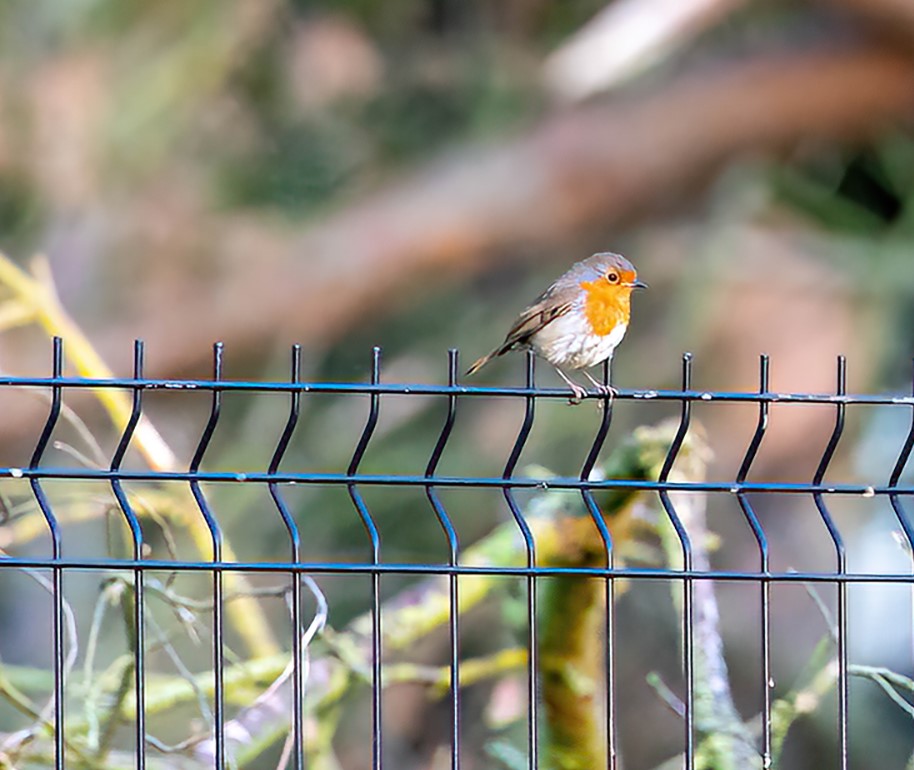
(Thanks to Zoe cooper for use of the photo)
The migrant birds like the Waxwing are a barometer of winter; “…And we shall have snow”, but none of them are the bird of winter. Only one bird will grace the snowflakes on the Christmas cards. “So what will poor Robin do then?” Well forget the nursery rhyme; he wont be sat in a barn, keeping himself warm and hiding his head under his wing; he’ll be sat on a branch answering all that winter can throw at him with a song.
 Raven on the Wing