Back in 2013, I realised an ambition and finally made a pilgrimage to a North East relic that I’ve been meaning to see for years. In fact I made two such pilgrimages that year. The first was to Durham to see the Lindisfarne Gospels which were on loan there from the British Library for three months; the other was to something, which in its own way is equally precious, the wild, white cattle at Chillingham.
It’s hard to think of anything with less in common than a book and a cow, except perhaps that the pages of the Gospels were made out of calf skin, but they have more in common than might first appear. Its not that either are a unique example of their kind; the thing that struck me most about the Lindisfarne Gospels exhibition was how many fragments of other books of that era had survived to this day and there are, unquestionably, lots of other cows. Rather what they share is the improbability of their preservation. Whether or not the Gospels really did get washed overboard at Workington and turn up unscathed at Whithorn, we marvel at them because they seem as if Eadfrith had just finished them. The history of the Chillingham wild cattle is if anything even more amazing.
In telling their story, it is perhaps worth pointing out that the original wild cattle, the giant Aurochs that Julius Caesar wrote of in such awe in the “Gallic Wars” as being, “a little below the elephant in size”, are no longer on the face of the earth. Had our ancestors not domesticated some of the milder tempered individuals of its species then cows would just be in the museum with dodos and dinosaurs. The last of the Aurochs died in Poland in 1627 which co-incidentally was around the same time as the first written record of the Chillingham wild cattle. Their story, however, probably started about 400 years earlier when the Chillingham estate was first walled to create a hunting park. The early Chillingham cattle, descended from domestic stock, may have even been beasts of the chase, their value not in their meat or milk but in their wildness. Eight hundred years later, no-one has milked them, herded them or even touched them. The only human interference has been to leave out some extra hay in winter and the occasional merciful bullet where an animal is in extreme pain. Although not free to roam beyond the walls of the estate, they are as wild as the deer that live in the surrounding woods and this is the only place in the world where the behaviour of truly wild cattle has been studied in detail.
Walled in to their 360 acre enclosure, which is only capable of supporting around 100 or so cattle at any one time, nature has chosen the best 100 in each generation. In fact in some years conditions have deteriorated to the point where only a few survived. The severe winter of 1947 reduced the herd down to just 13 animals in total, eight cows and five bulls. This tiny population results in what is known as a genetic bottleneck, whereby all of the individuals share a similar genetic makeup. The Chillingham cattle may be the most extreme example of this in existence and are virtually clones. Usually this is a disaster for animal populations because if there is a bad version of a gene then there isn’t a good version to counter it. What is remarkable about the Chillingham cattle is that the extreme natural selection processes that they have endured appear to have weeded out the bad genes.
This selection process is felt no more keenly than among the bulls. Unlike farm animals, all of the bulls here live together so there are around 50 cows and 50 bulls in the herd. That’s 49 potential challengers for the role of “king bull” and only the very best get to the top.
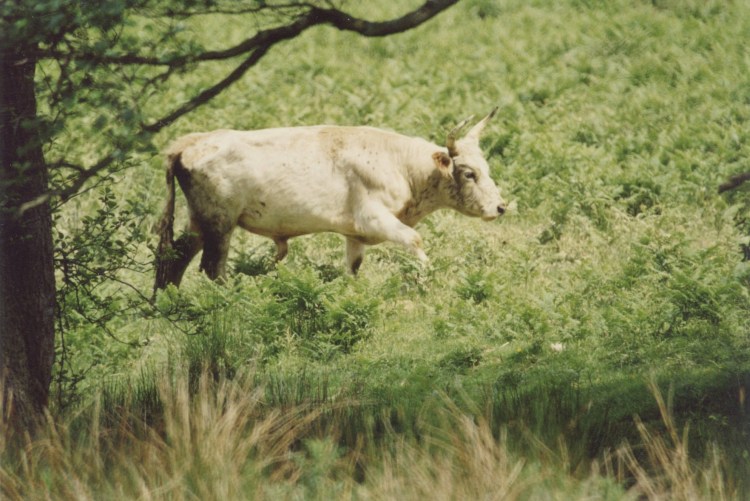
The warden in charge of the cattle was Richard Marsh; tall with something of a military presence and dressed in khakis, he looks like he should be leading safaris across the Serengeti. He leads our small group of six into the reserve, where we stop in front of a herd of uniform, white cows. At this point its like any walk in the countryside and we watch for a while as the herd does cow things, like chewing the cud and looking bored. Then, somewhere out of sight, a helicopter rumbles overhead and the herd are off and moving as a unit. It’s at this point that you start to notice the differences to other cows. Small and square, like a mobile beef stock cube, their lyre shaped horns point towards you, Minotaur-like, not out to the side like domestic cows. They don’t lumber along like cows either; their dainty heads and graceful trot are more reminiscent of deer and they can almost match a horse for speed. As we watch their synchronised semi-stampede, relieved that they decide to run parallel to us instead of towards us, Richard’s gaze is taken to something behind us. “Just keeping an eye on him” he says, as he gestures to a lone bull that has stationed itself between a couple of trees. “If he decides to re-join the herd, we’re right in his way and he won’t stop”. This is starting to feel like the Serengeti.
Fortunately the bull’s attention is directed the other way as it bellows out challenges that echo around the valley. Oddly the Chillingham bull’s battle cry is rather like the braying of a baritone donkey but there’s no mistaking the menacing intent. Soon he is joined by another bull, which sharing the same genes, is identical in size, shape and temperament; the only way to tell them apart is the battle dress of mud and dung that they daub on their white flanks. The bulls line up, head to tail, almost a ton of testosterone soaked beef, and stare. “They do this all the time”, Richard informs us, “they wont necessarily fight; they’ll just size each other up”
Like everyone else in the past millennium, we leave them to it and walk back past the ancient oak trees and the great holes in the earth where generations of bulls have pawed the ground to prepare themselves for battle. Lindisfarne may be a window on a past age but Chillingham is the North East’s, medieval version of “Jurassic Park”.
 Raven on the Wing