There are two types of animal. There are the real ones that share the world with us and then there are the ones that live in our heads. The problem is in knowing where one ends and the other begins. Ever since cavemen drew animals on walls and probably long before then as well, people have been trying to express what they know about animals. Every system of organising this knowledge from superstition through folklore and including modern science usually has at least a grain of truth and an unknown amount of error and somewhere on that continuum lies the animal that we think we know.
Few animals exemplify this blurring between myth and reality more than the hare. Ask anyone what they know about hares and I can bet that they mention “Mad March Hares”. What they are talking about is of course the aggregations of hares that form at this time of year and spark off into a series of boxing matches, the contenders dancing on their hind legs while putting together combinations of lightening fast jabs with their front paws. (Hares seem to have accumulated more collective nouns than any other animal so you can choose from a drove, down, husk, leash, trace, trip or mute of hares). Until recently it was thought that these were a series of male hares fighting each other for the right to mate, quite understandably given that this is the way that most animal species do it. It is now known that what is usually happening is that it is a female hare repelling males because it’s not quite the right time or he isn’t quite the right one. Female hares tend to be bigger than males, so she can usually enforce her prerogative.
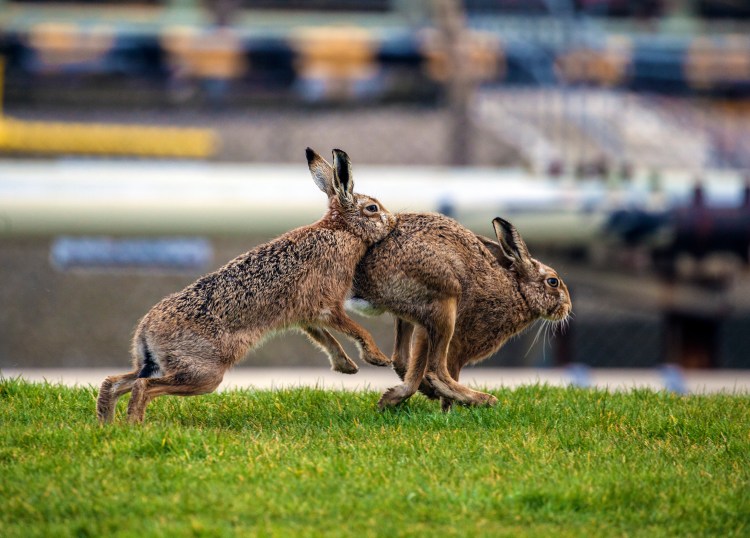
Not only was our interpretation of their boxing matches slightly wrong, they aren’t confined to March either. Hares breed right up to September, its just that the boxing tends to get noticed more in March before the vegetation gets high enough to give them some privacy. Hares can have four litters per year and can even be pregnant with litters of two different ages at the same time, a process called super-foetation. This high level of fecundity was recognized by the Romans for whom the hare was the symbol of fertility and by the ancient Greeks who gave live hares as love tokens (tempting but I just know my wife wouldn’t understand). It also led to it becoming a symbol of rampant sexuality, a badge that has now been transferred to its smaller cousin the rabbit.
In fact many of the myths that once applied to the hare are now associated with the much more familiar rabbit. The Easter Bunny was originally a hare, the sacred animal of Eostre, the Saxon goddess of spring, and Easter eggs were supposed to have been laid or transported by hares. In African cultures it is the hare that plays the role of the cunning trickster and this tradition morphed in to the tales of Brer Rabbit when slaves were transported to a land without hares but with cottontail rabbits.
While hares may look just like big rabbits (and it is astonishing just how big a hare can be) there are some fundamental differences. Unlike rabbits, hares live singly and rest out in the open in shallow depressions that they have scraped out of the earth, called forms. The form helps the hare blend in to the landscape but it is also situated to act as a lookout point and the slight wall at the back of the form makes an effective starting block. Several times I’ve almost stood on a hare that has exploded out of its form and sped away, jinking from one side to another as if it were a furry Scalextric car on an unseen track. With a top speed of 45mph, an adult hare is way too fast for a fox and can match a greyhound or racehorse for speed. Not only that but they actually do run on a set path that they have traversed, day in and day out, so that they know every meander and every gap in a hedge and they can twist and turn along it at full pace as if on auto-pilot, leaving their pursuers to guess their moves.
However the main difference between rabbits and hares is in the way that they rear their young. Baby rabbits, known as kittens, are born blind and totally helpless in a fur-lined nest in specially constructed burrows. Baby hares, known as leverets, are born in the open, fully furred, eyes wide open and are on their own from the first day. Well almost on their own. The leverets spread out from each other to sit in a form by themselves while the mother hare moves away from them. The only time she sees them after that is for a couple of minutes each day when all of the leverets meet up back at their birth place, just after dusk, for a very brief but nourishing suckle.
I was perhaps being a bit generous in suggesting that all of the beliefs about the hare had a grain of truth in them. In Chinese traditions, the man in the moon is actually a hare which grinds herbs to make the elixir of life; Boudicca released a hare before each battle as a means of divining how the battle would go (I can’t help thinking that the fact that it would have ran away very quickly should have been a bit of a clue) and hares were once thought by sea men to be such bad luck that they would turn back to port if its name was mentioned. I don’t know what hares think of us but it does make you wonder which one of us is mad?
 Raven on the Wing