This article is an update of the species account which I wrote for the book, Mammals, Amphibians and Reptiles of the North East, which was published by the Natural History Society of Northumbria in 2012. With one notable exception the situation, as far as I knew it, remained unchanged until 2022, when a search via the Environmental Records Centre North East and the NBN Atlas turned up a further one and four records respectively which showed Alpine Newts in new and in most cases, presumably unconnected locations. As these are essentially a few additional records rather than radically altering the picture of Alpine Newt distribution in North East England, they are presented in what in effect is an appendix to the original species account, which is reproduced here largely as written. It is my expectation that Alpine Newts will be more common than is described in this account, though probably still very localised and I would be pleased to receive any additional records via the contact details on this website.
The Alpine Newt Icthyosaura alpestris, is medium sized newt, slightly longer and noticeably bulkier than Smooth Newt Lissotriton vulgaris, or Palmate Newt Lissotriton helveticus. It occurs in the pet trade in the UK with the main sub-species available being the nominate form alpestris and the slightly more brightly-coloured, apuanus. The dorsal colour is usually dark, almost black, though this can have a brown, green or bluish tinge. Additionally there is a faint mottling on the back though this is not always readily noticeable. The dorsal side is slightly rough and the overall impression from above is of a small Great Crested Newt Triturus cristatus. Its ventral side is clearly delineated and a distinct, dense orange colour rather than the suffused orange appearance of the bellies of Smooth Newt or Palmate Newt. In the alpestris subspecies, there are no spots ventrally though apuanus may have spots on its ventral side (Steward, 1969).
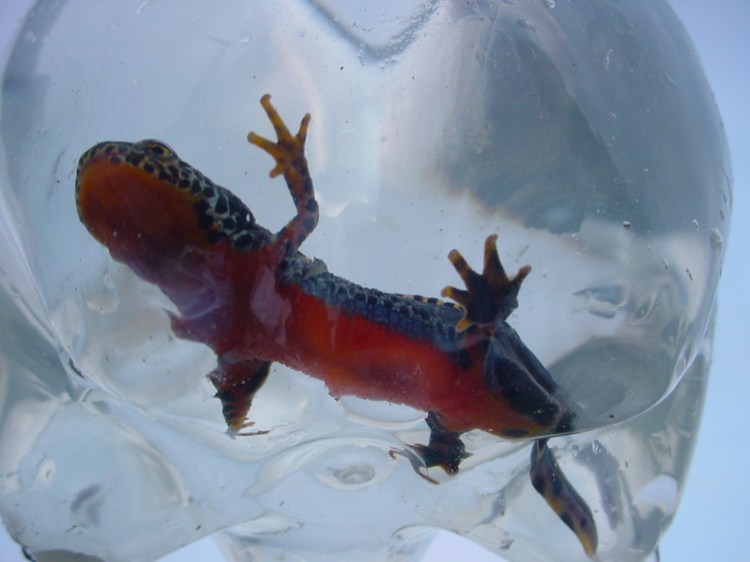
(photo Gordon Haycock)
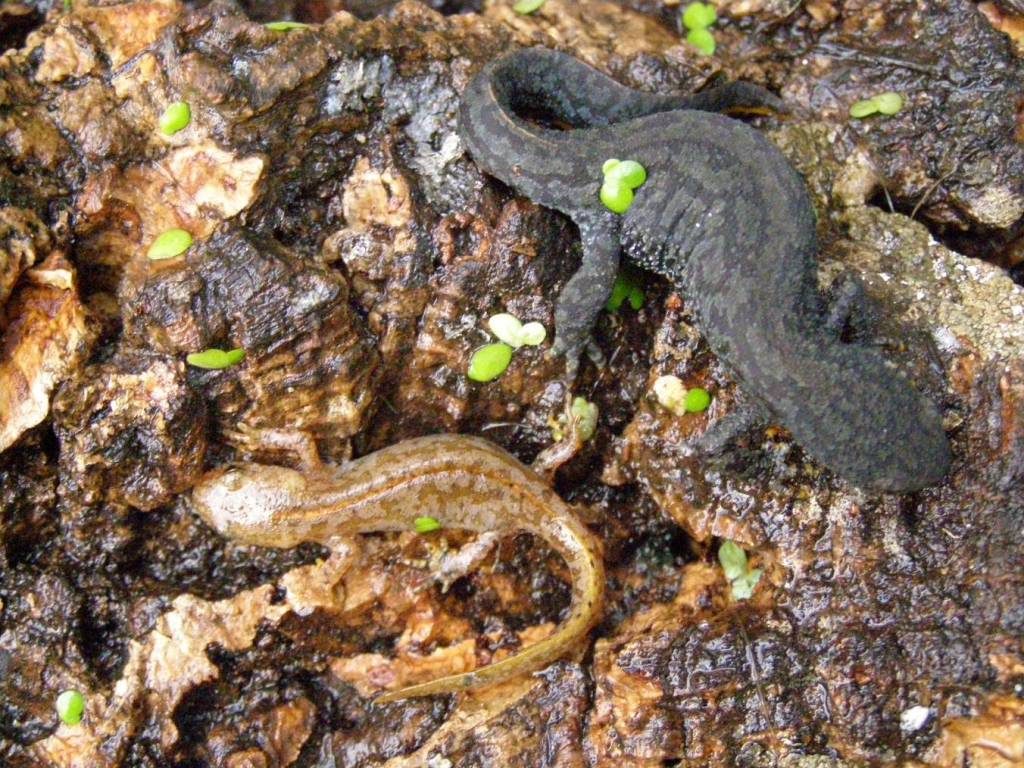
While Alpine Newts are normally very dark dorsally, at least some of those in the Teesside area are unusual in that the dorsal colour is brown, of a similar shade to that of typical Smooth/ Palmate Newts though still with mottling present. A very small male found in a pond in Eaglescliffe by the author was initially of normal colouration but then changed to this light brown colour within a few weeks.
The Alpine Newt is native to much of central, continental Europe and occurs up the coasts of North East France through to Holland but it does not appear to have been native to the British Isles. As its name suggests it can be found in montane habitats up to 2,500 metres in altitude but it can also be abundant in lowlands and it will use a variety of waterbodies including both shallow and deep ponds and slow flowing streams (Griffiths, 1995). Steward (1969) considers that it appears to be more adaptable than other newt species, wandering more widely from breeding habitats, being more inclined to enter water outside of the breeding season and being hardier than either Great Crested or Smooth Newts.
It is believed to have been introduced to Great Britain in the 20th century at an aquatic nursery in Newdigate in Surrey. Up until the 1970s this was regarded as the only colony in the UK (Lever 1977). It has subsequently turned up in an increasing number of locations across England and has also been recorded in Scotland. The Non-Native Species Secretariat described it as being established at 40 sites in Great Britain, as of March 2011. The known distribution of the species in northern England, including Yorkshire, was described in some detail by Bond and Haycock (2008) with a small number of additional locations for the species in the North East subsequently coming to light. It has also been found to be present in garden ponds a little south of the region in the Whitby area (Martin Hammond, pers comm., 2011)
Historically its best known North East site has been Doxford Park in Sunderland (Banks, 1989). The author carried out a torch survey of part of the lake in Doxford Park in June 2007 and found the species still present. Five individuals were seen though it was impossible to get an estimate of the size of the population due to problems with access and visibility. Local children have reported catching “blue” newts from this pond (John Durkin, pers comm., 2008) so it may be that the species is now more widely dispersed in the Sunderland area.
A garden pond in South Shields is known to have had Alpine Newts, along with the three native British newt species, for several years. These do not appear to have spread widely as a public survey of garden ponds by South Tyneside Council’s Countryside Service in 2007 found no evidence of them in spite of having had a good response from across the borough, including from garden ponds on the same estate as the known site. However in 2011 Alpine Newts turned up in a garden pond some 2.5 km away in another part of South Shields. This came to light when the house owner was surprised to find them in the pond in his garden and, on making enquiries, found that they had originated from the pond next door where his neighbour had some that he had been given (Gary Scott, pers comm., 2011).
A single Alpine Newt was recovered from a wheel wash facility at a landfill site at Carlin Howe near Guisborough in 2004 and brought to the author to confirm its identity. The complex of ponds at Carlin Howe had been the subject of several amphibian surveys over several years prior to 2004 due to the need to fill in and provide replacement ponds as part of the landfill operations. None of the surveys prior to 2004 found any definite records of Alpine Newts and it remains to be seen whether this newt was an isolated individual or part of a population.
The main area for Alpine Newts in the North East, if not the UK, is around Eaglescliffe, a large suburb in the borough of Stockton on Tees. The species is known to have been present on one estate, east of the A135, since the 1990s and has been found in ponds in several gardens on that estate. More recently it has been found in two suburban ponds about 500 metres further west and crucially on the other side of the busy A135 road that runs from Stockton to Yarm. It is therefore reasonably likely that the species will be present in other garden ponds throughout Eaglescliffe.
Alpine Newts are also established in three sites in that area that are also designated nature conservation sites. Eiliff’s Mill is a small complex of ponds next to an allotment site. The size of the Alpine Newt population there is not known but the site is a Local Wildlife Site on account of it’s having all five native North East amphibian species. Coatham Stob is a large Forestry Commission woodland plantation of fairly recent origin with a series of ponds, mainly recently excavated, either side of the Burnwood Beck. Small numbers of Alpine Newts were found in two of the ponds on the south side of the Beck by the author in 2009. None were found in any of the ponds north of the Beck at that time and, as far as is known, that remains the case. Elementis is also a Local Wildlife Site on account of its amphibian populations, which were annually censused over a period of years. Alpine Newts were first recorded at Elementis in 2003 and by 2007 had increased in number and colonised all of the ponds. This led to concerns that the decline in the numbers of Palmate Newts on the site may have been related to the increase in Alpine Newts. A decision was therefore taken to reduce the numbers of Alpine Newts and in October 2009, 400 adult newts were removed from a single pond and euthanised (Maxine Reid, pers comm., 2009). This may have done little do diminish its numbers in that area as in 2011 an ecological survey of a site at Urlay Nook less than 1 km away from both Elementis and Coatham Stob found large numbers of Alpine Newts, totalling well in to four figures (Graeme Skinner, pers com., 2012). Any Alpine Newts caught as part of that process were also euthanised however Alpine Newt larvae were still present in ponds at Coatham Stob as late as 2019 (author’s own data).
An extreme example of Alpine Newts ability to colonise was demonstrated in the author’s own garden ponds. In 2005 the author bred Alpine Newts in captivity, rearing 12 to the eft stage. The first two of the larvae to turn in to terrestrial efts climbed through the mesh on the lid of their tank and escaped into the garden. In order to avoid of repeat of this the remainder of the larvae were then brought indoors. In 2010, whilst sweep netting the ponds to count the Smooth Newts the author caught and removed a single male Alpine Newt with a further five caught and removed in 2011. This meant that the two efts had been a male and a female and that both had survived to maturity and managed to breed. Repeated searches are made annually and in subsequent years have caught and removed to captivity further Alpine Newts though, since 2012, only singles in any one year and then only in some years but not in others.
The situation as described above, with known populations confined to Sunderland, South Tyneside and Eaglescliffe, summed up the situation with regards to Alpine Newts in the North East for some years. The records that have come to light more recently have extended the known distribution to the south of the Tees and the north of the Tyne respectively. Prior to 2016, the only recorded individual of Alpine Newts south of the Tees was at Carlin Howe in 2007, which appears to have been an isolated individual. In the past decade Alpine Newts started turning up in a garden pond in Kirklevington, building up in numbers until in 2016 it was decided to remove them and a total of 168 (112 males and 56 females) were caught (Alistair McLee, pers comm., 2016). Despite all newts that were caught being euthanased, they continue to occur annually, albeit in decreasing numbers. This is likely to continue as the population is potentially being reinforced from a pond in an adjacent garden. Two further records have come to light in this area, both approximately three kilometres from Kirklevington though in different directions, so unlikely to be directly connected unless there are intervening populations. One of these records was discovered via a trawl of photos on social media (Allain & Lynn, 2021) and was of a single newt in Yarm. Although within 500m of some of the Eaglescliffe records, it it is separated from them by the lower reaches of the River Tees which is assumed to provide an effective barrier to dispersal therefore it must have resulted from a separate introduction. However the source of the south Tees records may have been the Eaglesciffe populations as it has been noted that the females at Kirklevington are of a brown colour dorsally (Alistair McLee, pers comm., 2022). The other record came by the Record Pool, a joint project to record herpetofauna, run by Amphibian and Reptile Groups UK and Amphibian and Reptile Conservation. This was of 120 Alpine Newts in a garden pond at Low Worsall. Allain & Lynn (2021) also recorded another geographically isolated records south of the Tees at Skelton near Saltburn. A single individual was recorded but in two separate years, 2017 and 2020.
What appears to be the first record for Northumberland was a female found in Acomb, north of Hexham in 2019. This was some 40km from the nearest known population at that time and thus far the only one north of the River Tyne, so would not have got there unaided. However in 2020, the Record Pool reported a second Northumberland record, this time just west of Riding Mill. Although less than 10km from the Acomb record it was south of the River Tyne, so again the populations are unlikely to be connected.
Although the number of records and the area over which records are distributed has increased since 2012, populations in the North East still appear to be localised and there is still no evidence that they are spreading far by themselves. A request by the author on the North East Reptile and Amphibian Facebook group in 2018 for any known records in locations, other than those listed in the original 2021 account, drew a blank. Instead, it seems more the case that, as predicted, there are a number of unrecorded populations from introductions to such as garden ponds and that some of those are coming to light. It wouldn’t seem rash to predict that there are other still unrecorded.
References
Allain, S. J. R. & Lynn, V. J. (2021). Distribution Of The Alpine Newt Ichthyosaura Alpestris In Great Britain Updated Using Social Media. Herpetological Bulletin, 158, 28-31
Banks, B. (1989). Alpine Newts in north-east England. Herpetological Bulletin 30, 4–5.
Bond, I and Haycock, G (2008). The Alpine Newt in northern England. Herpetological bulletin 104, 4-6.
Griffiths, R A (1995). The newts and salamanders of Europe. London.
Lever, C (1977). The naturalised animals of the British Isles. London
Steward, J W (1969). The tailed amphibians of Europe. Newton Abbot.
 Raven on the Wing