I don’t recall much of the journey from Selous to Ruaha but there was no doubting that we were no longer in the same place. If Selous had seemed like the Garden of Eden, Ruaha was more like the Israelite’s soujourn in the desert. In spite of the absence of the annual “little” November rains, the Selous had managed to maintain the impression of a green jungle; in Ruaha even the river had turned to sand. I’d imagined Selous to be as wild as wild could be, with hippos and the odd elephant straying into the perimeter of the camp. In Ruaha, the camp had strayed into the wildlife.

The camp itself was set along a former river bed though one that the river had long since abandoned. Instead of water, wildlife now flowed down it. Our tent was a mere 50 steps from the communal area but even so, for our safety, we had to be escorted for those 50 steps, back and forth each time. Meals were eaten outside around a long wooden table, with the evening meal accompanied by a roaring fire to deter any roaring lions. We were told that on one occasion the fire hadn’t worked its magic and a pride of lions had walked through camp while everyone was eating. The lions never invited themselves for dinner while we were there, but the climactic throb of a roaring male was enough to keep me up all night wondering why someone hadn’t invented a tent with something more secure than a zip. Our toilet was on the other side of that zip, surrounded by canvas for privacy but open to the skies. The roar was simultaneously both weakening and strengthening my 47 year old prostate gland; I can’t remember now which won.
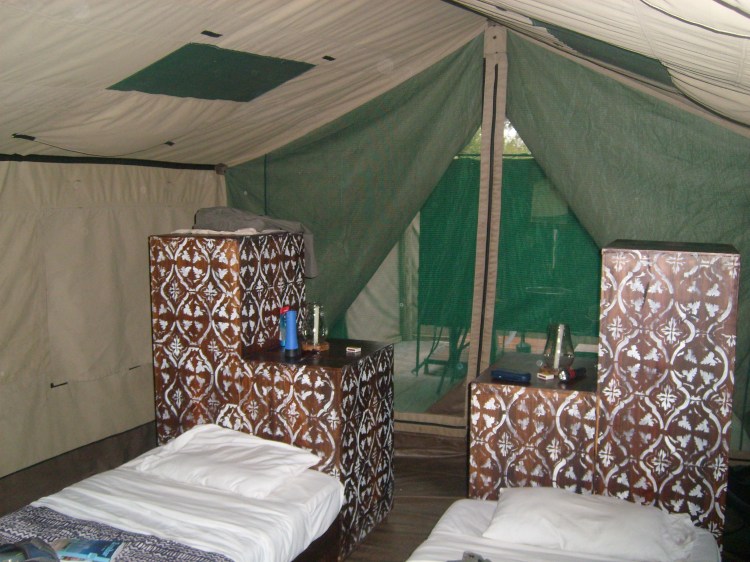
But most of the encounters around camp weren’t dramatic, rather they were normal. Herds of impala and zebra casually wandered along the river bed, striped mice ran under our chairs, a tree hyrax gazed at us from one tree and a brown parrot from another. Sat along that river bed we weren’t tourists watching wildlife, we were part of the furniture in the wildlife’s front room.
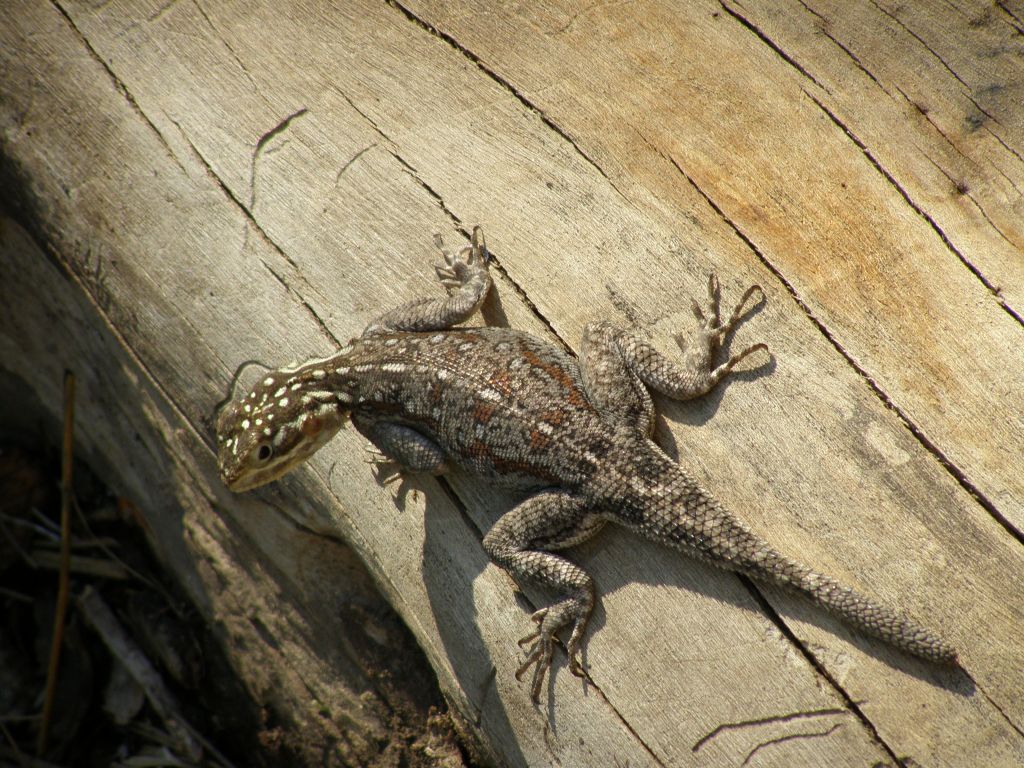
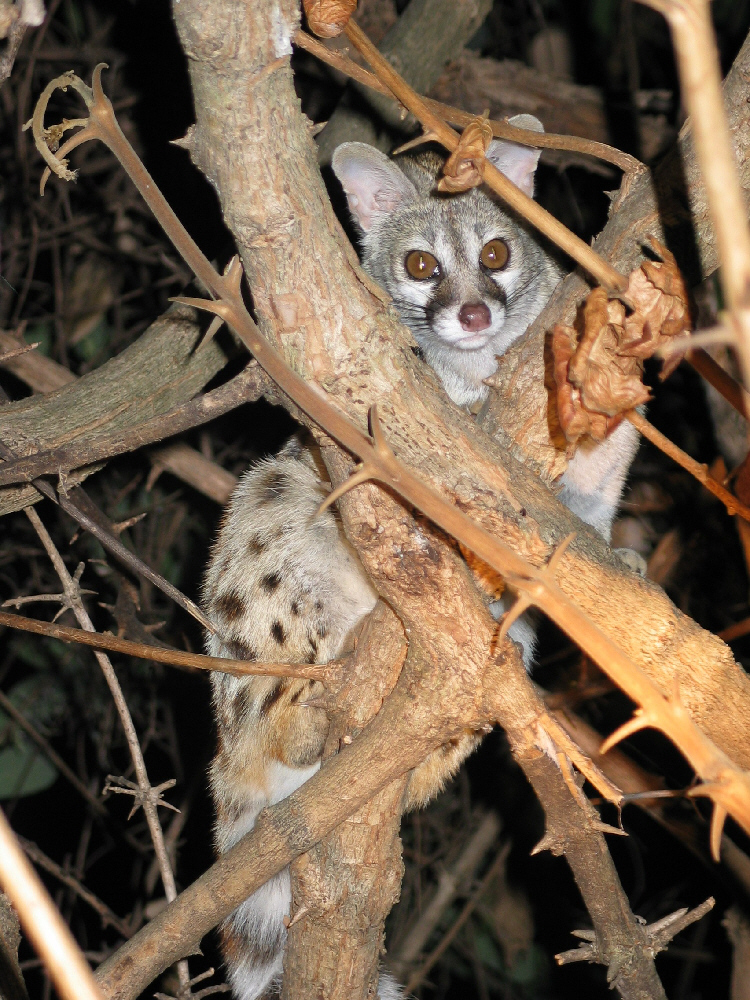
It’s difficult to pick a favourite from among the many camp residents. Cordon Blues, which I knew only as one of the more delicate and exotic birds from the pet trade, flocked round a bowl of water like pigeons in Trafalgar Square. The genet that posed outside the office window while we tried to get an email home to let my wife know that we hadn’t been eaten by anything, was easily the most photogenic animal I’ve ever seen, but the Sengi that hopped past my outstretched legs didn’t look like any of the species in my guide book. Sengis are about as unlike any other mammal as any mammal gets. They used to be called Elephant Shrews and they do look a lot more like a shrew than they do an elephant, but they belong to a small and ancient group of mammals called the Afrotheres, which means that they are actually much more elephant than shrew. Perhaps they should have been called Shrew-elephants. I’d love to think that I’d seen a species new to science but the photo I snatched was so blurry that it would make alleged Bigfoot photos look like anatomical drawings.
Our fellow travellers, mostly as seasoned as we were raw, were almost as diverse as the wildlife. The German, gloomy at not seeing the Cheetah, but whose face muscles suggested that he would have looked just as gloomy if he had. The Dane, who spoke English like an aristocrat but who lived and worked in France. He claimed to have taught himself fluent French in a couple of weeks from a French novel, when he found out that his business was transferring him there. He was there to take his French friend on his first safari. His friend, whose ambition it was to see a hippo on land, could have walked off the set of Hercule Poirot‘s, Death on the Nile. If it turned out that he was Hercule Poirot, it wouldn’t have been the most amazing of his Danish chaperone’s stories. Interesting though they all were, picking a favourite from the guests was easier than from among the wildlife. A Canadian couple, whose story I can no longer remember, where just downright, decent, salt of the earth; maybe that’s why I can no longer remember much else about them. As the only Canadians I’ve ever met I don’t know if they are typical but I got the impression that Canadians are a bit like if Carlsberg did Americans.
As our second night at Ruaha approached we tried to acclimatise; to the excitement of the surrounding wildlife; to the anxiety of walls made of canvas and above all to the desiccating, brain-shrivelling heat. Yesterday, Selous had been the hottest place I’d ever experienced. Today, Ruaha had been a couple of Dante’s circles further towards the centre. Tomorrow we were going to walk across it.
 Raven on the Wing