The poet Thomas Hood has beaten me to my blog this month. His poem, “No!”, ends with the stanza;
“No shade, no shine, no butterflies, no bees,
No fruits, no flowers, no leaves, no birds, November!”
That was pretty much it for November. I found two new plants, though neither was a flower, and added another five from earlier in the year that I’d only just got round to identifying. I only added a single new insect and just one new bird, though both were pretty stunning and both were in my garden.
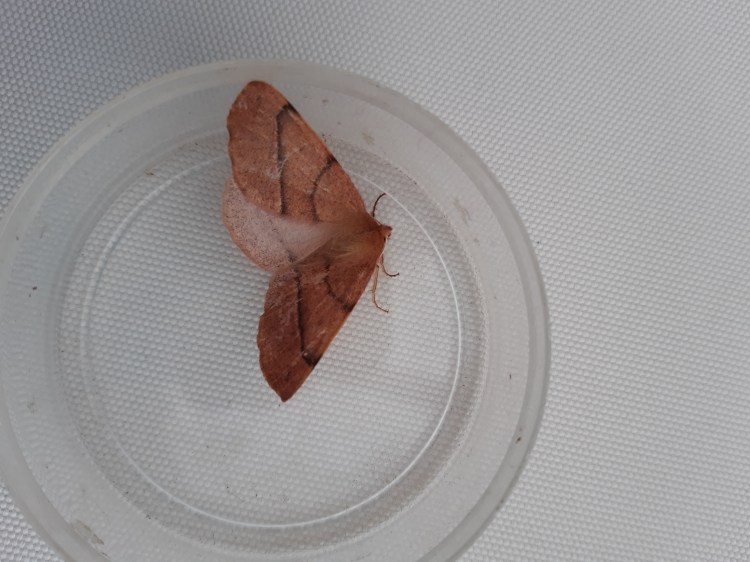
On the first day of the month I was amazed to see a large, brick-red “butterfly”, weakly fluttering by the window at midday and then crash land on the Leylandii. There are no largish brick-red butterflies, at least not in this country, hence my amazement. It must have been a moth, but I didn’t know of any moths that size and colour and especially not ones that flew in the middle of the day in November. For the first time this year, or at least the first time with any success, I wafted my butterfly net and caught the moth; although the verb suggests a more active role on my part than was merited, it seemed more like the moth just surrendered and fell into my net. It turned out to be a Feathered Thorn (and I ought to be able to make at least a feeble joke out of that name, but it’s late and I’m not sure it would be worth the effort). It also turns out that October-November is it’s time to be, just not at midday. I let it go and it struggled its way over the four foot fence into next door’s garden. This was not a moth that was looking like it would be around to see in the New Year, but I was delighted that it was around to brighten up my November.
The bird was a Brambling, which is essentially an orange and black Chaffinch. They flock to this country in winter (alright I have never seen a flock of them but there isn’t a verb to “drib and drab”) seeking sanctuary from the Scandinavian winters. They will be dribbing and drabbing (see it didn’t work) across the country every winter but I doubt that I have seen much more than a handful in my life and this was only the second ever in my garden. Stunning it may be, though partly because orange and black is a rare combination in birds, but it can’t match the Chaffinch. In some ways it’s a shame that Chaffinches aren’t rare because if they were we would fall over ourselves to fall over them. They mix understated beauty with the most extroverted of personalities and an all-pervading voice; if I’m ever unsure what bird it is I hear calling, it’s always a Chaffinch.
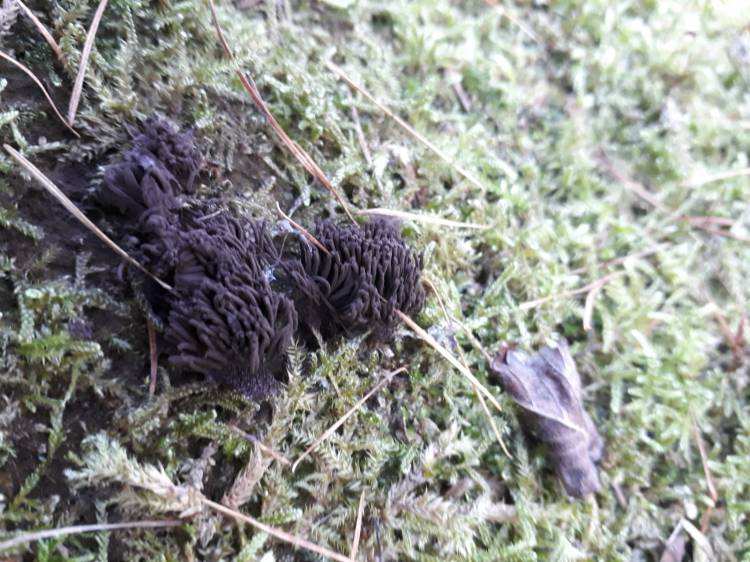
My species of the month was a bizarre life form which resembled a platoon of chocolate caterpillars doing a Mexican wave (the collective noun for caterpillars is an army but this was a smaller version). The resemblance was even closer when we blew on them and they vibrated in synchrony and released a cloud of chocolate dust. Of course, if it was a bizarre life form then you can bet it was a slime mould, which it proved to be and not only are slime moulds the weirdest form of life, they also have the best names. This one is called “Chocolate Tubes”; not quite as good a name as the Wolf’s Milk slime mould encountered in my May blog, but a lot more Christmassy.
My species list to the end of November stood at 924. This was essentially October’s list plus fungi and other strange life forms.
Fascinating facts:
A few species of butterflies and moths survive the winter as adults ready to emerge in the spring and will sometimes come out of hibernation in the middle of winter if it is a nice, sunny day. I once got called to a house where the builders had downed tools in the attic because they thought they had seen a bat. It turned out to be a Peacock butterfly, one of the largest species in this country. It was hibernating in the attic with its wings held up so that all you could see were the black underwings.
The species that I would really love to have seen, which turned up in the North East in November, was a Walrus. It was the first ever for the North East and would have been the species of a life time for these parts. Unfortunately for me, but fortunately for the Walrus as they are extremely sociable and being feted as the first Walrus to discover Northumberland would be scant consolation for missing its friends, it only hung around for a day before heading north again. By my calculations, Walruses (so why isn’t it walri?) are the tenth heaviest species of animal that can be found on land, weighing in behind three elephants, three rhinos, hippos and the two species of elephant seal, at one and a half tons.
 Raven on the Wing