“Last Chance to See”, the Hartlepool countryside events programme said, shamelessly plagiarising Douglas Adams. It did the trick though, as some two dozen people turned up for the advertised five-mile walk, hoping for a glimpse, perhaps their first, or maybe their last, of a Red Squirrel.
Hartlepool still surprises me with its contrasts and conflicts, both geological and biological. We start the walk near the line where Triassic Sandstone shoulder-charged the Permian rocks of the Durham Magnesian Limestone. Whilst glaciers won the last battle here, skirmishes between sea and dunes presage the next great act. Painted on this geological battlefield are splashes of biological colour; pockets of orchids and sprigs of heather; Common Lizards and rare butterflies and, most famously, Red Squirrels.
Of course, these weren’t any Red Squirrels, I told the assembled pilgrims. They were the last Red Squirrels in Hartlepool, the last Red Squirrels in the whole of Cleveland and, conveniently ignoring those few individuals that had slipped over the Pennines into the top of the Yorkshire Dales, the most southerly Red Squirrels remaining on the east of the British mainland.
A brief introduction to explain what to expect, how long we expected to be and to take the mick out of the man in white trainers and we set off towards Thorpe Bulmer Dene where the last Red Squirrels were last seen. These walks always resemble an exercise in herding cats. At the front people press enthusiastically to tell stories of where they had seen a red squirrel, or where they had missed seeing one, or the squirrel in their garden that they thought might have been a red. The birdwatchers drop off the back, scanning the fields like raptors and, in the middle, someone has started on their sandwiches.
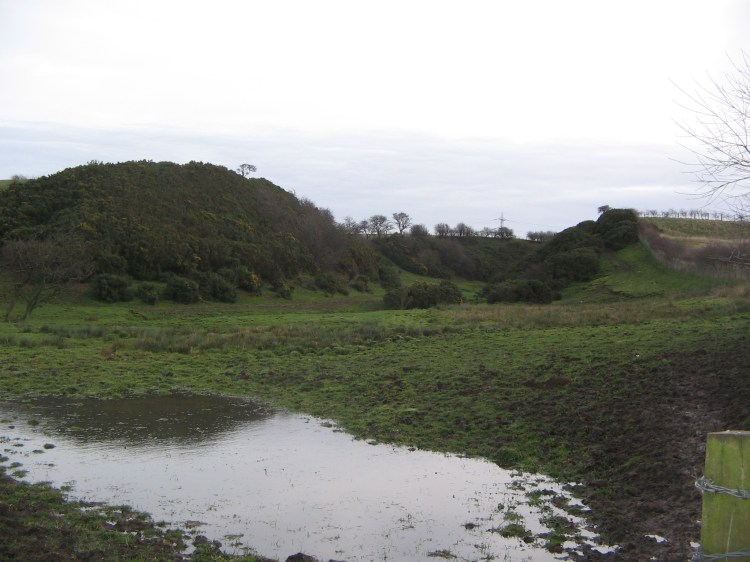
To our right we pass the tiny bump that is Short Cake Hill, an infant glacier’s mud pie made from a dollop of sand and gravel and topped with a splodge of boulder clay. Over to our left and shaded by a particularly pointless row of conifers is Hart Bog; once a teenage glacier’s pockmark, now a nationally important topogenous mire with a nationally rare beetle or two.
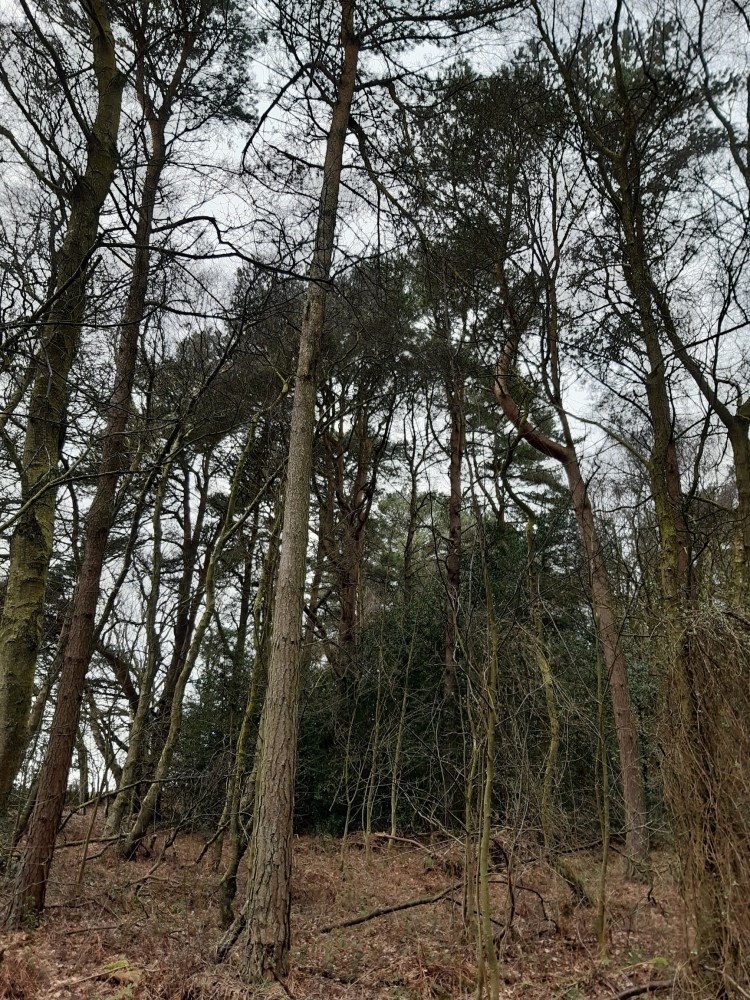
Thorpe Bulmer Dene is a mile ahead and marks the northern boundary of Hartlepool. It is part of a complex of Denes covered by woodland ancient and modern, native and exotic; ironically it is the modern, exotic conifers that are the reason that the reds clung on here for so long. Dene is a local term for the deep incisions that slice from the sea into the Magnesian Limestone but Thorpe Bulmer Dene itself is little more than a Permian paper cut, gangrenous with ferns and ancient woodland relics where the Scots Pine disinfectant hasn’t reached.
The group filters into a thin strip of conifers, the squirrel’s last stand in more ways than one. Mainly silent, almost reverential, they crane upwards for an epiphany in red. Flitting round the group I point out the fork on the tree where an old drey sits; “third tree back, where the land drops away; the thin tree with the snag half way up”. We wait, a straggled séance, willing movement, flinching at twigs in the wind, watching everything but time. A flash of movement in the undergrowth as a rabbit dashes for its burrow, startling those nearest to it and the hypnosis is broken. We drift back out, some disappointed, some animated at encountering any wildlife so close.
In an attempt to revive hopes I point out that these woodlands might hold more relics than just red squirrels; they were the only place in Cleveland to have had dormice, they held the last small pearl bordered fritillaries in East Durham and last year they turned up an adder, thirty miles and two hundred feet nearer sea level than anyone had ever suspected them. I joke about the lost plateau and the rumours of pterodactyls over the sea-cliffs at Blackhall.
But pointing out the features of interest only serves to emphasise that, in common with much of England, what is Hartlepool’s glory is actually its shame. Surrounded by a landscape that is drained, sown or smothered, these are tiny fragments of what once was; a thousand piece jigsaw with nine hundred pieces missing and the picture on the box fading. The red squirrels are just the next piece to get sucked up in the vacuum cleaner.
We walk back with a little less enthusiasm, take in a couple more scenes from the glacier’s family album, even bump into an unexpected Norman re-enactment society energetically despatching each other, but rabbits won’t pass for red squirrels and no-one has seen one for two years now. I don’t suppose that we’ll run the red squirrel walk next year, but I suspect that we’ll use the title again.
 Raven on the Wing