September sucked!
I was thinking of leaving the entry for September at that, a sort of blogging equivalent of the Haiku, only for people who haven’t the patience to read a whole Haiku. I had envisaged August as being the month when nothing much happened, a brief pause before the next season started. I hadn’t reckoned on September being that month and certainly not the sort of month where I only added 29 species.
That wouldn’t really be fair to September though. It was an exceptional month, one which stoked the flames of summer from the embers of an autumnal August. In truth, it was me that sucked. I thought that October would be the month to start off the fungi season, only to arrive there and be told that September had been better. I’d missed the Field Club outing at the beginning of September, deciding that it was too early for fungi and that I’d rather watch the first rugby game of the season instead. The fungi had other ideas and as I couldn’t make the next Field Club outing then I could only hope that the fungi would wait for me in October. My only trip out with the Field Club ended up being to Saltholme bird reserve at the end of the month. I did have high hopes for that, the migratory birds that I had missed back in March should have been returning by then, but, unlike the fungi, they were late and all I had to show for the morning was one new plant, Stonewort, one new bird, Barnacle Goose and one new moth, the Nettle Tap.

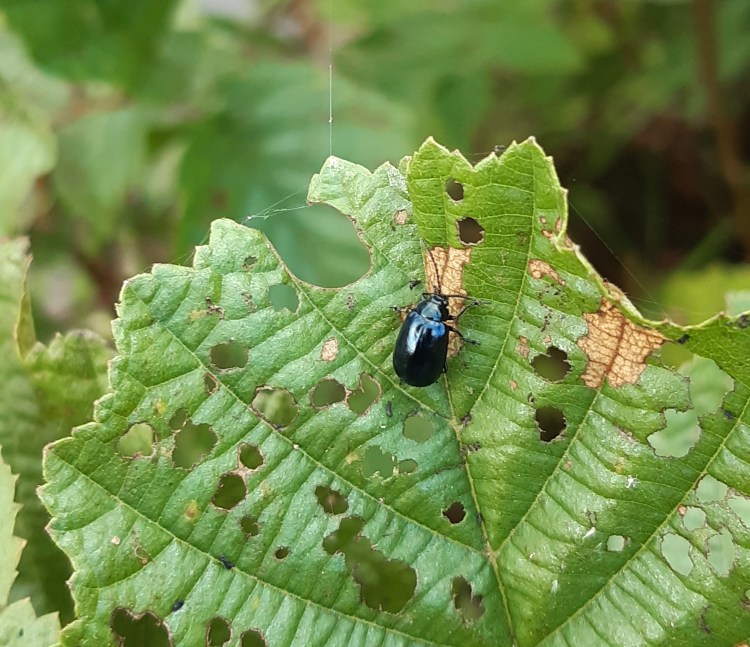
It turned out to be an afternoon visit to see the house and gardens at Kipling Hall in North Yorkshire that proved the most profitable trip of the month. We had time for a quick walk around the lake, whose entire perimeter was fringed, appropriately as it turned out, by the Fringed Water Lily. For such a distinctive plant it seemed odd that I didn’t know it but it turns out that it’s quite rare up north. The other distinctive species, which I had no trouble identifying as it had turned almost every leaf on the Alder trees into a skeleton, was the Alder Beetle. There were thousands of them, probably tens of thousands. What I hadn’t realised was just how unusual this was. The Alder Beetle was at one time considered extinct in Britain, just occurring here as migrants, but recently it’s been undergoing a population explosion and is another of those species for which Darlington is currently its northernmost outpost.
The Alder Beetle wasn’t my favourite species of the month though; my favourite was many people’s least favourite, the House Mouse. I can understand the hostility; House Mice don’t do a lot to endear themselves to us. As their name suggests, their typical habitat is the house, where they will nibble food, electric cables and anything else that is softer than their teeth, whilst all the time marking the boundaries of their territories by a constant dribble of urine that smells of basmati rice. Not having any in our house (we have the less smelly but equally nibbly Wood Mice) I can afford the luxury of appreciating their cuteness. I hadn’t seen one for almost 20 years when I noticed some scooting around the aviaries in the local park a couple of years ago. Compared to the bouncy Wood Mice, House Mice really do look like a clockwork wind-up toy; zooming from hole to hole without ever seeming to move their feet. I was pleased to see that they were still there; I expect the aviary keeper was less pleased.
It wasn’t just the weather that made September special. Sunshine was also radiated in the form our our granddaughter, as my wife took semi-retirement in order to mind her part-time. Mine is just a supporting role in this but one unexpected side effect is that I have had to hone my identification skills on a whole new habitat, “The Night Garden”. Telling “Iggle Piggle” from “Macca Pacca” was dead easy and I soon got my eye in with the “Tombliboos”, but I would defy anyone to tell the “Pontipines” apart without DNA analysis. Incidentally, am I the only person who finds the “HaHoos” just a teeny bit unnerving?
Of the 29 new species I added in September, there were; 2 birds, 15 plants, 2 mammals, 10 invertebrates, bringing my total for the year so far to 825.
Fascinating facts:
The island of St Kilda in the Outer Hebrides used to have its own sub-species of House Mouse, which was larger than House Mice on the mainland. When the last people left the island in the 1930s, the mouse went extinct.
Three of the four types of Tittifers (which for the benefit of those not trying to get a toddler off to sleep, are the birds that sing their song in the Night Garden) are real birds – White-cheeked Turaco Tauraco leucotis, Common Hoopoe Upupa epops and Channel-billed Toucan Rhamphastos vitellinus. I have no idea what the fourth type, the blue Tittifers, are and I’m not about to Google it.
 Raven on the Wing