I hadn’t expected much of August. The month when no news ever happens is also a lean month for wildlife. Most of the flowers are over, the fungi haven’t really started and the birds have swapped singing for skulking. It is still a decent month for moths and with a good guide book and a little help you can tell almost all of them apart. I had them as my “go to” group for August, that is until my moth trap fell to pieces at the beginning of the month.
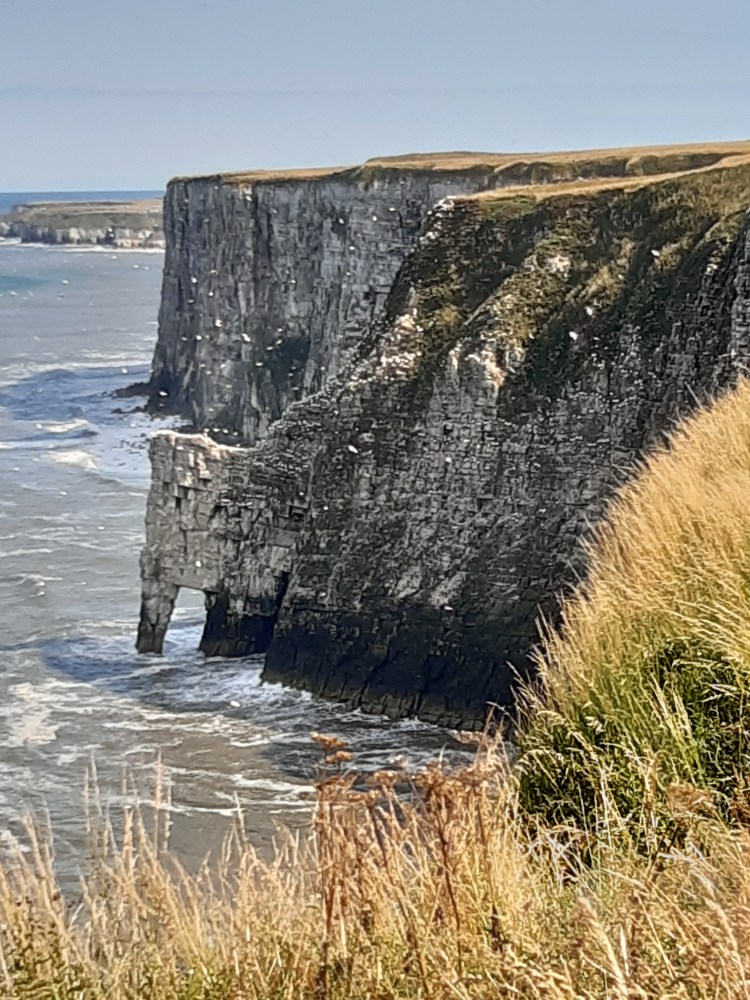
In spite of my low expectations I started off with great ambition, attempting to see what is possibly the most exotic animal ever to grace the north of England; an Albatross! Not only was this bird in the wrong country, it was in the wrong hemisphere. Lost without even its familiar stars to guide it, the Albatross has been cohabiting with the Gannets at Bempton Cliffs, where it seemed that everybody who went to look for it saw it. Bempton is a good two hour drive from my house, which would be the furthest that I have gone to see a rare bird by a good 90 minutes. A couple of wrong turns stretched that record to around three hours and we got there around eleven only to be told that the Albatross usually leaves for the day at 7.30am, as if commuting to work, but returns between 3pm and 5pm. We stayed until 5.15pm but the Albatross decided to work late that day. I should have been really disappointed but it’s hard to be disappointed when the warm up act was thousands of Gannets with six foot wingspans and a birds-eye view of a Harbour Porpoise quartering the sea, hundreds of feet below us. I even managed to tick Puffins and Razorbills, just before the last handful of them disappeared out into the middle of the sea for the winter and out of tick-able range until next spring.
The key to seeing lots of species is to see different habitats so our next couple of days out were to some habitats that I hadn’t managed to get a good look at so far this year. The first was to the North York Moors above Danby, though the trip was more to see the heather than its inhabitants. Heather moorlands are low in species diversity and I had already seen all three species of heather that we get locally, but species lists fade into insignificance compared to swathes of pale-purple Ling heather as far as the eye can see. Britain has more heather moorland than any other country and the North York Moors have the greatest expanse of it in England and therefore one of the greatest in the world. It turned out that we had got there perhaps a week too early; the brown of the heather was taking on a purplish tinge and there were patches of proper purple but the wow factor was missing as, it appeared, was quite a bit of the heather itself. As I was chasing around taking numerous fuzzy photos of a large, distinctive looking hoverfly that I hadn’t seen before but felt sure I would be able to put a name to if only it would stand still for a photo, a fellow heather admirer asked me if I was looking for the beetle. It turned out that he meant the Heather Beetle, which apparently had been killing off large swathes of the heather; the place where we stood was one of the few reasonably intact places.
In spite of its trail of destruction, I didn’t manage to see the beetle, or get a good photo of the hoverfly, but I did see a Mottled Grasshopper. Grasshoppers and their kin are my favourite group of insects. I’ve often thought that I would like to take a particular interest in them, were it not for the fact that by and large we just get two species in the North East and for the past decade the calls of one of those has been too high for my hearing threshold. Mottled Grasshopper was only the third species I’d ever seen up here, so a new grasshopper was easily species of the month at that point.
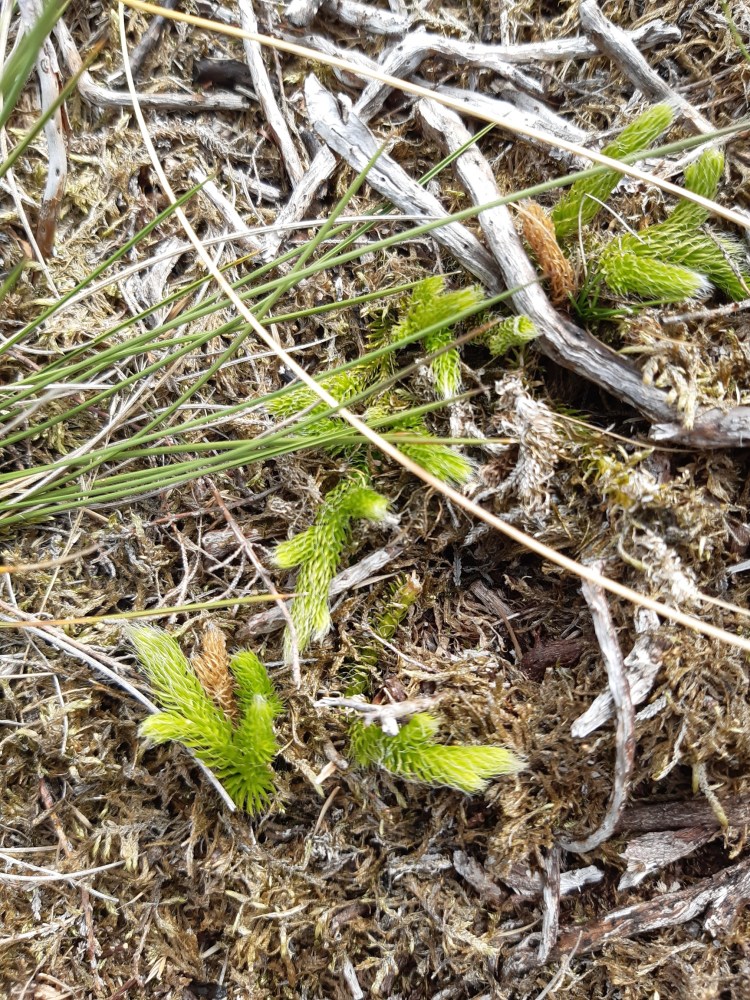
The beetle’s handiwork had also unearthed a second species that I wasn’t expecting, Stag’s Horn Club Moss. I had only ever seen club mosses once before, on the lower slopes of Cwm Idwal in North Wales, when I was a student on an Open University ecology course. I’d never expected them on the North York Moors, which as it turns out was not an unreasonable assumption as they have rarely been found there. To be fair to club moss spotters, they are small and grow low to the ground (the club moss that is, not the spotters) and I don’t know whether the dead heather allowed them to grow or merely allowed them to be seen. Although club mosses are related to ferns they do at least look like mosses. Their scientific name is Lycopodium, is a lot more misleading. Lycopodium is latin for “wolf foot” whereas they actually look like a furry, chicken’s foot – I have no idea what the latin is for “furry chicken’s foot”.
The other habitat that I’d been meaning to do was rock pools and to find some we had a day out in Staithes. Like the moors, the trip was more about the place than the species. Staithes is a jewel and you’d probably travel half the world in search of it (unless you’re Captain Cook in which case you travel half the world to get away from it) so it’s one of the places we try and go to every year. Good choice for the place then, but on reflection perhaps not the best for rock pools. The rocks form a wide, shallow platform leading imperceptibly out to sea, so that most pools are just an inch or two deep, whereas the deeper channels still connect to the sea and any mobile creatures can escape with the tide. Still, as Forrest Gump might have said, “life is like a rock pool you never know what you are going to get”. There were loads of little fish, which came in two colour forms that I hoped would be two species but the book said they were all just the common blenny species known as the Shanny. Hermit Crabs were everywhere as well, tentatively poking their legs out of the shell of a winkled winkle, then scuttling off when your shadow moved away. The remains of a large Lion’s Mane Jellyfish coating a rock, as if someone had thrown a brown ale flavoured jelly off the top of the cliff, was perhaps the most spectacular find but my favourite was a juvenile Sea Slater. Sea Slaters are a giant, semi-marine woodlouse, giant by woodlouse standards that is. This one was only about a centimetre long but with an attractive black pattern; attractive by woodlouse standards that is.
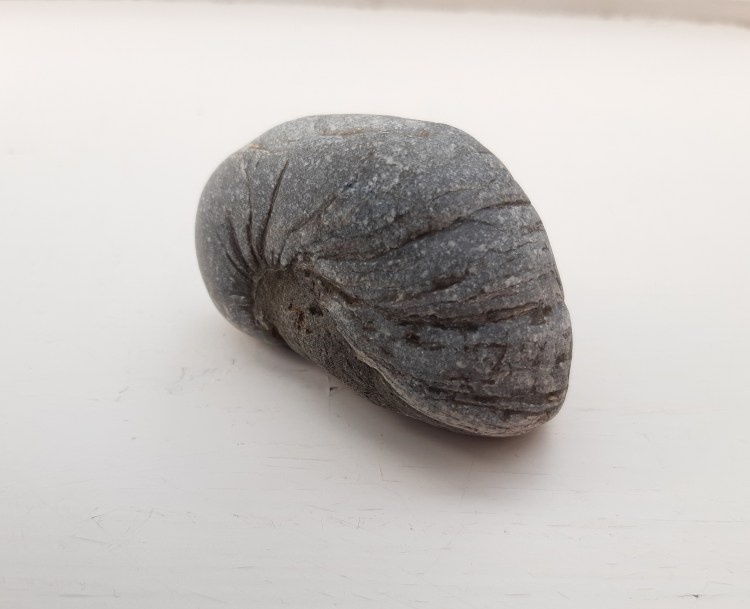
The rocks at Staithes are known as the Staithes Sandstone Formation. Formed in the Lower Jurassic they are renowned for their ammonites and a few of these could be seen around the rock pools. It occurred to me that I count dead things on my list so why not count these. After all, I don’t think there are different degrees of deadness and a hedgehog that was squashed by a car two days ago is just as dead as an ammonite that was squashed by tons of silt 200 million years ago. I know virtually nothing about fossils and can scarcely tell an ammonite from one of those tribes in the Old Testament, so this was never going to be a particularly fruitful diversion but even so I added a couple more types, including the largest Devil’s Toe Nail that I have ever found.
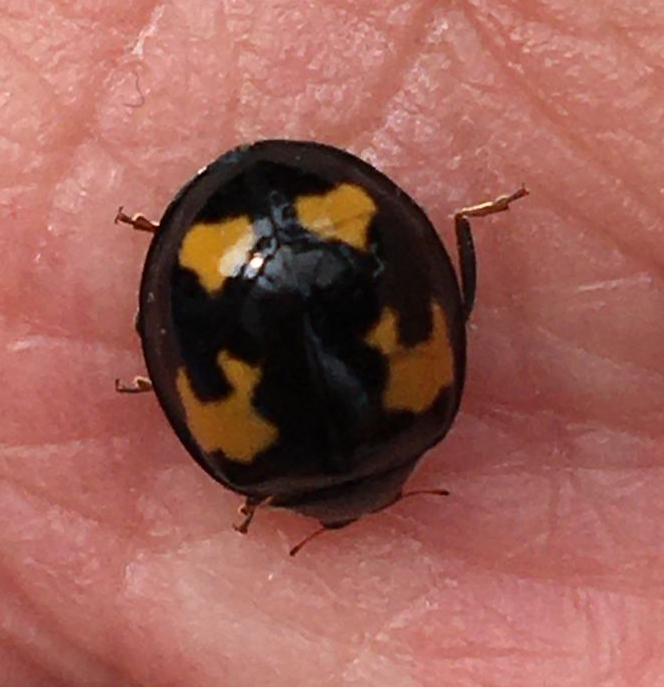
In spite of seeing some fairly spectacular species and some that I had never seen before, my species of the month ended up being one that I had seen loads of times already, as its larvae are dotted all around my vegetable patch, the uber-invasive, Harlequin ladybird. It comes in many guises; yellow, orange or red with anything from 0-21 spots, or even shiny black with two or four, red or orange blotches. The one that ended up in our bedroom had blotches that had fused to form a Rorshach blot on its back, which I swear looks like the Batman symbol. I wonder what that says about me?
In spite of my initial concerns I added a further 95 species in August, bringing the total to 794: 411 plants; 112 birds; 23 mammals; 3 reptiles; 5 amphibians; 7 fish; 177 invertebrates; 28 marine species; 25 fungi and other oddities and 3 fossils.
Fascinating facts:
Albatrosses can glide for hundreds of miles on a single flap of their wings. Their wings have a locking mechanism so don’t require any energy to hold them out. They mate for life and have the lowest divorce rate of any bird; even so I think this one is in bother when it gets home.
They may be small now but in the Carboniferous period Club Mosses grew over 100 feet tall and their trunks are what we now call coal.
 Raven on the Wing