Autumn may be characterised by its sights and smells as the season of mists and mellow fruitfulness, but it’s actually a characteristic sound that I hear each year that tells me that summer is fading and autumn is almost upon us. It’s not the twitter of the swallows as they gather on the telegraph lines; nor the gentle rustling as the wind stirs the drying leaves. Instead it’s the heart-stopping scream from my wife as she flees from the bathroom. There are two possible reasons for her distress, either a knife-wielding psychopath has appeared at the shower curtain, or a spider has! So far it has always been the spider.
Spiders are of course our close companions throughout the year; it’s just that they become more obvious in late summer as the males wander about in search of females. There is a well-worn maxim that says that you are never more than a foot from a spider (or six feet from a rat). This may well be true outside, at least for spiders, as one study found a total of 131 of them in one square metre of meadow but in a modern house you could probably swing a fair sized cat before coming within reach of the nearest spider (and its one way to get rid of the rats). I would like to think that this is of some comfort to arachnophobes, but I suspect that it isn’t.
Arachnophobia, the fear of spiders, must be one of the most common phobias, with an estimated fifty percent of women and ten per cent of men suffering from it in some form. I guess it’s something to do with the extra two legs, as similar sized, six-legged ants can appear in their dozens and only provoke a pained look rather than a scream. As I am only nervous of things without legs I am able to assume heroic proportions at this time of year as I remove the offending creature with my bare hands. But even I, super hero for a season, hesitate and reach for a jar when faced with the Giant House Spiders known to arachnologists as Eratigena.
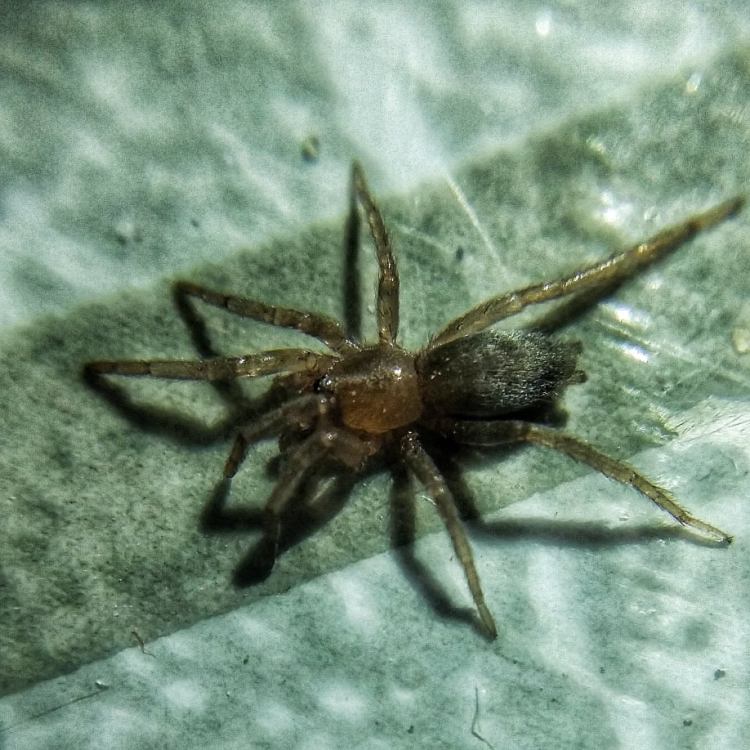
Unlike the typical garden spiders with their exquisitely fashioned orbs, Eratigena webs are flattened funnels built out of the way in some small, dark corner or crevice. There the spider spends most of its life waiting patiently for an insect to get trapped on the web. We only notice them at mating time but then with leg spans up to three inches across we could hardly miss them.
We have probably lived with house spiders for as long as we have been living in houses, in fact probably since we started living in caves. However some detective work by Dr Geoff Oxford of the British Arachnological Society, suggests that, although common in the south of England, the large, long-legged species of House Spider have only spread into the north east relatively recently. By researching into old museum specimens and the writings of previous generations of spider enthusiasts, it appears that these spiders only colonised Yorkshire in the 1960s and that the mere handful of old reports from further north of these very obvious species suggests a bit of successful hitchhiking rather than long-established colonies.
It was thought that there were only two closely related species of large house spider in the north east until some surveys by spider enthusiast, David Smith, showed that there was now a third species lurking in his house in Newcastle and not just in the house but in the garage and greenhouse as well. Not only is this the first case of this European species becoming established in the UK but further research by David and Dr Oxford showed that its presence seemed to be excluding the two other large species of House Spider. The newly naturalised species, named Eratigena atrica, has another claim to fame; with a top speed of 1.18mph it is the world’s fastest spider. While this might not sound particularly fast, it means that they can be across the width of your living room in about 5 seconds. Fortunately you don’t need to equip your settee with a set of starting blocks in order to evade them as all of these large House Spiders are very placid and rarely bite, even when picked up and evicted.

Eratigerans might sound like an alien race from Star Trek but then spiders possess a range of abilities beyond that of any extra-terrestrials that Captain Kirk ever faced. Their best known features are their complex, geometric webs but in fact spiders can make several different types of silk for different purposes, everything from guy ropes to parachuting. One tropical species even spins a bolass that it flings at its prey to snag it. Spider silk is one of the wonders of the natural world, twice as strong as steel, it is many times as elastic and the ultimate in recycling as the spider eats it and spins a new web each day. Spiders are also masters of concealment. The squat crab spider can gradually change its colour to blend with that of the flower that it hides on.

The daddy long-legs spider goes one better; when threatened it can spin in its web so rapidly that it becomes a blur, effectively giving itself a cloak of invisibility. Their strength and endurance is also out of this world. Spider legs work by hydraulic pressure rather than with muscles and a trap door spider, in lunging for its prey, holds itself in place with a single pair of legs and can support 38 times its own weight in this position. When times are leaner some species of spider can go for over a year without food or water!
Not all spiders are venomous but all but one of the roughly fifty thousand known species are predators. Even so, only about one species in a thousand is at all harmful to people. Perhaps then the one fact that we should remember about spiders is that they actually do us a lot of good in eating a host of insects that are potentially far more harmful to us. To get some idea of just how many insects spiders spare us from, bear in mind the calculation that each day spiders across the world eat a mass of insects, equivalent to that of eight billion bags of sugar.
As for the story that the female spider bites the male’s head off; well it is true for many species but it usually only occurs when he gets things wrong; which reminds me, I’d better go and remove that spider.
 Raven on the Wing