I do pick them! Years in which to do a Bioblitz that is and what a year this is proving to be. As far as winter lingering on in to summer goes, I think I can only recall one other year like it, back in the 90s, when the May blossom didn’t come out until June. May is supposed to be the best month – ask anyone! Even if you ignored all the good stuff in May it would still be the best, simply because it has none of the flaws of the other months. Imitating the traditional “in like a lion, out like a lamb” of March’s is really not what May is about and yet it stayed bitterly cold almost to the end, before the great switch-flicker in the sky allowed it to impersonate “flaming June” for its last couple of days. It’s no surprise then that everything was late this year, but just to mark May’s card; the St Mark’s flies, whose emergence is supposed to coincide with the saint’s day on 25th April, didn’t reach their peak until mid-May; the Swifts, which I can set my calendar by seeing on the first Bank Holiday in May, were two weeks late; (they are gone again by the end of July, I was starting to wonder if they weren’t going to bother this year); I didn’t even see my first bat until 12th May. Bats are the creatures that I am probably still most closely associated with, and the first sight of them is one of nature’s defibrillators, causing a welcome flutter after the torpor of winter.
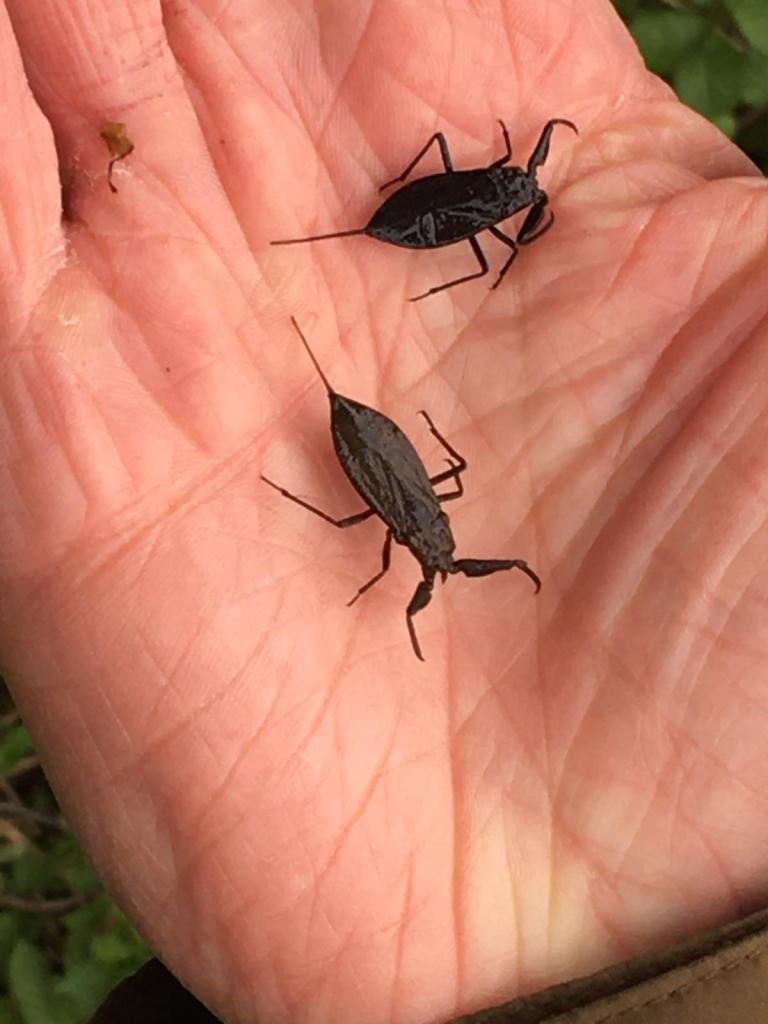
The first trip out of the month was to Low Barnes, a Durham Wildlife Trust reserve on the River Wear. It’s only a small site, a mixture of wetland, woodland and wet woodland but it is part of a series of lakes along the River Wear, so will pick up wildlife from that wider area. I added a few new plants, a couple of snails and several bugs. By bugs I mean your actual bug, as defined by them having a tube-like rostrum, a kind of drinking straw that they poke into things to feed with, rather than bugs in the broader sense that Americans use as the equivalent of our “creepy-crawly”. The best of these were the Water Scorpions, which aren’t scorpions but you wouldn’t know to look at them. What looks like the sting in their tail is just a tube that they can stick out of the water to breathe through. I might have even gone one better; there were some tiny insects wandering across the surface, which I suspected were baby Water Stick Insects. This is a southern species and Low Barnes was the first place in the North East where Water Stick Insects were found, back in 2016. When full grown they are Europe’s largest water insect, almost three inches long. These ones were just the size of a splinter that you might get in your finger but as they were at the wrong distance for the pair of glasses that I’d brought with me and they looked too delicate to fish out in my hand for a closer look, they will have to remain one to go back for.
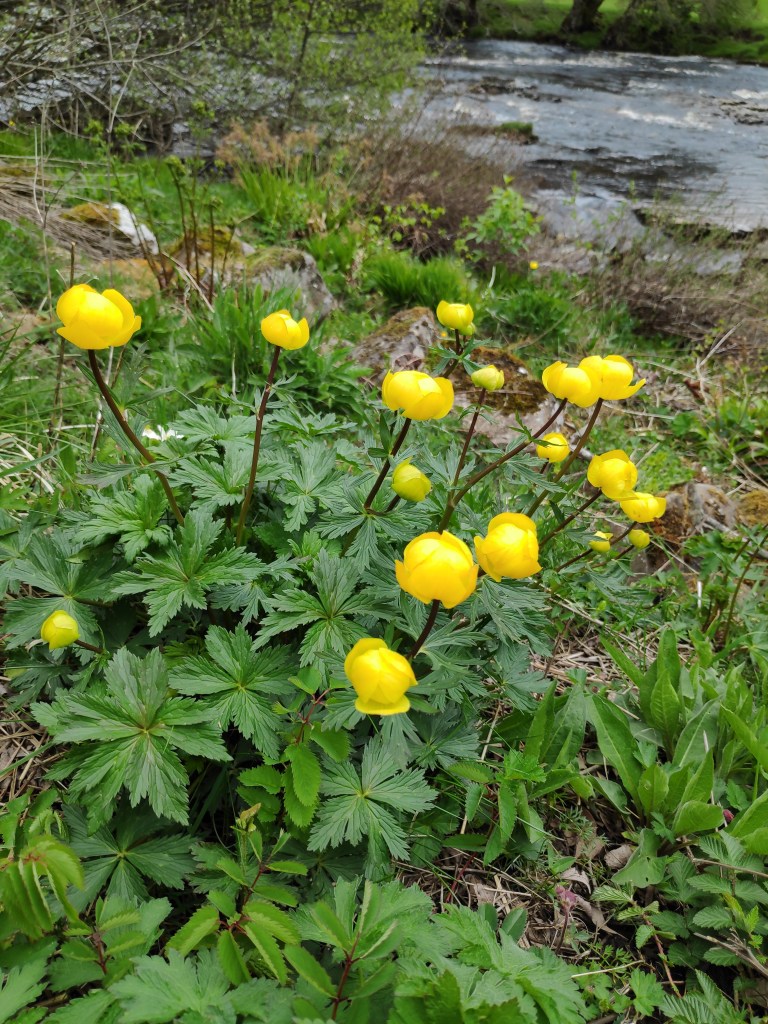
The main trip out for this month was with Darlington and Teesdale Naturalists Field Club, or the Field Club if you don’t want to use up half a line just for their name; an institution in its 130th year and visiting that most hallowed of all North East wildlife locations, Upper Teesdale. My last visit there with the Field Club had been 30 years ago, for its hundredth anniversary. We’d been led on the outing by none other than David Bellamy, who sprawled among the “double-dumplings” for a photo opportunity and told us about the time he jumped off High Force for a TV programme but they couldn’t show it for insurance purposes. Looking around I realised that I was the only person remaining from that day, even the great man, who had seemed as rugged as the landscape itself, had passed away two years earlier. I wondered if anyone would remember me on their 160th anniversary.
The good thing about going out with the Field Club is that they include in their numbers people with a diversity of wildlife interests but of all of them nobody puts the diversity into biodiversity more than Jill Cunningham. Jill is queen of the unseen. Where other people might identify flowers and trees, she identifies the smudges, squiggles and stains on those flowers and trees that turn out to be rusts, galls and moulds. We had just crossed the road from the High Force Hotel and I hadn’t even got my notebook out when she was crying “Melampsora populnea” at something on Dog’s Mercury that resembled a tiny version of the scabs I used to get on my knees as a child. I jotted down as much as I could but as we walked downstream towards Low Force the bitterly cold temperatures meant that I had to stuff my hands in my armpits to stop the Raynaud’s condition from rendering my fingers white and lifeless, so I concentrated on scribbling the English names I knew rather than the Latin ones that I didn’t. Jill took pity on my and promised to show me some Smut on the way back that I had walked past without noticing. Smut, should you be wondering, to a naturalist at least is a fungal pathogen on flowers that just looks like dirt. Even so it is a thing, a living thing, so could go on my list.
They say that golf is a good walk spoilt but natural history is a good walk ruined completely and we had only made it as far as Middle Force before we stopped for lunch. Afterwards the main group decided to retrace their steps so that they could see High Force which was currently spewing over a second fall, as if being the largest waterfall in England wasn’t enough. Derek Risbey on the other hand was heading down to Low Force, his mission the annual count of the Mountain Everlasting that grows on a cliff face there. I’d never seen Mountain Everlasting before and, as of 12.30hrs on 22nd May 2021, it was the best name for any form of wildlife that I’d ever come across. Forget the Smut; I was going to Low Force. Mountain Everlasting is a tiny plant, it’s white, woolly leaves helping it cope with the dry conditions that allow it to live in places where other plants can’t, such as on the apparently soil-less ledge that Derek was precariously leaning over in order to count them. It isn’t necessarily a mountainous plant it’s just that it has been all but driven out of lowland England and finds refuge in the hills. Unfortunately it’s not everlasting either, of the almost 30 sites where it occurred in Northumberland some 40 years ago, it now occurs in none. Long may it cling to its ledge at Low Force.
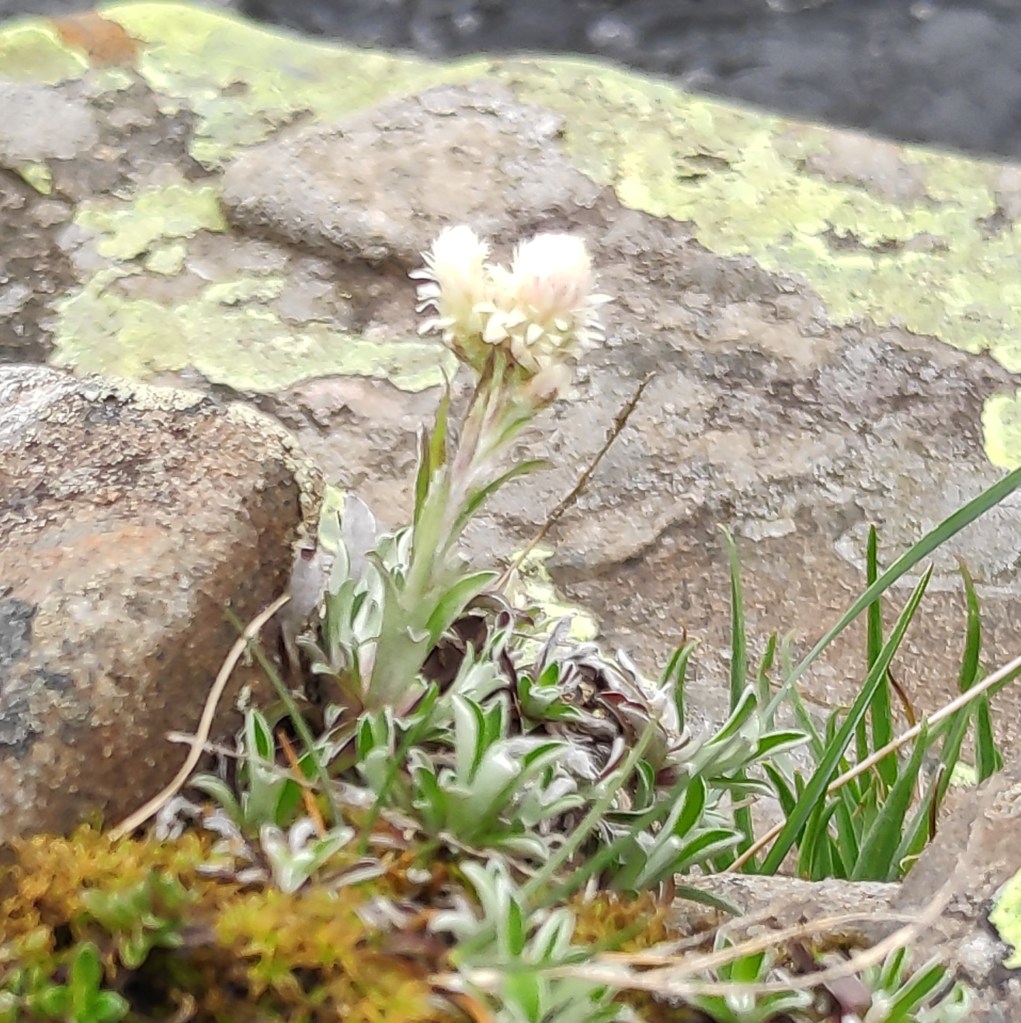
(photo courtesy of Derek Risbey taking his life in his hands)
We did think of trying to catch the up to the main group but by then we were suffering from lack of coffee and conversely too much coffee, so we made our way back to the hotel instead. On the way back up the steep, stone steps that had proved so productive for new species for my list on the way down, I spotted something unlike anything I’d ever seen before. Essentially it was blobs of goo sticking out of a completely rotted conifer trunk. Looking to be somewhere between a fungus and snot but with bright red tips, I guessed it was a slime mould. I took a photo and Jill later confirmed that it was indeed a slime mould, to be precise Wolf’s Milk slime mould. As of 13.30hrs on 22nd May 2021, Mountain Everlasting was the second best name for a form of wildlife that I’d ever come across.
Back at home things were progressing much more slowly but my son’s rotting decking, which had yielded an abundance of Green Cellar Slugs last month had another surprise for me, a Rosy Woodlouse. These are tiny things, a few millimetres long and are indeed a kind of brick-dust pink with a pale yellow stripe where its vertebrae would have been if it hadn’t been an invertebrate. And just as a bonus, on his wall there was a 14 spot Ladybird. With most ladybirds you do need to count the spots to identify the species but with the 14 spot version it’s easy as they are bright yellow and the spots are actually squares and rectangles.
The final trip out of the month was to Durham Great Wood and it was as well that it was in the wood as we had just been plunged from winter into factor 50 weather, like a Swedish health freak in reverse. This was just a family walk out to see the Bluebells but woods ancient enough to harbour swathes of Bluebells hold lots of things besides. My eyes aren’t what they were and the dappled light of a late-spring woodland didn’t help but fortunately we had my son’s friend Lucy with us. I think she may have been a kestrel in a previous life, her eyes missed nothing; the footprint of a rat in the mud; a dull brown Click Beetle on a dull brown path and an old owl pellet camouflaged in the leaf litter. I teased apart the owl pellet with my fingers (one of the few advantages of Covid is that you are never more than three feet away from a bottle of hand gel) and in it was the jaw bone of a vole and in the jaw bone was a tooth and in the tooth were open roots. Anyway to cut to the chase, that meant that it was a Bank Vole, so that went on my list as well. Under my rules, with mammals I don’t actually have to see them to tick them off, their signs will do. No-one ever sees mammals; you could be forgiven for thinking that they are some sort of ethereal creature that only exists as footprints and droppings.

Our route included a short cut across a field to Hollingside Wood. The sun had brought out a freshly minted Small Copper butterfly, dazzling in bright orange with black spots. It’s looking good for June.
Tally to 31st May: 532 species, comprising 290 plants; 100 birds; 17 mammals; 1 reptile; 3 amphibians; 2 fish; 83 invertebrates, with butterflies just edging out moths, 11 to 10; 10 marine species; 16 fungi/lichens/rusts (no smut).
Fascinating facts
When I was at school, life was divided into just two kingdoms, animals and plants, with fungi being lumped with plants. Then fungi were assigned to a separate kingdom with slime moulds part of that kingdom. But slime moulds are something else again. They start out as single cell amoeba-like organisms but can reproduce and form a large blob (technically a plasmodium) that acts as if it were living organism, moving around in search of food and even joining up again if pulled apart. They seem more like something from Star Trek than from a kingdom of planet Earth.
Owl pellets are the undigested bits of an owl’s food that it effectively “sicks” back up again. As owls tend to swallow their food whole then the skulls of their prey are often intact and are an excellent way of finding out what small mammals are about. In 2008 it was discovered that the Greater White-toothed Shrew, a European species, had somehow made its way to Ireland when its remains were found in an owl pellet.
The only two recent records of Mountain Everlasting in the English lowlands appear to be from Peterborough and Ferryhill, which may be the only thing those towns have in common.
 Raven on the Wing