March was a much better month; it just was! The weather got better, so much so that according to the papers we had the warmest March day for 53 years (when I say we, it was the Telegraph so it will have meant that the south had the warmest day for 53 years, but I still ended up carrying my coat quite a bit). The insects came out in the open, rather than just skulking beneath logs and, best of all, the slight easing of Covid restrictions at the very end of the month meant that I could venture south of the Tees and east of Tees Valley airport.
Of course it was still just March so, other than the hares, nothing went mad but I saw four different butterflies on the wing starting, almost inevitably, with the Peacock and my first ladybird and first bumblebee turned up within half an hour of each other. The ladybird, specifically the large, invasive Harlequin variety, was mooching around in the comfrey that I was hacking back in my allotment. At the same time I was keeping half an eye on the pond in case an amphibian broke the surface. It was just half an eye, as the thing that appeared on the surface looked like it was breakdancing, which amphibians aren’t noted for. The search engine in my brain being unable to find a match for “animals that breakdance”, I took a closer look and there was a bumblebee, spinning furiously. I put it in the sun to dry off which gave me the opportunity to see what colour its bum was and how many yellow bands it had, which is pretty much all you need to identify the queens of the seven widespread bumblebee species that you are likely to get in your garden. Appropriately it turned out to be the Early Bumblebee, which is quite small and shaggy as bumblebees go.
The ladybirds, bumblebees and butterflies are all lovely to see but I will see the common species of those in any given year, it’s just a matter of when. If I am going to reach my target of 1,000 species I am going to have to find some specialities that I don’t usually see, hence the middle of the month saw me on a very short pilgrimage for the Yellow Star of Bethlehem. This is a small and subtly beautiful bulb, which the Botanical Society of the British Isles atlas suggests, shines most of its pale yellow blooms on the “Little town of Darlington” (or more prosaically its centre of distribution is the banks of the River Tees between Darlington and Barnard Castle).
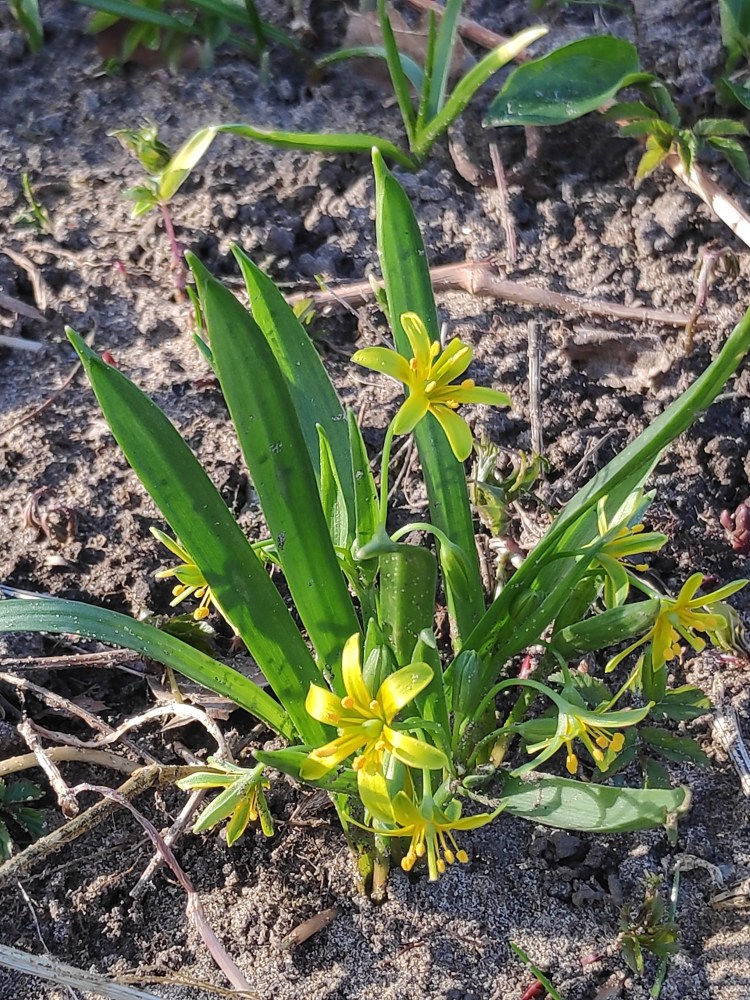
(my thanks to Derek Risbey for the use of the photo).
Starting in the east, we proceeded to scour the length of the woods at Low Conniscliffe without finding either the plant, or a manger, but I did find a couple of invertebrates that I’d only ever seen once previously. One was the Pygmy Woodlouse, which is probably Britain’s commonest woodlouse but at 2mm long, one you could be forgiven for overlooking. It sometimes appears with a shiny purple iridescence caused by an iridovirus, which helps enormously with identification; though this one didn’t so needed a X20 magnification hand lens to ensure that it wasn’t a baby of some larger species. The other less usual invertebrate was a Harvestman. Harvestmen (preferred pronouns, “it”, “they”) are essentially spiders without the bit in the middle; so whereas spiders have separate heads, thoraxes and abdomens, in harvestmen the head just looks like it is part of the body. Like spiders they are very difficult to identify to species level but it just so happens that I have the definitive reference guide to Harvestmen. It has the most exquisite and detailed illustrations of any identification guide I have ever seen which is just as well as it is entitled, “ De Nederlandse Hooiwagens”, which just happen to be my only three words of Dutch. I did have a go at making sense of the text; interestingly “interische” and “parallelle” would seem to have their English parallels and I think I got the gist of the phrase, “penis zeer lang en slank”, but otherwise it was all Dutch to me. Fortunately my Harvestman was the most easily recognisable of them all, as it was black with two reddish dots, rather like the negative of photo of a Two-spot Ladybird. Its scientific name is Nemastoma bimaculata, but I’m calling it the “Reverse Ladybird Harvestman”. I did find the Yellow Star of Bethlehem as well, just two tiny flowers poking through the Wild Garlic on the way back, but all the more appreciated for almost being missed.
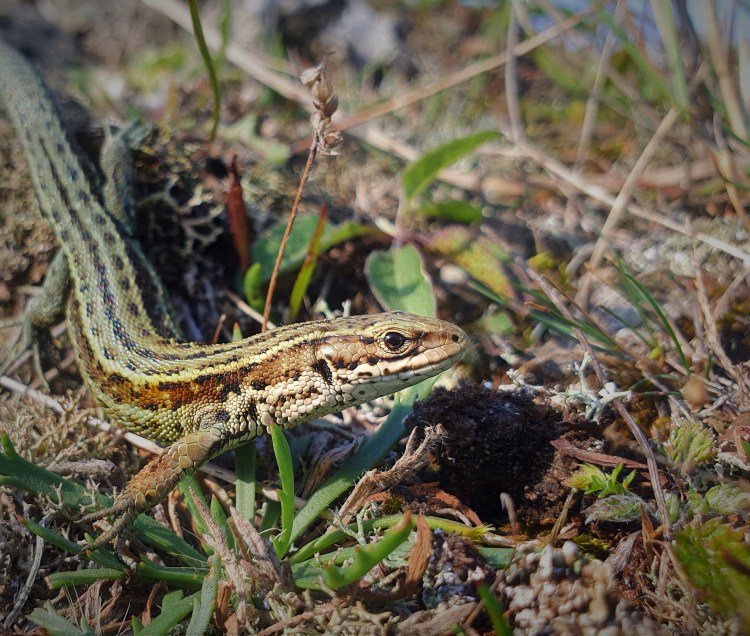
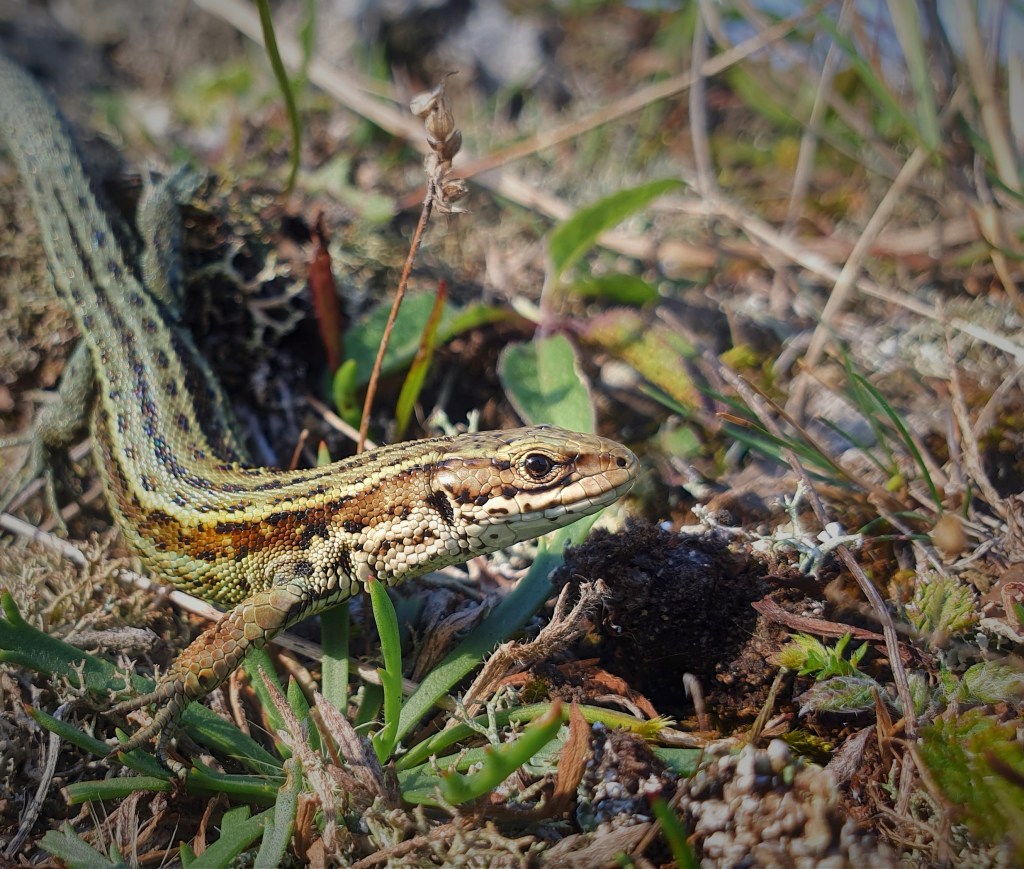
I don’t know if I will do a sighting of the month, each month, but if I do it won’t necessarily be the rarest or most unusual sighting. My main interest with wildlife is mammals but of all forms of wildlife, anywhere in the world, the ones I most like to see are the reptiles (alright if I could choose absolutely anywhere then maybe elephants but after that definitely reptiles). As far as I am aware, there are no reptiles whatsoever in Darlington, though apparently it had all four of the commoner British species in Victorian times, according to Richard Taylor Manson, the renowned Darlington naturalist who wrote, “The zig-zag ramblings of a naturalist”, back in 1884. North east England as a whole isn’t particularly blessed with them either and with scarcely an exception they are confined to the moorland fringes in the west and a series of narrow coastal strips. Fortunately I had the job of trying to catch one that had strayed onto a development site on Teesside and which needed to be moved out of harm’s way. This would pretty much be mission impossible were it not for the fact that lizards can be tempted by mats of roofing felt placed to catch the sun and provide the heat necessary for them to become active on warm days. It’s only a short window of opportunity before the lizards warm up enough to evade you and for several days the lizard sat on the mat, daring us to come closer, then scuttling off into the undergrowth at the last second. Eventually, becoming desperate, I decided to engage “feline-mode” and crept belly to the ground, almost imperceptibly moving each limb a few inches at a time, trying to thread my arms through the brambles and ignoring the fox poo that my right knee had come to rest on. I got within inches; we stared, reflected in each other’s eyes; I pounced, the lizard exited left. It mustn’t have quite been warm enough though as half an hour later it was back and this time it made the mistake of disappearing under the felt where my colleague caught it.
The roofing felt had the bonus that it attracted lots of other creatures as well; ants and snails in abundance and every so often a Nursery Web Spider, stretched out as if doing yoga, but best of all was a metallic green Tortoise Beetle, its legs characteristically drawn up under its shell. Not quite a reptile but the first time I have ever seen one, so almost as good.
A much sadder sight was my first squashed Hedgehog of the year. The first few weeks out of hibernation seem to be the worst time for this, as the males go roaming in search of females. For the past few years I’ve been keeping a record of all the road kill Hedgehogs that I see in order to try and work out patterns (see my post, “Where didn’t the Hedgehog cross the road”). At least the information gets put to good use but it’s not a task that I look forward to.
I did relent this month and add a couple of slugs to my list. The big black ones are easily identified and impossible to miss and my son’s new house came with a colony of Green Cellar Slugs under the decking. These are large slugs, extra slimy and almost luminous. They are described as synanthropic, which means that they like to live with us; they made it onto my list, that’s as close as we’re getting. What I refused to include on my list was a Horse Leech. I merely hate slugs but I have a phobia about leeches and if I do find that I am stuck on 999 species at the end of the year then I swear I will wear the same pair of socks for a month and put down the resulting fungal infection, rather than the leech.
On a brighter note, a trip to the coast at the end of the month for a little walk along the beach resulted in two more bits of seaweed, three sea shells and a starfish that had washed up on the beach. There was also a fish washed up, which I think was a Herring but I haven’t got round to identifying it from the photo yet and, while I don’t intend to identify everything to the precise species, I’m not going to give myself a point for “fish”, so that can wait for April’s tally.
Tally to 31st March: 299 species, comprising 151 plants; 67 birds; 12 mammals; 3 amphibians; 1 reptile; 46 invertebrates (4 beetles, 6 bumblebees, 4 butterflies, 1 fly, 1 harvestman, 1 lacewing, 2 millipedes, 1 mite, 6 moths, 1 shieldbug, 2 slugs, 7 snails, 4 spiders, 2 wasps, 1 earwig, 5 woodlice, no leeches); 11 fungi/ lichens; 7 marine species (3 shells, 1 starfish and 3 bits of seaweed)
Fascinating facts
Harlequin Ladybirds and Green Cellar Slugs may be vying with each other for the title of Britain’s most invasive species. The Harlequin Ladybird, which comes in a confusing array of colour forms, was first found in south east England in 2003 and spread incredibly rapidly; I found myself sharing a bench in York town centre with them just a few years later. Its voracious appetite includes other ladybirds, raising serious concerns about potential impacts on those species.
The Green Cellar Slug was first identified in the UK in the 1970s and has subsequently spread throughout the entire country, no mean feat for something without legs. Its spread has coincided with the steep decline in the numbers of Yellow Slugs, itself an earlier introduction, suggesting that the two things might be connected.
Starfish “eat” by pushing their stomach into their shellfish prey and digesting them in their own shells. Technically, is that eating?
 Raven on the Wing