Tues 6th November 2007. Seventeen hours after setting off from Darlington and 40 years after wanting to be “Daktari”, I was finally in Africa. On the journey I’d managed to doze for an hour and learn three words of Swahili. My son, Michael, had slept a little better but learnt less Swahili. We landed in Dar es Saleem at 07:15am and even at this hour the temperature was as high as anything we had ever experienced before and the coastal humidity had us pouring with sweat in minutes. My fleece, tied in a tight knot round my waist in embarrassment, seemed a little superfluous; surely their nights can’t be that cold, no matter what the brochure said! I’m someone who finds package tours to Menorca unsettling, so being on our own in Africa was distinctly edgy. As we sat in the terminal continually scanning between our bags, the airport officials and for anyone who might suddenly lift up a sign saying “Bond”, a strident chirping on the roof announced my first ever African bird, that most familiar of British birds, the House Sparrow!
In the Coastal Aviation lounge we got talking to a chap who had been a travel writer and who knew one of the judges of the BBC Wildlife writing competition which had resulted in me winning this trip as a prize for an essay about not finding Red Squirrels in Hartlepool. He gave us a few tips on surviving Africa and said he was looking forward to reading my copy of our safari. It seemed odd that someone was addressing me as if I were a writer, though I did hope that I might one day write something else.
After a couple of false starts, a dozen of us were stuffed into a very small aircraft and then bounced across the thermal eddies to the Selous game reserve. Disembarking across the compacted earth that passed for the landing strip, I noticed a pile of elephant droppings and with them came the sudden realisation that this was wild Africa, where elephants roamed where they liked and we got out of their way. I glanced around for somewhere that would do as a bolt hole if the elephants were still around but there aren’t any bolt holes in wild Africa.
We were met by a couple of guides from the Impala camp and were whisked off on a short game drive to keep us occupied until dinner time. As someone who has only ever known the tightly managed, biologically impoverished, ever so slightly green but still reasonably pleasant land that is Britain, the drive was like falling down the rabbit hole. Nothing looked the same; nothing was the same! I was in Paradise, gawping at creation but, like the best horror movies, with just the faintest of suspicions that something wasn’t quite as perfect as it seemed.
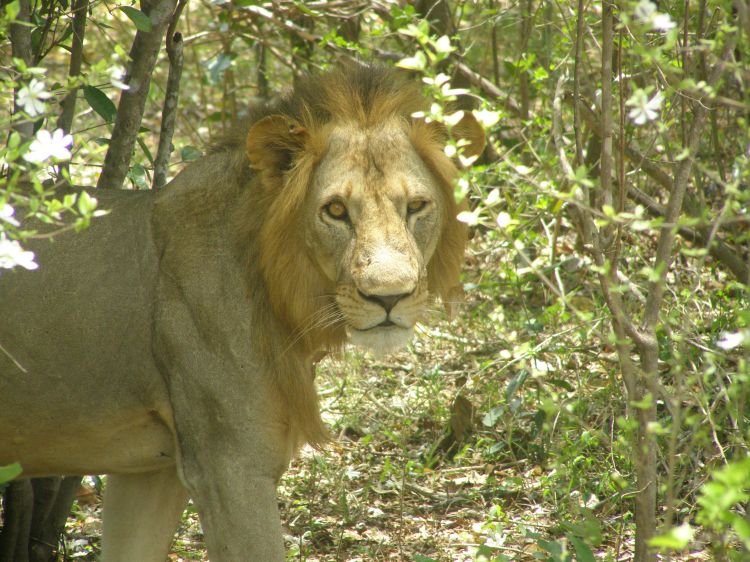
It wasn’t long before the source of this niggling sense of imperfection became apparent. We pulled up beside a pride of four lions sleeping in the shade of some bushes. These were your actual, genuine, red in tooth and claw, wild lions and the driver of our open sided jeep had decided to park about ten metres from them; or, as it is known in lion measurements, two bounds. I must have seemed distinctly nervous (I was distinctly nervous) as Hussain the guide jokingly asked if I was afraid that I’d get eaten. I asked him if he would lose his job if I got eaten. He didn’t seem to think his job was in any danger. The male lion, slim and athletic, got to his feet and gave us a stare. It was a full-on, “what are you looking at?” stare, which he managed to pull off while at the same time adding the comic effect of looking ever so slightly cross-eyed, as if imitating the lion in “Daktari” for my benefit. Thankfully that’s all he did. Maybe those were tired eyes; maybe the lions had eaten, maybe they didn’t like tinned food. I have no idea what was going through his mind, I knew what was going through mine. This might look like Paradise but there is nowhere to hide and every night some poor giraffe or zebra will draw the short straw and not see the next day.
The Impala camp was a loose cluster of Neru tents along the embankment of the Rufiji River, with an open plan dining area and lounge perched on the very edge of a river cliff, providing what must be the best view of any restaurant in the world. Placed around the camp, mainly for decoration I assumed, where the enormous skulls of elephants, hippos and crocodiles and, near our tent, was a row of dried elephant droppings looking like slightly squishy coconuts. These seemed an odd choice of decoration but I couldn’t think of another reason they’d been placed there.
The camp had the ultimate luxury in this climate, a small bathing pool. We were cooling ourselves in the pool on the afternoon when the camp manager called over for us to look at the elephant. We jumped out of the pool for what would be our first wild elephant. Still used to seeing wildlife at a distance (lions excepted) we scanned the far shores of the river, hoping for a distant glimpse, only to realise after some seconds that the elephant was splodging in the shallows at the bottom of a short, steep cliff only 50m away from us. It has to be said that you haven’t seen splodging until you’ve see an elephant do it. This elephant was clearly at least a sixth dan in splodging and the water swirled and jumped as it stomped its feet. Job’s exhortation to “Behold Behemoth!” now carried the weight that the Bible writer had intended.
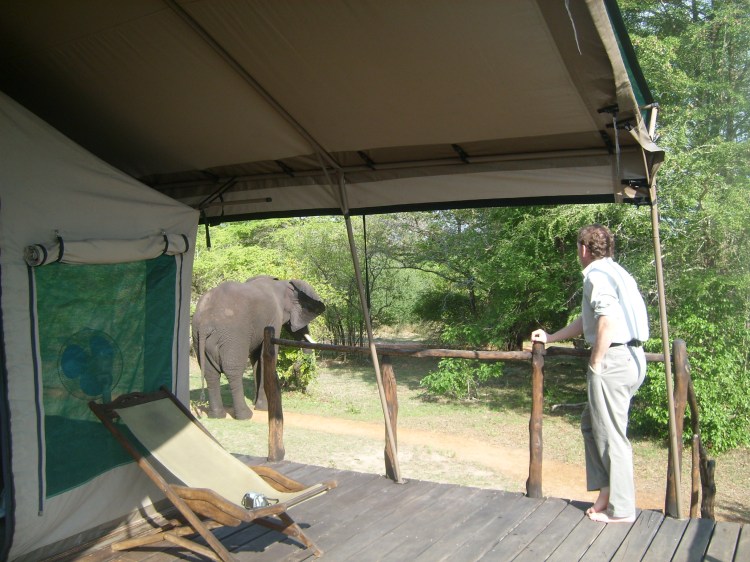
We rushed to our tent to grab cameras and throw some clothes on, only to find that the elephant had beaten us to it and was parked 15 feet away. Our tent was next to the path down to the river and the elephant had crossed the creek and come up the bank near the boats. We set the cameras on wide angle and got some great views of its backside, then stood on the verandah trying to find a slightly more photogenic part of his anatomy while the elephant shredded a bush. For some reason that I still can’t get my head round this wasn’t the slightest bit unnerving.
In the space of a few hours I’d gone from panicking at the sight of elephant droppings on a runway, to being close enough to almost slap one on the backside in the hope that the end with the trunk would turn round for a better photo opportunity. Adrenaline makes for a crazy ride and just in case our adrenaline glands had a little left to squeeze out of them, the late afternoon itinerary would be a boat trip down the Rufiji river.
 Raven on the Wing