Phenologists (that is people who study the seasonality of nature and not to be confused with people who feel the bumps on your head) reckon that nature’s calendar is gradually creeping forward. Well it took a big leap this month, as February stole March’s clothes as a month of two halves.
The first half was either frozen, or if it did briefly thaw, flooded. The last of several bouts of snow resulted in continuous snow and ice cover for a week, with the coldest night getting down to minus 8°C in my polytunnel; goodness knows what it got down to on the other side of the polythene. I kept telling people that I had never seen so much water on the fields. I probably have, I’m just too old to remember but I’m sure there was water where I have never seen water before and there wasn’t a square inch of ground anywhere that had the capacity to hold any more.
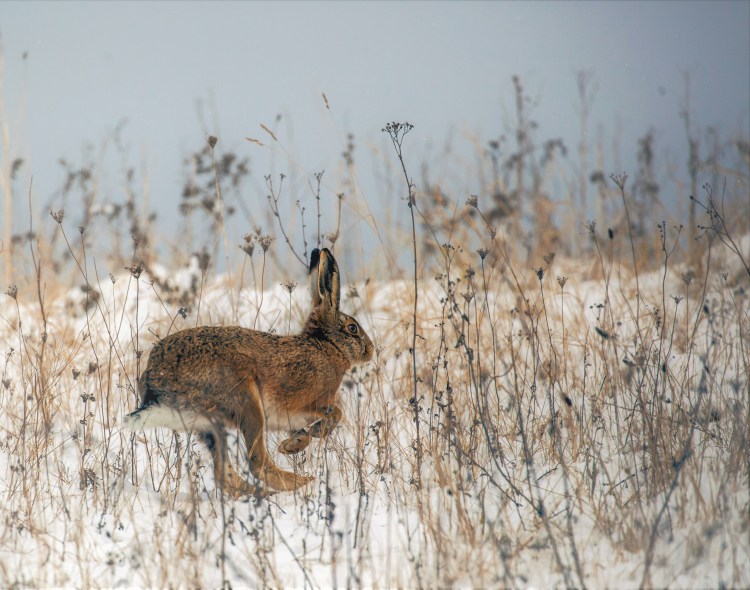
The weather forecasters described it as the “mini beast from the east” but under all that snow and water, minibeasts were in short supply. I did find a Giant House Spider to add my list (and true to my word didn’t enquiry any further as to its personal details in order to determine its exact species) but other than that all I could add to my list in that first, frozen half of the month was another six plants, two birds and a mammal in the form of Brown Hares; four of them to be precise, stotting their way across the snow.
I’d had a minor bout of Athletes Foot, which is a type of fungus. I was getting to the point of thinking that I might have to add that to the list to get the numbers up when abruptly, within a day, it was all change. By chance, I had a day’s holiday to use up that day so we took our exercise walk as a circular round the bend in the River Tees from Broken Scar to Blackwell. By the time we got half way round we were sweating and carrying our coats. I no longer felt guilty turning over logs and the woodland at Blackwell gave me a few to choose from. In just a few hours life had woken up; as I lifted the logs, a springtail sprang, a centipede pedalled, a white fly flew. All too fast to give me chance to identify them more precisely, even had I been able to, which I wouldn’t have been. On the other hand a few hours of warmth hadn’t been enough to bring the snails out from where they had sealed themselves up from the cold. Woodlice, however, were just right. Active enough to have reprised their niche role as under-log, wood munchers; slow enough for me to get a good look at them and distinctive enough for me to be able to assign them to a particular species. My woodlouse count for the year tripled.
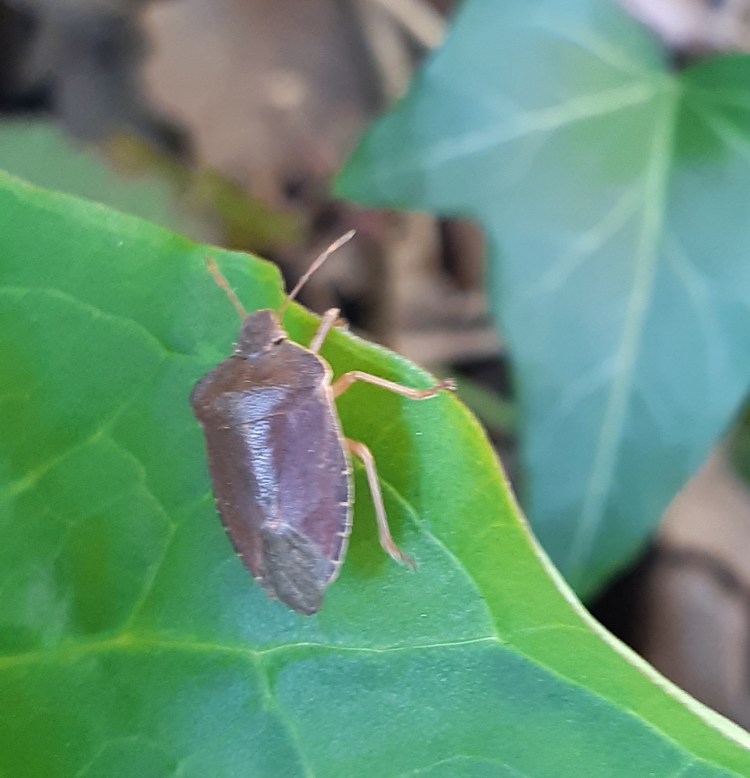
The rest of the month continued with a series of firsts. The first frog of the year always goes in the notebook. They usually arrive around 11th February then lie around on the surface for a month, looking as glum and bored as only a post-hibernation frog can, before finally getting round to spawning in mid-March. This year they were a fortnight late but their arrival was even more appreciated for that. My first shieldbug of the year was probably also first for Darlington. Green shieldbug is a southern species that is moving north and one I found one in Billingham a couple of years back appeared to be only the second record for the north east. The Green Shieldbug is actually purple in winter, which does make you wonder, why isn’t it the Purple Shieldbug that just happens to turn green in summer?
Even better, my first moth of the year, which appeared at our kitchen window on the 19th, was a new species for me. The moth, Agonopterix heracliana, is common enough but still doesn’t have a common name, so I am going to call it the “Not the Brown House Moth, moth”. It looks just like the Brown House moth that feeds on my tee-shirts, which almost got it squished on sight, but it was a little smaller and a closer look revealed that the tiny dots on its forewing that typify its more troublesome relative were replaced with tiny white squiggles. It turns out that its caterpillars feed on Cow Parsley, of which I have the appropriately named, “Raven Wing” cultivar growing in my garden to thank for its presence. Its true identity realised, I turned it loose to allow plant and moth to reacquaint.
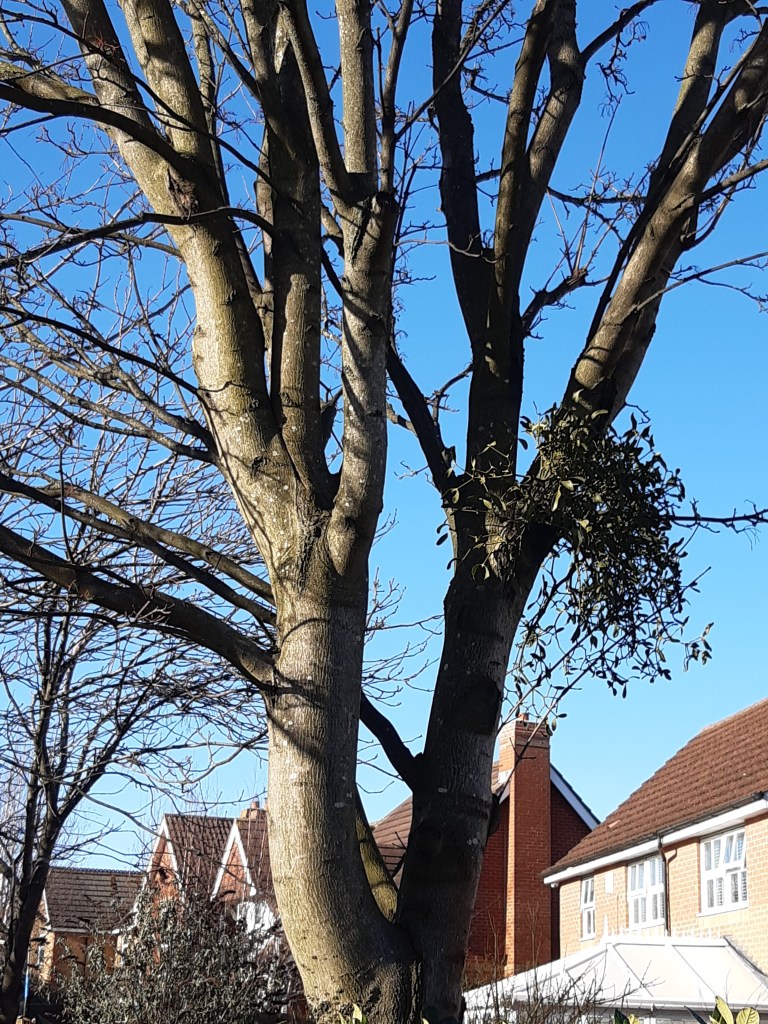
Speaking of a moth, which having a bit of a lisp I sometimes lapse into, my moss list increased to six and I have a few sprigs of other mosses laid around in bags which could double that total for March if I can identify them. Mosses might be getting the quantity up but for quality my best plant, in fact my best wildlife sighting of any type for a couple of years, was Mistletoe. Mistletoe isn’t supposed to be up here; the definitive “Flora & Vegetation of County Durham” only lists 12 records since 1950 of which only five remained, all on apple trees and all in parks and gardens, at the time of its publication in 1988. The tree that this Mistletoe was on wasn’t even planted in 1988; it was just a Norway Maple standard, planted on a road verge, an unusual host in terms of its age and species. The location was even more unexpected. It was just around the corner from my house; 258m away to be precise, I measured it on Google Earth and somehow I’d never seen it before. I can’t even claim credit for the discovery; it was my wife who spotted it. In my defence I only go that way occasionally and then only for a run where I usually take a sharp right 67m before the tree.
It will be interesting to see how March responds. Will it usurp April’s showers or will it stay true to form with only minor changes to nature’s procession. In either case Covid restrictions will confine us to orbiting our home until at least the end of the month, so I don’t expect the list to progress very far. Like everyone else in the country, I’m impatient for summer.
Tally to 28th February. 207 species comprising: 113 plants; 60 birds; 10 mammals; 1 amphibian; 15 invertebrates (6 snails, 3 woodlice, 2 spiders, 1 moth, 1 millipede, 1 gall wasp, 1 shieldbug, no slugs!); 7 fungi/ lichen and 1 piece of seaweed.
Fascinating facts
Woodlouse are crustaceans, so are related to crabs, lobster and barnacles. While most species live on land they lose moisture easily so need to live in damp environments. One of their great many colloquial names is “pissibed” as they are said to taste of strong urine – you have been warned!
The Brown Hare is Britain’s fastest mammal; half as fast again as Usain Bolt and with far more stamina. Its heart and lungs are much bigger than those of a Rabbit and its dark meat is due to the extra blood vessels in its muscles to transport the oxygen.
 Raven on the Wing