That Julius Caesar has a lot to answer for! What was he thinking of, making January the start of the year instead of March? Had he not heard the saying that, “The blackest month of all the year is the month of Janiveer” (alright, I pinched that one from the “Country Diary of an Edwardian Lady”, so he probably hadn’t). But it’s no wonder people struggle to get into the habit of keeping fit or giving up things that they’d really rather not give up. And finding wildlife in January is proving no easier than being tee-total whilst teaching yourself Tai Chi. Even that high priest of nature diaries, Gilbert White, could only seem to come up with a list of various forms of wildlife that were dropping dead with the cold, in his entries for January. March would have been a much better time to start any kind of resolution.
I probably shouldn’t complain; this January was a proper winter month, like the ones we had before global warming. Temperatures struggled to get above freezing most days and we had at least two spells of proper “snowman” snow instead of the insipid grey mush that passes for snow in our gradually warming climate. So I’ll take that, a brief return to the British weather that we knew as children, at least for those of us who grew up in the 60s. The wildlife will no doubt do what it always used to do and emerge in the spring, and maybe it will be better for the wait.
Even so, the frozen cogs of the species counter kept turning over, click by icy click, throughout the month. I passed the 100 species total on 5th January. The Reed Buntings which take refuge in my garden each winter made their first appearance on 2nd January, nudging my bird list to 34, but it was a site visit for work (as opposed to the round-shouldered face-off with the kitchen wall that work usually consists of these days) that moved the clicker into treble figures. I’d been asked to check an area of land on Teesside for invasive alien plant species ahead of some maintenance going ahead. Fortunately, for the company at least, there were none of the “Triffid” species such as Giant Hogweed or Japanese Knotweed. There were some Cotoneaster bushes though, three species of them to be exact. There are dozens of species of Cotoneaster in cultivation and most of them look very much the same, with small, evergreen, glossy leaves and bright red berries. Five of their number are listed under Schedule 9 of the Wildlife and Countryside Act as it being an offence to cause them to spread in the wild and telling those five apart from the others can be challenging. Two of the five I know quite well; the Herringbone Cotoneaster grows in my garden where it introduced itself without asking and the second, Small-leaved Cotoneaster (a not very helpful name as they are mostly small-leaved), I have done battle with at Rockwell nature reserve. Both were present, as was a third species that I couldn’t put a name to. Its identification took a bit of digging (pun unintended but I’m sticking with it) but then learning is what this quest is really all about. It also proved to be a Schedule 9 plant, Himalayan Cotoneaster. Fortunately Cotoneasters are much easier to deal with than most invasive plants; in fact I don’t think they should really be listed with those invasive plants of developer’s nightmares, they probably just merit their own category as slightly naughty plants.
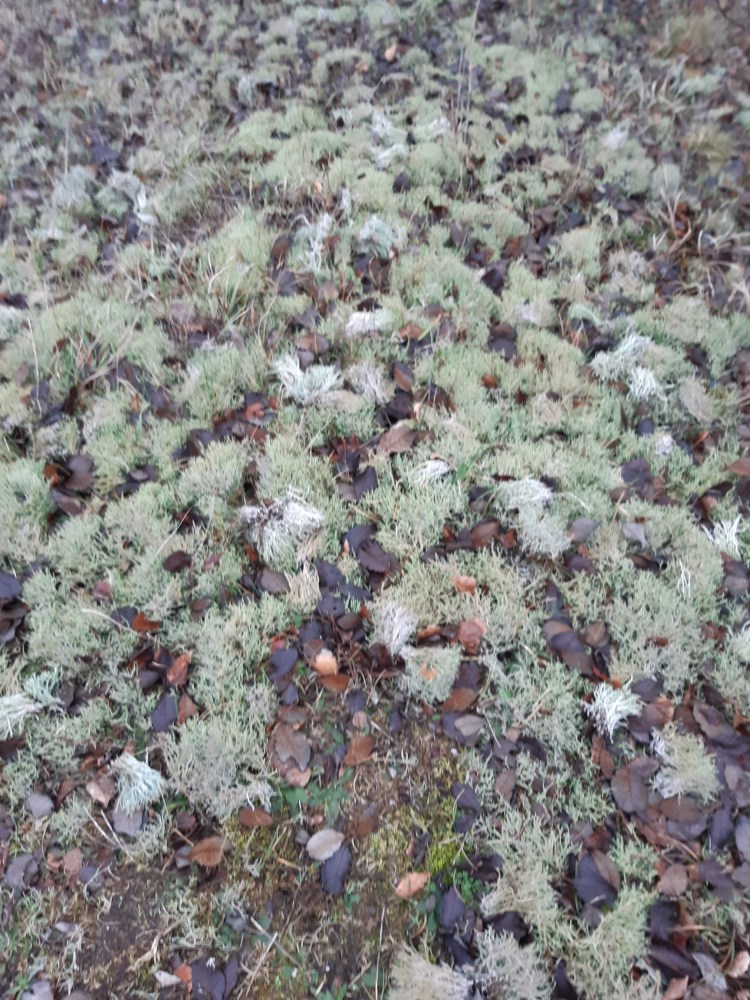
Good though a new plant was, the more interesting part of the visit was the ground that they were growing in, which was almost pure sand, this area having been part of the sea in my lifetime. Several of the typical sand dune plants such as Marram grass, Catsear and Stonecrop were still recognisable, but what really caught my eye was a tall, stringy, moss-like, lichen which covered a few tens of square metres. It looked just like what they used to make the vegetation out of in model railway sets and for all I know it might have been. I had seen it before but only in little sprigs and never paid it any attention, but here it grew as I’d never seen it before, in a lawn, refusing to be ignored. It turned out to be a form of lichen Cladonia arbuscola*, a relative of Reindeer Moss, which is also a lichen and definitely not a moss.
(*Where species don’t have a common name in English it is customary to refer to them by their scientific name, which is usually latinised and always italicised. However I think it’s fun and maybe even fair to the species, to make up a name for them that says something about them. So I am going to christen this “Model Railway Moss.”)
Once I’d finished looking for naughty plants, I was tempted to drive a mile in the opposite direction for a quick peak at the wildlife watching point at Greatham Creek, where hundreds of wintering waterbirds gather in multiple species among the two species of seal. But that’s a temptation for a year without Covid. The birds will be back in autumn and, god-willing, so will I. To compensate I did manage to add six bird species on the drive there and back; even at 50mph Shelducks are hard to not to spot.
It took another couple of days before I caught up with the Mandarin that I’d missed on New Year’s Day. As if to make up for his absence he’d brought a friend and so two Mandarin drakes graced Drinkfield Marsh, though sadly they only count as one for my purposes. But, other than a Barn Owl at South Burdon community woodland, out hunting at midday in desperation as the snow started to melt, there was very little of note. It was just a couple of plants here, a bird there and, with just the odd exception, everything that wasn’t a bird or plant, neither here nor there. The furthest we got was South Park at the other end of town. That added another three birds in the park and three plants down a back alley on the walk there (back alleys really are the place to go for biodiversity).
By the end of the month I had pretty much exhausted all of the plants that were recognisable in the parks and streets of our town in January and, with Covid travel restrictions set to continue and the weather set to stay the same in the first half of February, I was starting to get a little bit desperate. I could always turn some logs over and, I expect, add three woodlice and half a dozen snails to the list without too much effort, but it was flipping freezing out there and I didn’t have the heart to disturb them. So the last weekend of the month found me surreptitiously pulling little clumps of moss off people’s walls on our exercise walk round the streets. I’d been reading a little bit about them and been encouraged by comments like, “a distinctive species of moss”, “easily identified by..”, etc. That’s hogwash! I now have a collection of them on my windowsill and I can vouch for the fact that mosses are without exception little, green, stringy things, whose distinguishing features are that they look little and mossy and nothing else. Nevertheless I really need to get on better terms with mosses as they can be distinctive indicators of habitats, so I mean to persevere with them in February.
Mosses then are more a measure of dedication than desperation. The true measure of my desperation was that I was thinking of slugs. They are everywhere; in my compost bins, in my garden and they even push their luck in our outbuilding. But crucially for my purposes they come in multiple sizes and colours, reflecting the different species. There is even a superb new field guide to the “Slugs of Britain and Ireland”. There is a drawback though; I hate slugs! So in what is surely one of the most bizarre proofs of Chaos theory, Julius Caesar changing the start of the year from March to January has, just over two thousand years later, resulted in me contemplating a slug safari. Honestly Julius, I just don’t know what you could have had against March!

Tally to 31st January: 151 species comprising: 84 plants; 52 birds; 5 mammals; 5 invertebrates (2 snails, 1 spider, 1 woodlouse and a gall wasp cunningly disguised as a Robin’s Pincushion); 4 fungi/ lichen and a piece of seaweed.
Fascinating facts
Cladonia arbuscola (or Model Railway Moss as it’s now known) contains Usnic acid, which has antimicrobial properties and has been shown to inhibit the growth of certain types of human cancer cells.
The Mandarin isn’t native to Britain; it was introduced at the beginning of the twentieth century. It actually comes from China and Japan, where its population is gradually decreasing. In Britain its population is increasing and this country now supports a significant part of its global population, making Britain important for its conservation.
There are 36 species of slug in Britain. That’s way too many!
 Raven on the Wing