You get those moments, those brief seconds of bafflement when your brain scrambles frantically to decipher input that makes no sense at all. As I scanned the Teesmouth foreshore the white shape in front of me didn’t resemble anything I knew, didn’t move like anything ought to move and yet moved frantically while at the same time staying rooted to the spot. I focused my binoculars and the white shape coalesced into a bird. It was an Eider drake, obviously in distress and scrabbling desperately as if trying to escape some unseen hand pinning it to the mud. I sneaked around it in a long arc, trying not to make it panic. Positioning myself between the bird and the water I crept up until I could reach down and pick it up in my hands. The unseen hand proved to be 30m of fishing line, snagged like trip wires between the rocks and wrapped neatly round the bird, holding it a prisoner to the incoming tide. As the tide played Mr Wolf behind me I lifted it up, taking care not to entangle it further, but instead of panicking and fighting the bird just flopped in my hands, its long neck falling limp across my leg as I crouched with it. I thought the stress might have killed it but I set to anyway, cutting the line where it had dug in to its leg, then another loop around its wing and another around its neck and finally a second around its wing.
Most ducks are pretty smartly attired birds but up close this was probably the most exquisitely beautiful animal I had ever seen. Its plumage, immaculately tight and water-proofed, gave no hint of consisting of feathers. Instead it seemed like porcelain, glazed in black and white with a blush pink wash on its breast and two strokes of pea green across its neck, yet still warm and as soft as only an Eider could be.
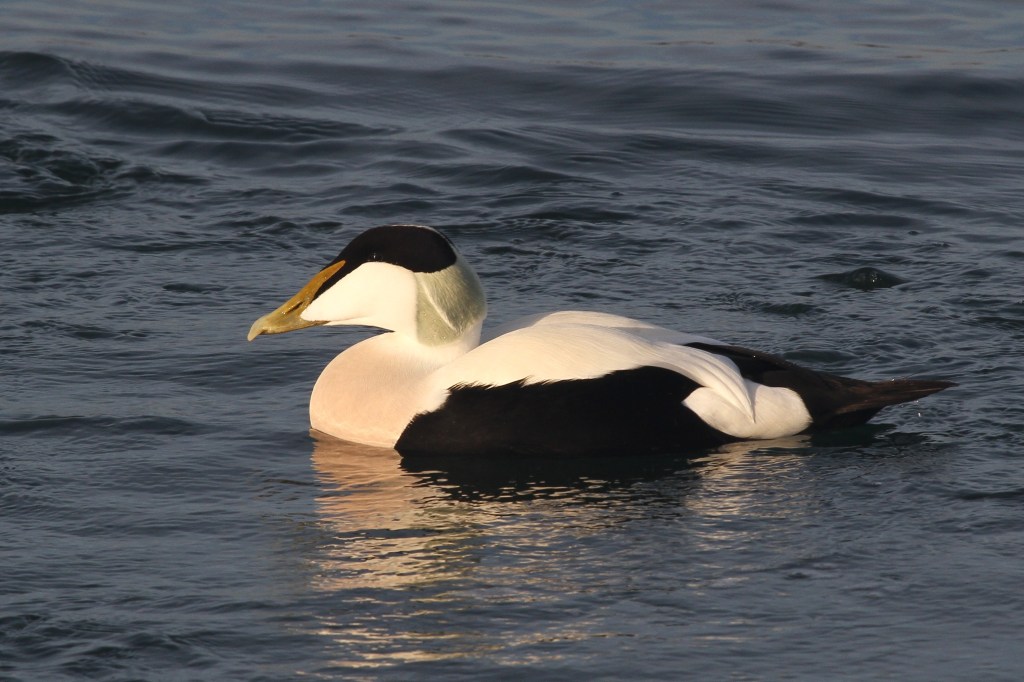
All ducks are tough but Eiders are the toughest of the lot. They are predominantly an Arctic bird, spending almost all of their time at sea and hardly coming ashore except to hatch their eggs. So well engineered are they for a marine life that they have glands above their eyes which remove the salt that they take in, expelling it through their nostrils with a shake of the head. Their food is the blue mussel of which they eat around half a pound a day, diving down to three metres and staying submerged for a minute at a time.
The islands off Northumberland are the furthest south that they breed along the North Sea, though in winter they range all the way down the North East coast, the stormy, rough swells off Cleveland, a little milder than the Artic, are the Eider’s only concession to a softer life. Their presence off the North East has ebbed and flowed over the centuries; in the nineteenth century they were only found in northern Scotland but back in Saxon times they must have been here as in 676 AD St Cuthbert decreed that they should be protected, one of the earliest examples of nature conservation in the world. This protection may have stemmed simply from a love of the birds by a kind-hearted saint but it could well have been more in line with the modern idiom of protecting nature for the services it provides. Certainly Eiders are very valuable birds. With down from approximately 60 nests being required to produce enough for one duvet it is very much at the luxury end of the market. However no other natural material can match eiderdown for its thermal properties and if a synthetic sleeping bag were to be packed to keep you warm at minus seven degrees, the same amount of eider down could keep you warm at minus thirty-five degrees. It is also much lighter and more breathable, allowing body moisture to escape thus deserving its reputation for comfort.
In these days when sustainability need only mean that someone is making a profit, eiderdown harvesting is sustainable in the old fashioned sense. Iceland is by far the main producer of eiderdown with the practice being introduced there by Viking settlers a thousand years ago. The female Eider pulls the down from one spot on her breast to insulate the eggs in her nest and only a small amount is harvested from each nest so as not to affect the incubation of the eggs. As close a case of not killing the goose that laid the golden eggs that you are going to get in real life. The ducks aren’t farmed as such but they are often provided with nesting shelters and predators are controlled thereby encouraging nesting ducks to return to those areas. This is important as female Eiders sit tighter than other birds and are thus more vulnerable to predators, in spite of the drab, barred-brown camouflage of their feathers.
The line was removed from my Eider but still it hung limp with no sign of life other than a faint warmth that still filtered through to my numbing fingers. Wondering if there was any point trying to get it to a vet, I laid the bird on the mud while I untangled the line from the rocks so that it couldn’t claim another victim. My back turned the bird leapt into life and pelted down the mud, its feet pattering like an “It’s a Knockout” contestant playing the joker, before launching itself into the tide. Immediately afloat it just bobbed there nonchalantly taking the odd sip of water as if it hadn’t a care in the world. I still can’t help breaking in to a grin whenever I think of it. I hoped St Cuthbert would have been proud of my good deed for the day and it only goes to show, you just can’t keep an Eider down.

 Raven on the Wing