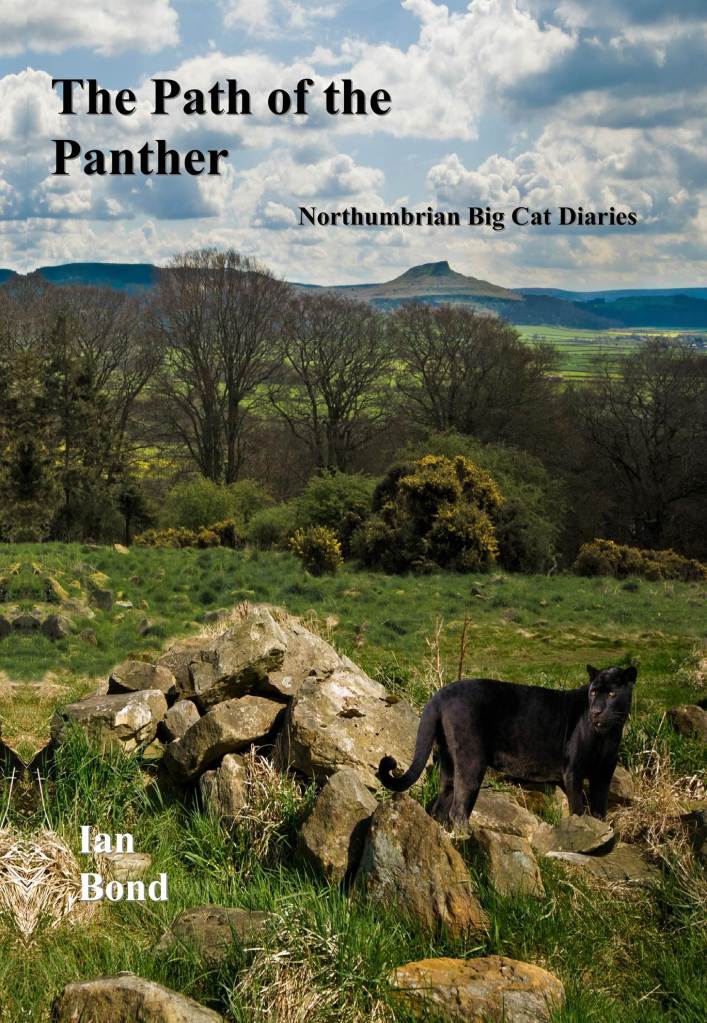
Back in 2010 I wrote a short book entitled, “The Path of the Panther” which was a compilation of all the editions of the “Big Cat Diaries” column that I had written for Northumbria Mammal Group’s newsletter up to that point (you can download the book on the homepage of this site). Forward to 2020 and I’d been out of the Big Cat sightings loop for so long that I had assumed that I had stopped writing the column after the book was published. It was only when I saw a post on Facebook about a sighting of a Puma in Newcastle, thought to be around 2014, which I knew I’d heard of, that I thought I might have kept the column going longer. It turns out that I did and these are the extra editions that I could find; there are eight in total so it’s a bit of a long read for one session. I have kept them as written, hence the repeated, tongue-in-cheek plugs for my book; tongue-in-cheek is how the column is best read.
Spring 2011
It is an axiom of any research that it is out of date the moment it is committed to paper. I’ve been busy the past couple of months putting the final touches to “The Path of the Panther”, my short book on big cat sightings in the north east. The bulk of the book is a compilation of all of the Big Cat Diary entries for the past 10 years, so if you are one of those organised people who keeps every back copy neatly filed away then you probably don’t need to buy it. However at the end I attempted a short analysis of what all the reports that I have received might be telling us about big cats in the north east (I’m tempted to say it’s worth buying it just for that but I think I would be over-egging the pudding somewhat). The analysis is based on 134 sightings where I had enough information to put a dot on a map, though in all I reckoned that I’d received a total of around 150 reports. This works out at around 15 reports a year though the rate of reports has accelerated somewhat in recent years.
When I did an initial analysis in 2007 for the Big Cats in Britain yearbook I only had 65 reports to base it on, which means I’ve received around 25 reports per year over the past three years. Getting a report on almost a fortnightly basis strikes me as fairly impressive and may even mean that big cats are the most commonly reported mammal in the north east but even that has been blown away by the number of reports that have come my way recently. The last edition of the Diaries took us up to August last year. Since then I have received 19 reports listing a total of 23 new sightings or other encounters with what were thought to be big cats. Given the other rule of writing that you should never write a book without having the sequel in mind, I’m going to give each of them a mention though I’m not even going to attempt to find a thread running through all 23; instead I’m just going to list them in something roughly approximating to north-south order.
First up then was another of these biggish, black cats that are definitely not panthers (not even young panthers) but which appear to the observer to be of an altogether different scale to Felis catus. Annoyingly I’ve lost the bit of paper on which I took down the details but the encounter was by a cyclist on a lane/ minor road near Belford. The cat came out of a hedge and cyclist and cat stared at each other at close range for quite some time before the cat moved off. The cyclist’s first instinct was to try and follow the cat but then thinking about the size of the cat he decided that perhaps that wasn’t such a good idea. When he mentioned the encounter to a neighbour he found that this wasn’t the first time that the cat has been seen in that area.
The title of my book, “The Path of the Panther”, reflected the fact that most of the sightings were of big, black cats and actually only six of the reports that I had received up to that point described a Puma. That changed in dramatic fashion with the next report, which almost gave us the inevitable road casualty that sceptics say we should be seeing if big cats are out there. I’ve quoted this report in full given the circumstances of the encounter.
“In a nutshell I was travelling to work one night about 7 or 8 years ago at approximately 19:40hrs travelling along the Chevington opencast road towards the A1. Approximately 300yrds from the junction of the A1 I saw what I can only describe as a big cat, basically puma like and coloured. There was a Rover about 40 yards in front of me at the time.
The cat ran out from the field in a North to South direction over the road, it was too late for the Rover to brake which collided with the cat. It then proceeded to run to the field over the other side of the road.
The Rover braked hard and pulled up with me pulling up behind it. I got out and walked over to the car in front where I spoke to the male driver who was examining the front of his car which was quite clearly damaged ie headlights and grill smashed. I asked what had happened even though I knew already. He replied “a big cat ran into the front of me”. He seemed really concerned over the damage and not what had caused it, also more importantly his wife, who he didn’t seem to be worried about, was screaming in the back of the car. I asked if she was ok and she calmed down and replied “yes I’m ok now”. I returned back to my car and drove off to Morpeth where I was the centre of entertainment for the rest of the shift. In the morning about 07:45hrs I drove back and parked up fully expecting to see a dead big cat but nothing to be seen. It was a sandy/ light golden colour about three and a half to four feet long; possibly just over two feet high and seemed to keep quite low to the ground as it crossed the road. Call me bonkers as many did but I know what I saw and more importantly so did the bloke in the Rover. I`ve often wondered what he put on his insurance claim form. I don’t see the big deal in all of this with people not believing as its obvious that somewhere the size of Northumberland could quite easily support an animal like this.”
A few years earlier, in 1996, and a little further down the road at Lynemouth there was another close encounter though not with the same cat (unless their colour fades with age). A man was letting his dogs out on some rough land near his house, as he did every night, but the dogs came running back up the path and fled in to the house, apparently scared stiff. Curious as to what had caused this he decided to investigate. The reason for their panic didn’t take much finding as a Labrador-sized, black cat stopped on the path only three metres in front of him. He was struck by the cat’s broad shoulders and muscularity, as well as its yellow eyes. The cat then turned and fled leaving him to go back inside, shaking like he’d seen a ghost. He phoned the police but claimed that they didn’t seem to believe a word and instead asked if he’d been drinking, although he was at pains to point out that he hadn’t drank in years.
The next encounter was also reported to the police but this time it is a fair bet that they didn’t ask if anyone had been drinking. In November this year during playtime at Red Row First School the children called a couple of members of staff over to look at the big cat over the field. What they were looking at was a black or dark coloured cat about 2m nose to tail end with a tail, the length of its body, which turned up at the end. The cat’s back came up to a low branch which was later examined as being knee high from the ground. The cat was watched for an estimated three minutes from only around 30m away. What was even more surprising was the reaction of the staff and children who were said to have loved the experience (Now that’s what I call environmental education!)
The final sighting in south east Northumberland was in woods next to the river at Bedlington. A man was walking his dog when a big, black cat loped out of the bushes on to the path, only a matter of a few metres away. Although the cat was black, where the sunlight caught it, it was possible to see spots that appeared a faintly lighter colour than the rest of the coat. The cat was about the height of a greyhound and around 2m long. The tail was about 1m and curved upwards towards the end. What was particularly interesting was that the ears were described as rounded. The shape of the ears is one of the most distinctive differences between panthers and moggies, although a total length of 2-3m and greyhound height are also pretty diagnostic when seen from 4m. This is one of the most detailed reports that I have come across in terms of the description, helped no doubt by the cat glaring at the man with a “shocked” expression for several minutes before bounding off, though I might have equally expected it to be one of the most garbled descriptions for exactly the same reason.
The area around Morpeth was previously a relatively warm spot for reports of big cats but the next pair of sightings, from the same person, takes us back to squarely to one of the hot spots in upper Tynedale. “I spotted a big black cat on Easter Saturday 2006 in the village of Haydon Bridge, Northumberland. I was walking along a disused old road (known as Spa Well) that runs parallel alongside the current main road (A69) about half a mile out of the village. It was around lunch time and my sister and I had our Jack Russell dog out on the lead. Suddenly she stopped and gasped in shock. I asked her what was wrong and she pointed to the undergrowth beside us. I looked down and saw a decaying dead bird. I laughed and mocked her for being scared as this was at the time of the bird flu epidemic but she then explained that it wasn’t that she was referring to – it was a large four- legged black creature she had seen running past. I stood for around two minutes, staring up into the trees and foliage to see if I could spot what she had seen. In haste, a very dark cat like creature with a long tail ran stalked past, up where I was looking. I would say it the body was around four foot long, it was short-haired and it appeared startled.. We didn’t report this at the time as we thought people would think we were mad! However, the following Thursday, our local Hexham Courant newspaper reported a sighting of the same description at Allendale, seven miles away. I put the whole experience to the back of my mind until recently. Around 10 days ago my mother and I were walking the dog at around 4pm at Allenbanks, a local National Trust area, when we spotted extremely large paw prints in the thick mud by the river. We both marvelled at the size of them – I’d describe them as the length of a large mobile phone. After a couple of minutes we carried on walking through neighbouring fields, me walking several metres ahead. My mother stopped in her tracks suddenly, shocked. She explained that she had spotted a very large cat, around the size of a labrador but thicker bodied, in a sparse area between two fields. It was around 40 metres away. I didn’t see any signs of it unfortunately. I walked over and explored the area but it was long gone.”
A little further down the road, the A68 near Kiln Pit Hill to be precise, two cats were seen by a driver and passenger just after midnight in September. Initially they were by the side of the road but then ran across in front of the car giving a clear, if brief view. The cats were 13-15” high with short tails, which looked like they’d been docked, distinctively pointed ears and patterned coats. The person who saw the cats suggested that they might have been a rare domestic breed such as the “Desert Lynx” but I wonder if they might instead have been proper Lynx.
Following my vaguely latitudinal descending order, the next sighting was from a new area just north of Chester le Street. A passenger on the train from Alnmouth to Chester le Street looked up from his book to see a large black cat crossing a paddock near a house. He was on a reverse facing seat and the animal had its back to him so it wasn’t possible to make out too many details but he compared it in size to a deerhound, which strikes me as interesting on two counts. For a start a deerhound is a huge breed of dog so this cat must have been noticeably large and secondly to know what a deerhound is he must have been reasonably familiar with animals as I suspect most people have never seen one.
Without consulting a map I’m not sure which is the farthest north; Chester le Street or South Shields. What I do know is that I can’t think of anywhere less likely to have a big cat roaming about than South Shields given that it has got to be one of the most built up and least wooded boroughs in the north east. However I have just received not one, not two, but three sightings. These follow on from a close up sighting of a large, grey cat near Souter Lighthouse earlier this year, as described in “The Path of the Panther”. (Apparently one of the laws of advertising is that people need to be exposed to something five times before they buy it; three more to go!)
One of these was on Halloween and involved something that struck the observer as looking like a black panther as it leaped the centre railings of John Reid Road, coming from Biddick Hall Junior School field over to Biddick Hall Drive. It was thought to be a panther as in the words of the observer “if it were a cat it would have ran through the railings or jumped on the top then over but this animal jumped the railing like a horse.” It’s hard to know what to make of this sighting as the observer didn’t seem to be absolutely sure himself that it was a panther. Perhaps in this case it could even have been a deerhound that seemed cat like with its speed and agility.
The next pair of sightings were in the same location as each other and presumably involved the same animal although there was a slight disagreement as to the colour. A retired couple had separately seen a cat like animal in the early hours of the morning on consecutive nights outside their house. The husband described it as grey, with a long bushy tail and a small head for its size. The animal was creeping low to the ground past their house. It passed close to their own cat, which is a large Bengal tom, but appeared not to pay the cat any attention. In size it was estimated to be about 3-4 times the length of the Bengal cat. The wife had seen it the previous night and was sure it was a cat. She agreed with the description, including the noticeably small head though she thought that its colour was dark, even black and described the fur as rough, not sleek as might be expected in a cat. Again the animal was low to the ground as if stalking something. When shown a picture of a Puma, the husband remarked that’s it except a bit more grey, darker and the tail was maybe a bit bushier.
While this report is intriguing given the corroborating observations and the close comparison with the large, domestic cat, the idea of a puma stalking the housing estates of South Shields and more pertinently then finding somewhere to remain unseen during the day, seems very unlikely. Another possibility that has been suggested to me is that it was a big dog Otter. That would certainly fit with small head, big tail and low to the ground and South Shields does at least boast Otters on the River Don and presumably along the coast.
One of the noticeable differences between my analysis of the 65 sightings that I had collated as of 2007 and the analysis for “The Path of the Panther” in 2010 was the increase in reports from Weardale, up from one in 2007 to seven by 2010. We can now add another couple of reports to this collection. The first was back in February by a member of staff from the Farplace animal sanctuary. He was walking his dogs close to some allotments on the edge of the moorland at Rookhope when he disturbed a big cat which ran off towards the fells. The cat was described as collie-sized, black with a brown undercoat and looked as if it was moulting.
The second report was of a sound, rather than a sighting, on the outskirts of Stanhope. The sound was that of a growl, so loud that two people stood 400-500m apart both registered it as being very, very loud. They later listened to clips on the internet to try and convince themselves that it might have been something innocuous like a Badger or Fox but after listening to sound clips of panther and Lynx they were pretty sure it was something like that. Interestingly, although one of the people had a couple of greyhounds with them, the dogs didn’t seem to react to the sound.
The next report is what I suppose is now a bog-standard “Trimdon Panther” report from Spring/Summer 2009. Someone on the bus on the road leading from Wingate Nature Reserve to Wheatley Hill roundabout had a short, 10 second, view of what they thought was a black leopard, the length of a field away. They described it as either dark brown or black with a tail that was estimated as being 3 feet long, rounded, chunky and noticeably long.
Of all the reports that I have received for this edition, as far as I am aware the only one that made it in to the newspapers was regarding a big cat said to be roaming the area around Ravensworth on the North Yorks/Durham border. It came to prominence because of suggestions that a big cat was responsible for a half-eaten sheep found with its neck broken. The Teesdale Mercury was the first to run with the story and also unearthed a number of sightings and rumours of big cats in that area although it all seemed a little vague to me. One report quotes me as believing that the cat which surfaced in Teesdale about ten years ago and which gave rise to stories of the Durham Puma, was more likely to have been a panther and to be dead by now in any case. While the last third of that sentence may be a true reflection of what I think, I can’t actually remember anyone asking me that question for this report. As I live in Darlington, Ravensworth is closer to me than most of the north east but I have only heard of one other report from that area in the past ten years. That said the report was one of the most astonishing, or alternatively improbable, stories featured in “The Path of the Panther”. Did I mention that the book is now available to order?
With all this snow we’ve been having I was hoping to either find some big tracks myself or at least be sent some photos of possible tracks. Unfortunately much of the snow has been powdery and didn’t register tracks with sufficient definition and the fact that we have had snow on snow on snow meant that any tracks that were made were either soon obliterated or blurred and getting to anywhere to look for tracks hasn’t been that easy in any case.
I was sent one set of pictures of what were presumed to be big cat tracks from Warrenby near Redcar. I guess the reason that they were presumed to be those of big cats and not some other form of wildlife is that they were big and rounded, though they were so big that they would have approximated to Lion tracks rather than your average panther or puma, not only that but they traversed ten or more garage roofs. While the prints were roughly cat shaped overall they were peculiar in that there was a small heel which had registered deeply and clearly whereas what would have been the toe pads had only gone less than half of the depth of the “heel pad” in to the snow. What was even more peculiar was that the pattern of the tracks was completely regular with pairs of tracks exactly side by side and about a foot apart and then the next pair of tracks about two feet in front. I strongly suspected a hoax as the prints could easily have been a small shoe heel for the heel pad plus a gloved hand with fingers curled back for the rest of the print but the tracks appeared to be in pristine snow with no evidence of where someone could have leaned over to have made them. My other theory is that Spring-heeled Jack has regained the use of his other leg and come back to haunt Cleveland. (Perhaps I see another book coming on).
When trying to establish the veracity of any wildlife records, the experience of the person making the record is often the deciding factor. On that basis the other report of a set of prints that I received are given considerable credence as they were found by Kenny Crooks, who is probably Cleveland’s leading expert in mammal signs. What Kenny found were two clear prints in some mud, obviously a cat of some kind but much larger than any that he’d come across before. Unfortunately he didn’t have a camera or mobile phone but his multi-tool had a ruler so he managed to get some measurements. The width of the prints, from the outside of each outer toe measured 68mm, and from the back of the heel pad to the front of the toe was 65mm. This is at the low end of the range for Puma or panther but would be about right for Lynx. It’s certainly way too big for a moggie, which would make prints of about 25mm. The prints were found in a wood near Pickering back in August. Although not on our patch I had to include them as it’s very rare that any evidence is brought forward other than sightings. Reports of the “Beast of Ryedale”, a black, panther-like cat seem to be quite common though there has also been a sighting of a Lynx at Cropton Forest near Pickering.
At the other end of the North York Moors someone carrying out an ancient woodland survey in Pinkney & Gerrick Woods had two sightings of what they presumed was a large black cat. Earlier in the day she had seen it as a black shape out of the corner of her eye but later on she found herself facing it at a distance of about 15m. She thought it was a very large black dog at first but when it bounded off very quickly between the trees she noticed that it moved more like a cat.
I’ve abandoned any attempt at geography now as I wanted to save the best (best as in most bizarre) until last. In the space of a week I’ve had four reports of the Trimdon Panther, or rather I would have had, had they all been of panthers. The first was from a couple who were driving down the A19, just south of Elwick when they saw what they described as a medium sized cat bounding easily through the snow. It is worth bearing in mind that the snow at that point was about 30cm deep. The cat was described as Labrador size with dark markings on a lighter coloured body. It had a flattish face, long legs with a banded long tail. It was coming towards them as if it was going to cross the A19 and was only an estimated 10-15m away. I have previously had a report of a Serval from that area. As it was a second hand report I don’t know why it was considered to be a Serval; maybe it was same cat as long legs and dark markings on a lighter body would be consistent, though they would have had to have missed the tail as Serval’s tails are noticeably short.
The object in the cliché about things being infrequent then two coming at once, e.g. buses, policemen, etc., can now be replaced by big cats at the Wynyard Woodland Park. I haven’t had any good reports for ages then there were two on the same day. Not only that but they weren’t even of the same cat. At the northern end, in an area of long grassland called Pickard’s Meadow, a couple watched a large, pale-sandy coloured cat cross the field about 100m away. They were quite shook up by their encounter and needed reassuring that they were unlikely to be at any threat from the cat if they went walking there again. Bizarrely when they told their encounter to another visitor, the visitor claimed to be a former warden and told them that it was known that there were two or three Pumas there, that the wardens knew about them but weren’t worried about it and that there was even a couple who regularly brought meat to feed the Pumas. (I should point out, as a former warden there myself, that none of that is true as far as the current wardens are aware).
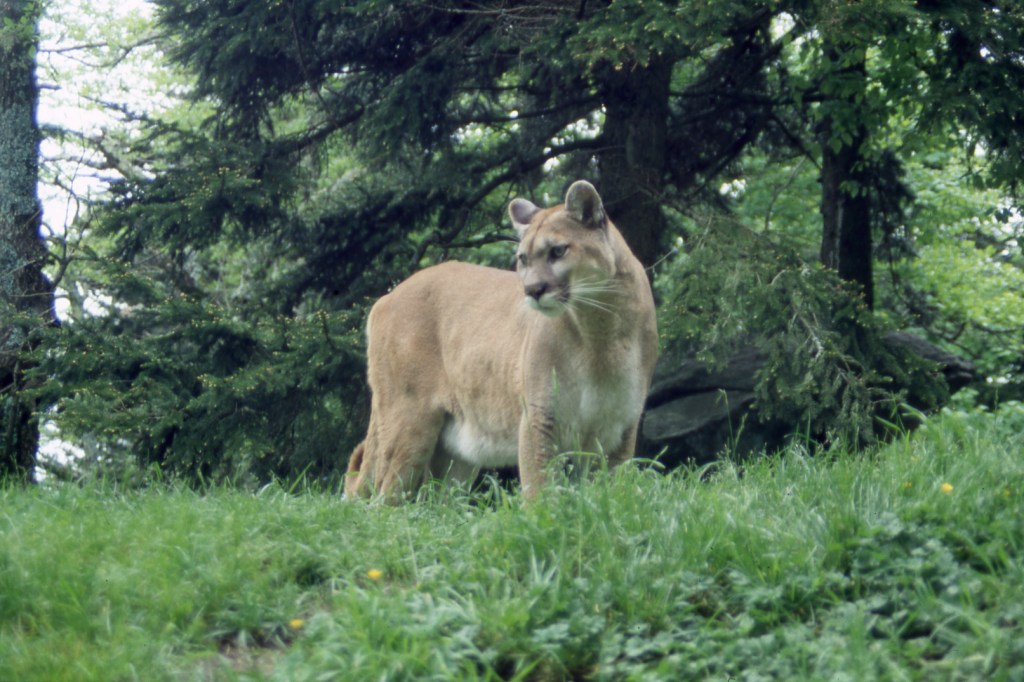
Meanwhile about 2km further south in Thorpe Wood, a man saw a large dark-coloured cat, which he at first thought was an Alsation, chasing a deer in the wood. As if that weren’t enough, the next day he claimed to have seen the cat again, only this time with a cub. So we now have a Leopard/Ocelot type cat, a Puma and a panther (and cub) all stalking the same area at the same time. I’ve suggested that the wardens could stake out some goats and start running safaris to bring some income in to the public sector. Who needs the Serengeti! If the past five months have seen almost a 20 per cent increase in sightings on the total for the past ten years then I am bracing myself for what might come in once “The Path of the Panther” is published. But will any of this change the current picture? Well you’ll just have to buy the book to find out!
Summer 2011
The launch of my book has generated quite of bit of interest (which unfortunately isn’t the same as sales) among my work colleagues and several have come forward to tell me their big cat story. First up was someone who had been camping near Hawes with the family. Looking over the dry-stone wall from their camp site, in the next field they saw a sandy coloured cat, the size of a large dog (and when he indicated the size he meant a very large dog), which just strolled away, paying them no attention.
Another was driving down the A1 western bypass at Low Fell with his Dad when they saw a large animal, the colour of cardboard, on a mound by the side of the road. They didn’t get a good look but were sure it wasn’t a dog. It did occur to me that this could have been one of those occasions when the animal actually was a Muntjac.
The most detailed report was from a former colleague who e-mailed me the following report:
“I was working at (name withheld) Farm; Racecourse Road; Sedgefield yesterday (Monday 21st) when I turned to look towards the hedge line I witnessed a large animal all black in colour running down between a tree and some sheds. The distance was two fields away and I was on the house roof repairing the slates. It was as large as say a Labrador dog maybe slightly larger. Jet black in colour and its gait wasn’t like a dogs gait its two front legs sort of went out together and its tail which seemed to be thicker than normal hardly moved when it ran. I alerted my labourer who saw it too and he said it’s a cat but a big one. It covered the distance of about 100 yards in about 6 or 7 seconds and disappeared into the undergrowth. We both had a good look at it for about 10 seconds and were surprised at its size. I have kept Lurcher’s most of my life and it certainly wasn’t a dog. The visibility was excellent and it was sort of late morning /dinner time when we saw it.”
Another person remembered a sighting from the mid-1990s, when she was a teenager. A couple of her friends, aged about 14, were in a field that bordered the Clavering estate at the north of Hartlepool when they saw a big cat. They climbed over a fence to get away from it whereupon the lad got his body warmer caught on the fence and was so frightened that he wet himself. My colleague wasn’t present herself so couldn’t recall details of the cat but it had obviously created a lasting impression.
On the other hand I received a word of caution from a former colleague at the Wynyard Woodland Park about the recent sightings there.
“Hi Ian, I had another ‘big cat’ sighting the other day at Grindon, however I would temper your excitement. Most of the sightings have been near Grindon and it so happens that the Hateley’s house is now occupied by new owners who have two black cats. When I quizzed the spotter the other day he said it went up the steps towards the house. When I grilled him on its size, he eventually agreed it may have been the size of a large male domestic cat (at the start of the conversation it was a panther). The gentleman is a regular visitor and was aware of big cat sightings. He also couldn’t tell me if it had a tail or not. I am suspicious that people are expecting to see a big black cat and it can sometimes be difficult to judge scale. The two cats may also explain the sighting of cat with ‘cub’. I am now leaving my chainmail vest, pepper spray and taser at home. Cheers, Bob”
While I think Bob’s probably got it right with these two sightings, the previous sightings included one of a cat chasing a deer and another of a sandy-coloured cat, of Lioness proportions a couple of miles north of Grindon, in the Pickard’s Meadow. Whatever these two animals were it probably wasn’t a moggie. Another piece of news coming out of Wynyard Woodland Park is that they have got a grant to turn the 16ha former arable field that is Pickard’s Meadow, into a wildflower meadow and that it is to be grazed by sheep. Not only is this a regionally significant habitat creation scheme but it also means that I will no longer have to go to the trouble of staking out a goat there.
I have long since stopped being surprised by the number of people who have a big cat sighting story. In fact I start my big cat talks by announcing that there will be someone in the audience who has either seen a big cat or knows of someone who has. I feel a bit like a stage clairvoyant but so far I’ve not been wrong. I’ve done three talks in the last couple of months. The retired teacher’s group in Hartlepool had between them seen a big black cat crossing a cereal field at Sheraton, just north of Hartlepool (big enough to be seen through the crop which was at the harvestable stage) and a big, black cat running across a meadow in the south of France several decades ago.
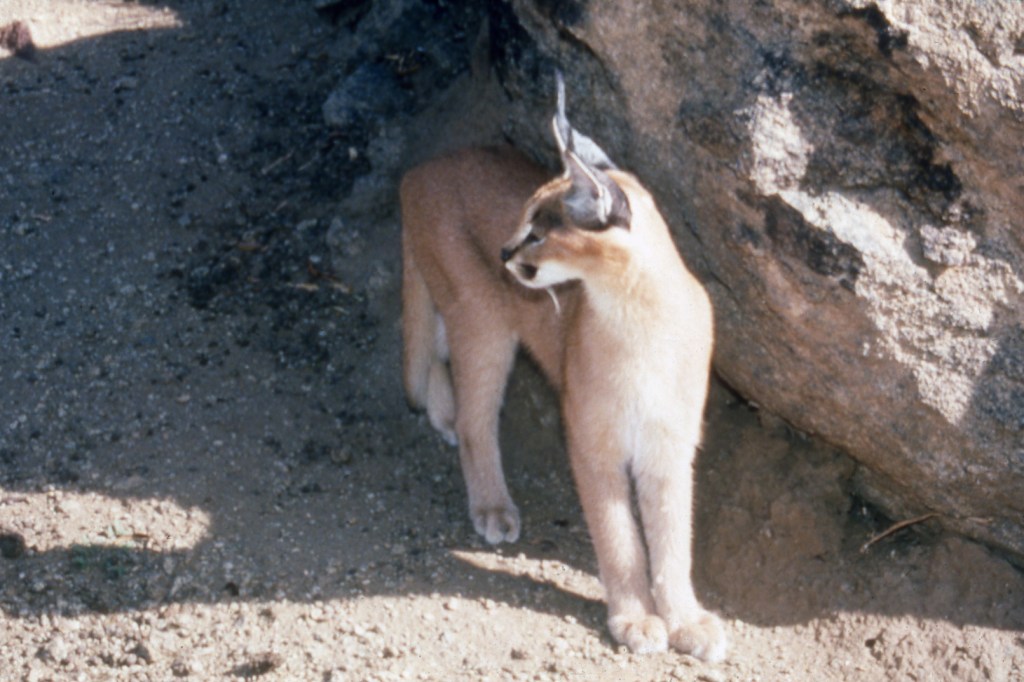
At the talk to Darlington Naturalist’s Field Club I thought I was going to draw a blank, the only person who spoke up to say that he had seen a big cat in the north east was the person who gave the vote of thanks, who had seen a panther on a lead in the meat market in Newcastle, in the years before the Dangerous Wild Animal Act. Nevertheless, afterwards several people came up to me to tell me about sightings. Most of the details are a bit of a blur what with having to pack away and renew my membership etc., but one of the reports was from my half-cousin, who I hadn’t seen for years, who had seen an Ocelot down in Gloucestershire. Another was from the man who during the question time at the end had got up and spent about 5 minutes expounding on why there weren’t any big cats out there (I’m not sure if he actually asked a question). He had seen a Caracal cross the road in to Aycliffe Quarry about 20 years ago.
Best of all though was the talk to Hartlepool Natural History Society. The talk was opened up to the public and we had around 60 people, several of whom had come because they had seen a big cat. At least two had come because a member of their family had seen one but weren’t able to come in person so had sent a relative; it felt a bit like I was a cryptozoological Messiah, confirming their faith in big cats. (In case anyone takes offence at that I should point out that I’m not really the Messiah, I’m just a very naughty boy!) Afterwards I had a queue of people who wanted to talk about their sighting and I made a note of seven reports. I didn’t manage to speak to everyone and got the impression that there would have been more had we not had to vacate the premises dead on 9pm. Four of these reports were the standard, big, black cat, the size of a Labrador/Alsation/Great Dane, crossed the road in front of me, though none the less significant for being typical. All four sightings had made a profound impression and at least three had been at very close range, in fact one had to slow down for it; these things really must have nine lives. The most recent was by a couple whose sighting had been reported in the Hartlepool Mail. They came along to the talk and were able to clarify some of the details (and made it a much better talk for having some real live witnesses). Their sighting had been mid-morning on the Coast Road where it bisects the Denes at the north of Hartlepool. A very large, dark-coloured animal with a particularly long tail ran across the road from Crimdon Dene, which is a popular recreational woodland next to the beach, and disappeared into the extensive and largely off-limits, Thorpe Bulmer Dene. The road is very shaded at that point so they couldn’t be sure of the colour and had assumed that it was a Puma as co-incidentally the husband used to do a bit of drawing and pumas were one of his favourite subjects. However on learning that Pumas are never black they thought it more likely that it had been a panther.
Unsurprisingly, as this was a talk in Hartlepool, almost all of the reports were from the typical Trimdon Panther locations. Someone started telling me about their sister’s sighting at Peterlee, which immediately struck me as out of place as it would have been a bit further north than the usual report locations but then it turned out that she had been driving south on the A19 near Castle Eden Dene when she saw it. Included in these Trimdon Panther reports was one from the fox hunting era. The terrier man from the local hunt was about to put a couple of dogs down a fox hole near Hurworth Burn Reservoir when he looked up and found himself staring in to the face of a panther that was under a bush a few feet away. So much for the argument that big cats can’t be out there because the hunts never encounter them! My favourite of these seven tales was the one that was from further afield, on a farm near Scotch Corner. The farmer was lifting bales out of a barn with a tractor; as he took one of the bales out, there was a panther that had been resting up behind it.
An even odder location for a big cat was a residential area in Shotley Bridge. Described as jet black with a sleek coat, rounded ears and a tail longer than the body, the animal was watched by two people from their window on the opposite side of the road for around a minute as it sniffed a wall on the other side of the cul-de-sac then strode off towards Shotley Bridge Hospital! I would normally tend to dismiss this as a misidentified moggie but the animal was estimated to be about 18-20” high, which they calculated by comparing it to the wall, which they later measured as being 12” high.
Shotley Bridge is at least within a bit of a hot spot for big cat sightings but I received an e-mail from a man in Littletown, just east of Durham City, which definitely isn’t on their usual path. I got the impression that he knew something of big cat sightings already as he asked whether this was the only sighting this far north. (In fact it isn’t the only one but it is unusual). The animal in question was spotted near to an area used for smallholdings, sheep and allotments at around 6pm on Saturday March 5th, at which time it would have just been getting dark. The man’s collie dog, which had earlier been behaving strangely, heckles up and sniffing about, saw the animal and tried to give chase though in vain as this animal shot off with “amazing acceleration” and dashed off into the Woodland Trust site of Elemore. He estimated that its height was similar to that of the collie, ie 21 inches. Perhaps the reason that reports are very rare in that area is that there is very little woodland cover in east Durham, in fact other than the coastal denes, Elemore is about it.
I thought I’d finish with another report from back at HQ in Hartlepool. I gave an interview on BBC Radio Tees about my book and as a result was contacted by a man about his sighting in Thorpe Bulmer Dene some 15-16 years ago. He had been in a quiet part of the wood without public access and had just sat down on a log when a large, Labrador sized animal with a cat face and its tail straight up in the air got up about 20-25 yards away from him. It just walked away slowly, without really paying him too much attention. I’ve finished with this report because it illustrates one of a couple of points that have struck me in the six months since I finished “The Path of the Panther.” Firstly there are an increasing number of sightings that go back beyond the lifespan of any cats living today and from locations other than those that I remember as typical of the Durham Puma back in the 80s. Secondly there has been a significant increase in the number of reports that I am receiving, full stop! I was anticipating this because of the publicity around my book, though actually other than among my colleagues and the report above, it’s generated very little interest. Instead this seems to be part of a trend. So much so that, as you may have noticed, I have got to the point with some reports of briefly summarising them, lumping them together or, in the case of the talk to Darlington Field Club, not even bothering to note them all. It makes me wonder whether or not I should reconsider my opinion, which is that there is just the odd cat out there and that while breeding isn’t impossible it must be extremely rare. But then the alternative, that there might be a small population in the North East, still doesn’t seem right to me either. Oh well, we’ll just have to see what the next batch of reports indicates.
Autumn 2011
I expect it’s my age but I’m finding myself with a growing crisis of confidence with wildlife. I’ve finally given in to the realisation that I just don’t have the “spot the difference” skills that you need to be able to identify wildlife accurately and I’ve a growing disenchantment with bat detecting (though the latter state is where I think all bat workers inevitably end up). Now I find that the broad patterns that I thought were emerging with big cat sightings in the north east are being peppered with anomalous dots as new reports turn up and fill in the blanks on the map.
First up is a report from the North Yorks/Durham border. While there has been the odd report(s) in the local press recently about a sheep kill(s) near the Ravensworth area, that were attributed to a big cat, those didn’t seem to involve anything more definite and I’d previously only received two second hand reports from this general area, both involving terrified farmers from the Scotch Corner area. This report, on the other hand, is a first-hand sighting. I spoke on the phone to the person who reported it but there wasn’t much to add to his earlier e-mail below, except that he was convinced of what he saw.
“My wife and I were having dinner at the Morrit Arms on the A66. I had parked my car directly opposite the hotel. At approx 2140 we left and walked to the car. I unlocked the car but wondered what was on the other side of the grass lawn with a high metal fence as the land seemed to drop away.
I started to walk over to the fence I realised there was a strange black creature in the tree line to the other side of the dead ground. It was moving slowly but in a cat like way very stealthily. I dropped down behind I think it was about two foot of wall with the fence on top and without looking at my wife motioned her over.
My wife had high heels on which were sinking into the grass and so did not get to me quickly. The animal which I would say was the size of a Labrador (but did not move or look like one) moved slightly further into the wooded area. My wife had reached me by this point I could still see it just in the darkness of the woods but as she didn’t know exactly where I meant she could not make it out. It moved off. We jumped into the car and headed down the road in the direction of where it was walking but did not see it again although we did wait to see if it broke cover (from the safety of the car).
I would say it was dark in colour possibly black but very dark and moved like a big cat was quiet and very stealthy. About the size of a Labrador very roughly. The sheep in the field were nearer to us and were facing our direction and did not seem to see it. However, there were no rabbits about but did re appear later when it was gone.”
A colleague of mine, who is new to the North East and who lives near the army ranges above Richmond, says that she heard of several reports of dead sheep from that area that were being attributed to a big cat so maybe there will be more reports to follow. Whether these turn out to mainly be old reports just coming to light, as has been the case with Upper Weardale in the past three years, or whether this is new territory for a big cat, time will hopefully tell.
What really upset the distribution applecart though was a Freedom Of Information request to Durham Police for reports of big cat sightings over the past ten years. I’ve no idea who asked for this but a similar FOI request to Cleveland Police by Shaun Stevens of Big Cats in Britain a few years back returned just six reports. This Durham Police FOI request turned up thirty two! (Thirty three if you include the suspected drunken hoax). Of these twenty eight were actual sightings with a further two being of suspicious sheep kills and two of attacks on a sheep and horse respectively. Incredibly, out of the some two hundred reports that have come my way in that period, only three appeared to match those reported to Durham Police. Putting even more strain on this big cat report Venn diagram is the fact that many of the police reports were from areas other than where I typically hear of them. In particular several of the reports were from lower Weardale, whereas I can only recall having found one report from that area previously.
I don’t intend to go through all of the FOI reports but one that did strike me as interesting was a report of a large, black cat chasing a fFox near Ebchester. My initial thought was that must have been something bigger than a moggie but then moggie’s have been known to see off foxes on occasion and surely, if it had been a panther, there’s a good chance that it would have caught the Fox, not just chased it. If you would like to look at all of the reports they can be found at:
Durham FOI request http://www.durham.police.uk/uploads//disclosure_log/223-11.pdfhttp://www.durham.police.uk/uploads//disclosure_log/223-11.pdf
On the subject of police and big cats, there was briefly hope that Northumberland Police might have come up with some hard evidence in the form an attack on a sheep. The sheep, which was attacked near Morpeth, had what appeared to be scratch marks and was so badly injured that it needed to be put down. When I heard about it the evidence was locked away in Bedlington Police Station’s freezer but Kevin O’Hara assures me that the injuries turned out to be tears rather than scratches, so dog rather than cat.
Another lower Weardale report that neither I nor Durham Police had received was told to Peter Shield by a fellow allotment holder at Butterknowle. The man’s dog, a large collie, started going bananas at about 3.30am one morning. When he opened the door to see what the dog was barking at he saw a large, black cat, bigger than the collie, which just walked slowly away. Bearing in mind that Peter had only just got the allotment, so the man hardly knew him and wouldn’t know that Peter was a professional ecologist, the cat must have made a big impression on him for it to be his opening topic of conversation.
I had a similar experience involving an unsolicited report and an over-sized collie a couple of weeks back on a housing estate in the north of Hartlepool, within pouncing distance of where Jonathan Pounder lives. I was beside a railway embankment with Neil Porrit of Tees Valley Wildlife Trust (who later claimed to be a bit of a big cat sceptic but then told me of several fairly convincing reports south of the Tees). We were there to look at the possibility of putting in a pond, though there was nothing to suggest that we had anything to do with wildlife, we might as easily have been there to inspect the fence or clear the litter. A man was walking past with a large, handsome, chocolate and white collie so we said hello and complimented him on the dog (technically we complimented the dog but it feigned indifference). I could have sworn that his opening phrase was, “have you seen the big cat” but was equally sure that it couldn’t have been, so just assumed I was becoming delusional (a much more likely conclusion) and smiled and grunted. Probably mistaking my inane smile for stupidity (a common mistake) he repeated it, only this time that’s definitely what he said. I said no and asked if he had seen it, to which he replied that several people had seen it and that it travelled along the railway embankment and he indicated a size somewhat larger than his dog. I was so taken back that I didn’t point out that, by an amazing co-incidence, I was the very person in the North East who collected reports of big cats (plus of course because my modesty is second to none). I have no idea why he would come out with this to complete strangers and can only assume that after years of doing this I now exude an aura that says “tell me about your big cat sighting”. If you’ve noticed that please let me know, my confidence could do with a boost.
Winter 2011
Since the last edition I have been pleasantly surprised to find out that I have been crowned, Big Cats in Britain “Researcher of the Year”, for my book, “The Path of the Panther”. (“Crowned” is probably over-egging it a bit, I get a certificate and a plaque but nevertheless I’m still quite proud of it). I had no idea that I was even a contender however should I wish to contest the title next year I could be in with some stiff competition.
I have had some very interesting correspondence lately from Lyndsay Cuthbert about research that she has done on the distribution of big cat sightings in Northumberland and Cumbria. Lyndsay has tabulated some 31 reports ranging over the past decade. Many of these came from the Hexham Courant and, as with the Durham Police FOI report, most of these reports are additional to the couple of hundred that I have amassed for the whole of the north east; further evidence that what I am getting passed to me may be just the tip of the iceberg as far as people seeing big cats goes.
The Courant also reports from Cumbria, where Ulverston seems to be a real hotspot. As Stocksfield is this side of the border Lyndsay concluded that there seemed to be a pattern in the way in which the reports moved from place to place. Although acknowledging that this is open to bias because of the nature of newspaper reporting what was interesting was that “black panther” type cats were being reported in for example Haltwhistle and Ulverston in the same month, suggesting that they might have been different cats. I have reproduced an abridged version of Lyndsay’s table at the end of this edition so that you can draw your own conclusions.
Not only has Lyndsay done an excellent job in collating all of this information but one of the reports (Whittonstall to Stocksfield road, Feb 2008) is actually her own. I’m going to further crib from Lyndsay and include her full report as passed to “Big Cats in Britain”, so actually this edition should really say by Lyndsay Cuthbert. (The bit in bold towards the end of her report is my emphasis as I thought it was such a pertinent point).
“Description: The animal was all black and its eyes were large, forward facing and appeared yellow in the car headlights. The tail was quite long (2-2.5 feet) slender and held up in the air with a curl at the end and the ears were rounded. The exact length of the body would be difficult to estimate as the animal was somewhat ‘crouching’, but the overall body size (in terms of height) I would compare to that of a Dalmation dog. The legs appeared stocky though, not slender.
“I was travelling by car, myself driving and my partner asleep in the passenger seat, on the B6309 between Whittonstall and Stocksfield. I’ll always remember the date as we had been to Knitsley Mill for a meal to celebrate my brother’s birthday and where returning home to Prudhoe probably some time between 11-12 pm. I travel this road regularly at night and I always drive fairly slowly (approx 30mph) partly to drive safely on the country roads but also because I am always on the look out for wildlife – I quite often see little, tawny or barn owls on late night drives this way. It was pitch black so I had my main-beam headlights on. Suddenly, I caught in my headlights, not far ahead and on the right hand side of the road, big, round eyes staring straight at the car. As I got nearer and passed by I saw that they belonged to a large, smooth, black animal. The animal was obviously caught off-guard by the car and was standing in a defensive position – with its head and eyes facing forward, but the head lowered to the ground, somewhat crouching with its stocky front legs, but with its rear end raised up. But the most distinctive feature was its long, thin tail, which was raised up in the air and had a little curl at the end. Although my view was only for a couple of fleeting seconds and was in bright headlights, I got a clear snapshot of the animal, especially the tail end.
I very quickly braked and stopped the car in the road ahead, turned the car around and drove back through the section of road, then drove a little further up the road before turning and driving through again but there was no sign. Meanwhile, my partner had been dozing in the passenger seat. When I had slammed the brakes on he had got quite a shock – thinking I had crashed the car, so I was having a hard time explaining why I was doing a three-point turn on a country road in the pitch black dark. Obviously, he missed seeing the big black cat and he still will not believe my account of what I saw. I really wish he had seen it too.
On inspection of the area the next time I travelled that road, I could see that the cat had been on the grass verge in between a house and the Highland Cattle Centre, but also that a narrow strip of woodland adjoins the road at that very spot so it is an obvious site for nocturnal animal crossings. The animal as it was standing, was with its head end facing away from the road and tail facing ‘into’ and up the road as if it had just crossed over the road from the wooded side”.
“Immediately after the sighting, I was completely in shock and eagerly told my family when I got back into the house. Quite typically, my Mum (said that she) believed me but my Dad did not. And so I didn’t feel like telling anybody else! Even if they listened I knew people were thinking that I had just seen a badger or a dog. Until a couple of months later, my Mum had spotted a story in the Hexham Courant about a resident of New Ridley who had seen a big black cat in almost exactly the same location! And since then I have found out that at least two other people had reported sightings too.
Personally, if I had not seen what I saw that night I probably would find it very difficult to believe peoples’ accounts of big cats and instead I would assume that they had just seen a large domestic cat or a black Labrador. Conversely, I now judge people who think it is inconceivable that large cats can live undetected in well wooded sections of the English countryside. I have been to Africa on safari and know how difficult it is to locate big cats with much denser populations, within a habitat that is largely open, grassy and unwooded. And the fact is that they are clearly not ‘undetected’, a mere Google search of news headlines is enough to tell you that they are seen by people all of the time!
In terms of where they came from, I went to a talk by Ian Bond last year and the most interesting point that he talked about and that I really pondered on was – if these animals had arisen from illegal releases following the Dangerous Animals Act in 1976, then to still be present it would mean that they have been breeding. I know there are at least two reports of big black cats with cubs from the north east, and the widespread nature of sightings would preclude that there is more than one big cat, however, I personally think it is more likely that these animals have been released more recently than that. I read a news story the other day about a man stopped at Bangkok Airport customs and he had, amongst other things, a couple of baby leopards in his suitcase. And he was travelling first class! It just takes one bizarre person.
I work in nature conservation myself and usually we don’t like non-native species! But I would hate to see these animals hunted down and killed. I much prefer the situation at the minute where nobody’s been hurt and there is still no (really) hard evidence, but we are instead left to piece together tantalising anecdotal evidence from people who have encountered such wild animals, or domestic animals that might have been eaten by such wild animals! And then there is always the possibility that you could have another encounter, my walks in nearby Slaley forest and Broomley woods have never quite been the same since!”
Lyndsey Cuthbert – Big Cat records
| Date | County | Nearest town | Location | Comments |
| Sep 2001 | N’land | Slaley | Linnel Wood Farm | Fears a puma could be on the prowl after discovery of five dead sheep and a badly injured ewe and lamb. Following the latest attack a half-eaten lamb carcass was found similar to one discovered a few weeks ago. There have been reports locally of possibly paw marks and dung that doesn’t look like being from any native or domestic animal.” |
| 2004 | Cumbria | Barrow-in-Furness | Walney Island | The four muddy prints were spotted in a field in Cows Tarn Lane. |
| Jul 2004 | Cumbria | Ulverston | Hodgestone Quarry, Baycliff | A snapshot near the village of Baycliff is believed to be the first time the reports have been backed up by photographic evidence. |
| Oct 2004 | Cumbria | Ulverston | Bouth | In the latest incident a motorist claims he was forced to slam on the brakes when a black panther jumped out into the road in front of him.It was black and bigger than a labrador with a long thin tail and pointed ears. “It was the image of a panther and was as startled as much as we were before it jumped back into the wood.” The witness has worked with animals all his life and swears the animal he saw could not have been a domestic cat or dog. |
| Jul 2005 | Cumbria | Ulverston | Scales | “It was like a panther — long and thin — and no way could it have been a dog or anything like that. It was definitely a big black cat. “ |
| Jul 2005 | Cumbria | Barrow-in-Furness | Bennett Bank, Roanhead | A pedigree Suffolk Gimmer sheep found savaged. |
| Aug 2005 | N’land | Consett | Kiln Pit Hill | “The cat looked at us briefly and leaped over the dry stone wall. When we got out of the car it had disappeared.We were not mistaken. It was a black panther or a creature very similar.” |
| Nov 2005 | N’land | Bellingham | Snabdaugh | “I was out lamping foxes last week when we picked out a set of eyes up a tree on snabdaugh, we stopped the landrover and my mate put the lamp on it while i took a look through the scope,and what i saw made me drop the rifle! it was a large black cat about the size of a labrador which looked at me then jumped out of the tree landing on its front paws and was gone.i regret to this day not pulling the trigger.” |
| Jan 2006 | Cumbria | Broughton-in-Furness | Duddon Valley | A a puma-like creature spotted |
| Sep 2006 | N’land | Hexham | Langley Dam | Witness was driving past Langley Dam in the dark when the creature came within view of her headlights. “It was about the size of a badger,” she said, “but it was very feline in its movements.” |
| Sep 2006 | N’land | Hexham | Fourstones to Warden road | A Hexham woman was taking her son to work at 5.45am last Sunday when a large creature crossed the Fourstones to Warden road. She said: “It was black, and the size of a labrador dog. It was definitely not a fox or a domestic animal.” |
| Sep 2006 | Cumbria | Ulverston | Newland, alongside A590 | Witness saw the large creature in a field alongside the A590.The worried visitor watched the prowling animal |
| Sep 2006 | N’land | Haltwhistle | Park Road, Haltwhistle | A dog walker saw the panther-like big cat in land at the end of Park Road. It came out of a field, crossed the road in front of her and disappeared into some bushes. |
| Nov 2006 | Scotland | Gretna | Nr Annan, A75 | Wildlife expert spotted a wild cat on the A75 near Annan.He said: “It was about 150 yards away, but I could clearly see it was far too big to be a domestic cat. It was more like a panther.” |
| Apr 2007 | N’land | Haltwhistle | Nr Halton Lea Gate | Witnesses were driving towards Halton Lea Gate when the cat ran into the road. One said: “We were stunned but we didn’t hit it. It was lightning quick. It was jet black and it was just like a panther.” |
| Apr 2007 | Cumbria | Ulverston | Greenodd | “Then, all of a sudden, this big black cat with a very long tail ran across the road onto the central reservation.It was about one-and-a-half metres long. It was so prominent as it ran from the sea side of the road across to the central reservation and then turned and looked back at me.” |
| Nov 2007 | N’land | Hexham | Humshaugh | Several yards up the road, at Fellside, the witness spotted a large black creature about the size of a puma jumping over a wall. “But I had a good view of it from about 35 or 40 yards away. It was just a few minutes after noon, so it was broad daylight. I saw the back end of a big, cat-like creature – its tail was curled and hooked – as it jumped over what is a 7ft high wall”. |
| Feb 2008 | N’land | Stocksfield | Whittonstall to Stocksfield Road | |
| Apr 2008 | N’land | Stocksfield | Hindley | Witness said: “I was driving home from work and was heading towards Hindley from Stocksfield, and had just passed Old Ridley, when I saw a very big black cat crossing the road in front of me. The creature jumped over a gap in the fence and through a field towards a wooded area and went out of sight. I have seen a lot of wildlife on that road, including many deer, but never anything like this. I’m certain this wasn’t simply a large house cat; it was far too big. It was black all over and very reminiscent of the panthers I have seen in zoos.” |
| Apr 2008 | N’land | Stocksfield | Newlands | “It was coming across the field behind my garden, and then it went under my neighbour’s fence. I’d say it was about the size of an Alsatian, but fatter, and it had a cat’s face – it looked at me. It was jet black and it had a curly tail.” |
| May 2008 | N’land | Stocksfield | Guessburn | “There was no one else around, it was quite quiet and I looked across the fields and saw a deer. Then I noticed something behind the deer, stalking it. It was black with a long tail and was a lynx or large cat-type creature and had pointed ears. As I looked across it stood and stared at me for a few seconds before it slunk off into the distance and disappeared. It was quite close, I would say about 150 yards away. I’ve spent eight months in Africa and I’ve been on safari in the past, so I’m quite sure about what I saw”. |
| Oct 2008 | N’land | Slaley | Slaley forest | The witness was walking her lurcher dog in the woods last week when a large cat leapt out on to the path in front of her, before disappearing into the forest. She said: “It had a glossy coat in midnight black, with no other markings. It was stocky, with huge shoulders that came up round its ears, but it was the big tail that struck me. It was as thick as a man’s arm, and roughly the same length as its body at around three feet, with a small turn-up at the end“. The animal is described as having a large flat head, with floppy round ears. |
| Nov 2008 | N’land | Corbridge | Corbridge to Styford road | The witness explained: “It was unlike anything I’ve ever seen before, particularly in terms of movement. The nearest mammal I can compare it to in size and shape is an oversized labrador. I am very used to creatures of various shapes and sizes flinging themselves in front of the car on dark country lanes and can confidently rule out deer, badger or an oddly shaped hare. It was far too large to be a domestic cat, and moved with such stealth and speed that I doubt it was a runaway dog.” |
| Nov 2008 | N’land | Corbridge | Stagshaw to Oakwood road | The elusive, panther-like creature was spotted at Oakwood earlier this year – accompanied by two cubs |
| May 2009 | N’land | Hexham | Causey Hill Way | |
| May 2009 | N’land | Prudhoe | Bradley Hall | A farmer was checking his livestock when he noticed a calf was missing. “I thought it must have been asleep somewhere, but then I came across the carcass – all that was left of it was the head, the four legs and a piece of skin lying over it. I thought it was a bit strange, but I imagined it might have died during the night and that foxes or something like that had eaten it. So I kind of passed the first incident off.” But tragedy struck again with another gruesome discovery on the following Monday morning. “Everything had gone from the middle – there was not a picking of meat that had not been eaten away. That’s when I really started thinking about things; it’s not natural for something like this to happen twice in three days. The other explanation is that it could be a black cat.” |
| Aug 2009 | Cumbria | Coniston | Nr Coniston | “When I saw a black animal in front of me it looked like a black cat, but not of the ordinary size of a domestic cat, it was about the length of the width of my car, it took a few strides and strolled up into the woods from the road. As I looked up, to the side I saw a flattish shaped face, then I saw a long black tail.” |
| Oct 2009 | N’land | Hexham | Priestlands area | The witness said she saw the black cat walking in the Priestlands area at around 8.15am before it ran off in the direction of surrounding woodlands |
| Oct 2009 | Cumbria | Carlisle | Carlisle | “I could see straight away that it was not a domestic cat: it was far too big. The back of its spine was the height of an Alsatian and the head looked like a lynx“. |
| Oct 2009 | Cumbria | Carlisle | Rockcliffe | A jogger at Rockcliffe, near Carlisle, has spotted a large black animal that he believes was a wild cat. “When I saw it side on, I realised it wasn’t a dog but had the characteristics of a cat only much bigger. It was 80 to 90 centimetres high”. |
Spring 2012
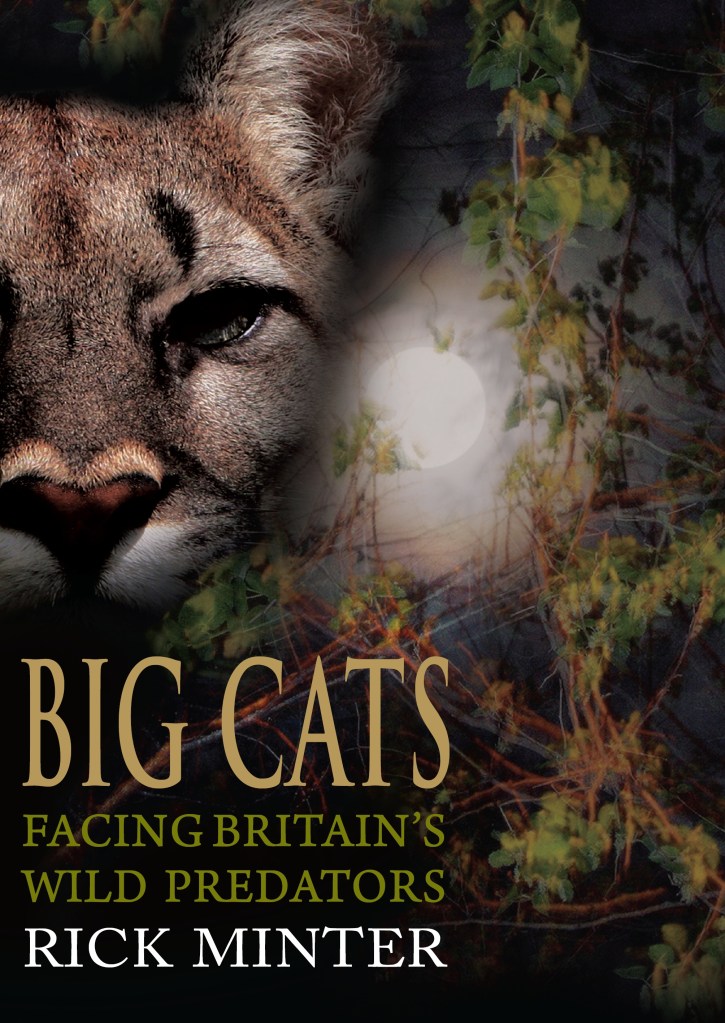
At the risk of sounding rather blasé about what should be a very exciting aspect of natural history I have pretty much reduced the Big Cat Diaries reports for this quarter to the two words, “fairly typical”. Unfortunately I haven’t had time to write them all up for this edition, though I am pleased to say there has been another encounter with the growling bush at the Castle Eden Walkway; instead I am going to do a quick review of one of my Xmas presents. Not the socks. (Yes, there were socks) Nor the pocket microscope from the Natural History Museum, much as it is incredible quality for eight quid. Rather it’s my present from my eldest son, which was a copy of a new book on big cats in Britain. The book is by Rick Minter who co-edits the well-respected “Ecos” journal so as you can imagine it is very well written and thoroughly researched. It differs from other books in this field in that it isn’t so much about reports of big cats, though it has plenty of those to illustrate the points. Rather the book is about trying to move the study of big cats in Britain from the cryptozoological to the bona fide realms of ecological research and, as you might gather from the front cover, opening up a debate as to how we deal with the situation of large predators becoming established in the midst of our green and pleasant land. To take such a stance presupposes that there is a viable and increasing population of big cats out there in Britain. This is one point where I would disagree with Rick, at least based on my impression of what the situation is in the North East and in spite of the headline in the Journal that he quotes, which says that “Wildlife expert, Ian Bond, says that big cats are prevalent across the north east”, which is pretty much the opposite of what I said. (You may spot the other inaccuracy in that headline). Nevertheless this is an excellent book, which summarises the best of the research and evidence, interviews leading researchers and briefly reviews other literature on the subject. If you are in to this subject then this is the book to get. I suspect that one of the aims of the book, to engage science and nature conservation bodies, will prove to be a bit premature; after all if someone like me, who compiles a column on big cat sightings, thinks that there is still a comparative paucity of evidence for large numbers of cats how much more are they likely to remain cautious about the subject. But if, as Rick and others believe, the numbers of big cats are higher in certain other parts of the country and they are now part of our fauna, then this book deserves to be the seminal work that unlocks that interest.
Following my talk to Durham Badger Group on big cats in the North East (surprisingly this was the first group that I have spoken to on the subject that didn’t have any additional big cat stories of their own) I received an e-mail from Lesley McNaughton entitled “Durham Puma?” I was expecting the breakthrough photo so I was a little surprised to open it up and find a morality tale about the wisdom of old dogs. But as one who has passed a great many lampposts myself, I found it most amusing so make no apologies for including it. For the purposes of this column the dog has been appropriately changed to a Labrador:
“An old Labrador starts chasing rabbits and before long, discovers that he’s lost. Wandering about, he notices a panther heading rapidly in his direction with the intention of having lunch. The old Labrador thinks, “Oh, oh! I’m in deep shit now!” Noticing some bones on the ground close by, he immediately settles down to chew on the bones with his back to the approaching cat. Just as the panther is about to leap, the old Labrador exclaims loudly, “Boy, that was one delicious panther! I wonder if there are any more around here?” Hearing this, the young panther halts his attack in mid-strike, a look of terror comes over him and he slinks away into the trees. “Whew!,” says the panther, “That was close! That old Labrador nearly had me!”
Meanwhile a squirrel who had been watching the whole scene from a nearby tree figures he can put this knowledge to good use and trade it for protection from the panther. So off he goes, catches up with the panther, spills the beans and strikes a deal for himself with the panther. The young panther is furious at being made a fool of and says, “Here, squirrel, hop on my back and see what’s going to happen to that conniving canine!” Now, the old Labrador sees the panther coming with the squirrel on his back and thinks, “What am I going to do now?,” but instead of running, the dog sits down with his back to his attackers, pretending he hasn’t seen them yet, and just when they get close enough to hear, the old Labrador says… “Where’s that squirrel? I sent him off an hour ago to bring me another panther!“
Summer 2012
I’ve often quipped that big cats are one of the North East’s most regularly reported mammals. If the most recent set of reports is anything to go by it seems that they are becoming one of the most widespread as well, as the first five reports are all from new areas. I’m pleased to see though that the long-standing panther/ Labrador symbiosis continues, as this first report from a wooded area surrounding the Meadowdale estate in Bedlington demonstrates:
“I was walking my Labrador, who began to freeze and stare into the woods. I came around a blind corner and there was a large black cat in front of me on the footpath, 15/20 feet away. It looked like a normal domestic cat, completely black with pointed tufted ears and a long, curved tail. It was larger than my Labrador, who is 26″ tall and more powerfully built, long legs and big paws. The cat stared at me for about 30 seconds before disappearing into the undergrowth. I was too close to mistake either the size or type of animal.”
In days gone by, the Durham Puma was reputed to stalk Teesdale and even left a bona fide dropping at Whorlton. However in the first decade of the Big Cat Diaries there has only ever been a single big cat sighting in Teesdale; that of a possible Puma at Barnard Castle (I’m not counting the three foot square cat with the liking for Morrisons’ cooked chickens that was seen at Gainford). More recently reports have come to light in the surrounding area at Ravensworth and adjacent to the A66. Indeed the reports to the west of Richmond that I said I would try and get some more information on a couple of editions ago have turned out to be current with stories of big, black cats, lambs going missing and farmers frightened to go out on a night. Then just this March a cat turned up right back in Teesdale, albeit lower Teesdale just outside of Darlington, when one leapt across the road at Winston. I’m saying that it was a cat though the person who saw it couldn’t swear that it was a cat. What he saw as he had just drove across the bridge over the River Tees was a large, dark coloured animal leap over the fence and land in the middle of the road before disappearing across the fence on the other side of the road in a couple of bounds. In what was obviously a brief encounter and in the dark, though from no more than 50m, all he had time to note was its deep chest, its thick muscular limbs and snub face; he didn’t see any indication of a tail. In reality the only animals of that size that could make those sorts of leaps would be a deer, a Lurcher or a large cat. But this was a sighting by someone who shoots regularly and while he described it as the size of a Roe deer, he knew it definitely wasn’t a deer and with the thick legs and snub face, nor was likely it to have been a lurcher. In fact he had seen puma in the wild in America and the muscularity of its build was similar. It’s difficult to know what to make of this as he thought Lynx was probably a bit small for what he had seen; perhaps we now have a Manx Panther stalking Teesdale.
Meanwhile just a bit further north in lower Weardale and again just outside of the Darlington boundary (not that I’m territorial or anything), a couple were sat on the old spoil heap at Brussleton Woods, watching for the resident barn owl, when suddenly a Roe deer came hurtling towards them from some trees and ran straight past as if terrified. Then in the words of the observer, “About ten seconds later, my eyes caught movement 15 yards further down from where the Roe had come from. However crazy, my first thought was a little black bear, of course it wasn’t, but it was hunched up. It then bounded behind a tree, not walk, or run but a slow bound. It then came around the other side and I got a full side view and was gobsmacked. I know my wildlife and this was nothing native to the UK. It was a big feline. It saw me then, looked for a few seconds, then turned and sloped off slowly but a slinky movement through the young trees. My partner said, “What the hell was that?” Against my partners wishes I ran after it but didn’t see it again. The new trees are very thick. To me it was twice the size of a big domestic cat easily, but slightly smaller than a puma/panther, but not by much.”
Just over the border into North Yorks but only just, near Tanton on the Stokesley to Stockton Road, someone driving home late at night saw what they could only describe as large, jet black, four legged animal moving in the ditch next to the hedgeline. Again in their own words; “ When I say large I mean large, this was no moggy. I saw it before my car reached it so it was in view for at least a second or so. It must of been at least 3.5/4ft long (head and body). Black in colour as my lights hit its coat had a glossy shine. I remember thinking, as my car was almost next to it, that it was possibly longer than half the length of my car (small estate car). It was walking / creeping through the trench. It has its head down low so I did not see its face or eyes. Also its tail was bent down over towards the ground and was hidden in the darkness of the trench, although I could see the base of the tail. It was not bushy like a Fox’s and the little bit I could was far too long for a dog. I see many Foxes.”
While the last three reports are from new areas, they are at least in the countryside and within roaming distance for a big cat from other reports. However down here on Teesside we pride ourselves on the way in which nature and industry co-exist so perhaps it’s no surprise that our last new big cat location is Redcar Steel Works, or at least the A66 next to the steel works, where a cat ran across the road in front of someone finishing a night shift. The person who filed the report with Big Cats in Britain on behalf of the person who saw it also mentioned that his boss had been out on his own land lamping foxes when he had an encounter with a huge black cat and that prior to that sighting the local farmer had been losing lambs. Not only that but he had himself seen something similar on Wynyard many years ago.
If you have been following the Big Cat Diaries for a little while you will be aware that we can’t have an edition of Big Cat Diaries without a mention of Wynyard and I have been told that there have been several more sightings over the past few months of a big, black cat down towards Thorpe Thewles. For those of you who have been following this topic for years you will realise that the Wynyard cats can appear as a disembodied voice in a bush or even change colour and while most of the big cat sightings there are of a black animal, of the ten reports that I have had across the North East of a large, sandy coloured cat (ie a Puma), five of them have come from Wynyard. So at the same time as black cats are being reported at the southern end, I had an an e-mail from someone who works on Hartlepool’s rural fringe, and who, with her colleague, saw a deer sized, sandy brown cat. The next day she e-mailed me again to say that she had seen it again only this time it was further away and not such a good view. Both sightings were in the middle of the day. Anyway, the company she works for has CCTV cameras up, one of which was pointing right at where she saw the cat the first time and she had got permission to check the cameras and she was going to get back to me the next day with what she felt sure would be a clear shot. As you haven’t seen this on the national news and as you might have guessed, in accordance with the Law of Sod it turned out the distant cat was too far away for one camera to pick up and the other camera, which was pointing right at the cat, wasn’t working.
What I found was almost as interesting as the sighting itself was my reaction to it. Until I got the news of the camera malfunctions, I was at the point whereby I was sure that the next day was going to bring conclusive proof of a Puma wandering around Hartlepool. What’s more the woman had in one of her e-mails seemed a bit concerned about the cats being out there. I managed to allay her fears, I think, but for a day or so I was left pondering the scenario of what happens if this actually becomes official. In one sense it wasn’t that big a deal to me; after all it would only prove that there is one big cat roaming about parts of Hartlepool, which I’ve long accepted had been the case anyway; it would still say nothing about the status of big cats throughout Britain. However to the press, the public and particularly the employees of that company it would probably be a very big thing.
For one thing if it went public we would have loads of people with guns and dogs trying to hunt it. On the other hand if it was hushed up, shouldn’t we at least warn people who work in that area that there is a big cat wandering about outside the offices? Either way would be a problem. What if there is an official decision that we must catch/kill it? What brought that home to me is that, if it is in Hartlepool, then as Council’s ecologist I am part of the official response and while my advice might be “leave it alone on as they’ve been there for years and never threatened anybody”, the decision as to what to do isn’t mine. I could even find myself being part of one of those cover ups (if only for the cat’s sake) that I previously reckoned would probably never happen. (If you don’t hear any more about this, ask yourself, is it because the cat never came back or is it because I am covering it up?)
I actually found myself thinking, “do I really want this to be definitively proved” and in some ways I’m not that disappointed that in the end it wasn’t. In the words of the new big cat book by Rick Minter, I am wondering whether we are ready to face Britain’s wild predators. That said, I have borrowed one of Northumbria Mammal Group’s trail cams and just as soon as I figure out how to work it (which may be some months given my advanced technophobia) panther/puma Cam will be going out somewhere on Wynyard. At least if I’m doing it with my Northumbria Mammal Group hat on I don’t have to tell anyone if I don’t want to.
Spring 2013
Perception is a strange thing. I’ve long been aware that I tend to march to a different drummer to most people nevertheless I had always thought that I saw the world pretty much as everyone else does. It wasn’t until one time when I took part in a team-building day with the rest of the Stockton’s countryside service that I was struck by the realisation that perhaps we don’t all think alike. As part of the process of discovering our particular contributions to the team, we were presented with a picture and asked to describe what we saw. The picture was very surreal in overall make up but it still clearly depicted readily identifiable elements. I set to as if describing a new bird and noted down colours and sizes and the juxtaposition of the different elements; indeed any possible feature that might prove to be important. I expected that everyone else would have done the same except perhaps not in as much detail, as I was being a little bit competitive. Imagine my surprise then when people had to read out their description and I found that some people hadn’t “described” anything at all. Instead they talked about how the picture made them feel, or what they thought the artist was trying to say and other such things that had nothing at all to do with what the picture looked like. (At the end of the day, when we were all thoroughly tested, it turned out that I am a pragmatic (and introverted) sort of person and apparently not everyone else is).
This episode was of course some years ago now, before countryside rangers became a Red Data Book species, but I was reminded of it when Steve Lowe had me going that we had missed a species from the otherwise pretty damn comprehensive Mammals, Amphibians and Reptiles of the North East. After he had let me dangle for a while it turned out that he was referring to the reports of Bigfoot in Northumberland from a few years back. I knew of these but hadn’t been on the Bigfoot Research North East website (yes, you did read that correctly, there really is one!) to read the first-hand accounts. When I followed the link Steve sent me I found that these weren’t written as fleeting glimpses of ghost like figures but actually gave specific details and I quote, “I could hear he [sic]footsteps on the wooden track then I saw it at the edge of the track standing in the undergrowth a tall figure standing at least eight feet tall and very wide at least double my size, with what looked like two glowing eyes.” Another described a creature dark brown in colour with muscular arms. Now to quote a well-used Darlington saying, “I will bare my backside in Binns window if there is a Bigfoot in Northumberland.” There can be nothing that you could conceive of that is more “not so” and yet there are people who reckon that is what they saw. It is this scope for seeing the world differently that has struck me as I’ve been compiling this edition of the Big Cat Diaries. While I am still absolutely convinced that some of the reports over the years have genuinely been of big cats, as this edition’s reports might suggest, perhaps we should be shaking the salt cellar a bit more vigorously.
The first report is about as typical as they come. It was third hand report via a Gateshead Countryside Ranger (a critically endangered sub-species of countryside ranger) of a woman who was out jogging round Derwenthaugh Park with her dog at 6.30am when she saw a large black cat. To quote her friend who told the ranger “She saw four deer, three froze and her dog ran off after the cat – she screamed at the dog for it to come back but she is certain the cat was very large stretching across the footpath which is at least 2m wide!”. Leaving aside the fact that there seems to be something missing from the chain of events, eg the relation of the deer to the cat or indeed the deer to anything, there are unfortunately a few things that leave room for doubt as to the cat’s identity. For example a black cat that stretches 2m when stood still is a panther but a black moggie going at full tilt might well appear to stretch the full width of the path. Also why was her dog chasing the panther; it’s supposed to go the other way and, in my best “Points of View, frustrated of Darlington” voice, “Why oh! Why”, doesn’t it mention what type of dog it was and how big the cat was in proportion to it? The ranger wondered whether the Council had a protocol for such things, to which I was amused to see Terry Coult, who is to cryptozoology what Richard Dawkins is to creationism, respond that you can’t have a protocol for something that doesn’t exist.
We leave Gateshead then with at best a possible panther that was a bit of a scaredy-cat. However, the next report produced that most elusive of evidence; a photo of an alleged big cat. This was at Bowesfield, a Tees Valley Wildlife Trust reserve next to the River Tees but also next to a business park and housing estates. A couple were walking along the path near the houses and beside the river when they saw a large cat, sandy brown in colour, which startled them. The cat was 100 yards away and walking towards them. They immediately thought Puma and reckoned the cat to be two feet high and perhaps twice that in length to the tail. Unnerved by this, they turned around straight away and went back in the opposite direction but glanced over their shoulder to take a couple of pictures, though the cat had gone off in to the woods on the second photo. When they saw the picture they were even more convinced and later in the day they took the picture to the local police station, which sent out a van to investigate though by then it was getting dark and there was no sign of the cat. They were so convinced that they were prepared to go to the papers though the police asked that they didn’t. Instead they managed to via Google to contact Jonathan Pounder and sent him a copy of the picture, which he shared with me for a second opinion. The picture isn’t very distinct as the camera has focused on the plants in the foreground but it does show a brown, cat like object, which is crouching beside the path as if to pounce on something just inside the woodland. Whatever it is, it definitely isn’t big enough to be a Puma and as far as I can tell, it is not outside of the parameters of domestic cat size.
However the report that most brought home to me the potential to misjudge size was by Malcolm Birtle. For those of you who don’t know him, Malcolm is editor of the Vasculum and an old-school naturalist, who identifies invertebrates based on the minutest of differences, ie someone who makes meticulous observations of wildlife. Malcolm was roaming the countryside near Alston when he saw a large black object on the path up ahead of him. At first he took it to be a silage bag but then looking more closely realised that it was animate. Then he realised that it was a cat and what appeared to be a huge cat, bigger than an Alsation. The cat disappeared in to a field and still somewhat reeling from this Malcolm thought to himself that if he looked over the wall, he could probably still see it. He did so and there in front of him was an ordinary black cat. This must have been the same cat, yet so convincing was the first impression of a huge cat that Malcolm admitted to still half wondering to himself if perhaps there had been two black cats, but what are the chances of that? Had he not looked over the wall, this could have gone down as one of the better reports given Malcolm’s impeccable credentials as a wildlife observer.
You will know by now that many of the reports that I receive compare the animal to a black Labrador so I thought I would leave the last word to Phil Roxby who was out in deepest, darkest, rural Darlington spotting owls. In his own words, “Oh and I also saw a black Labrador-sized animal wandering near the road at Great Stainton last night at nearly midnight….unfortunately, it turned out to be just that!”
Summer 2013
You may recall from the Spring 2013 edition of Big Cat Diaries that there has been a comparative dearth of claimed big cat sightings recently. Interestingly what has always been a steady trickle of sightings of panther/Puma sized cats continues to run dry and the only report that I have of a panther-like animal is of one heard roaring by military personnel on the army ranges west of Richmond. I have long predicted that the sightings would one day dry up as any cat(s) out there reaches the last of its nine lives. So in one sense if this pattern continues it could be said to support the idea that previous reports were based on a real animal. (I am of course also aware that there are alternative explanations to the dearth of reports).
Anyway there has been so little to report that there is no separate Big Cat Diaries for this edition of the newsletter; instead I have tagged the one report that I have had for this region on the end of my “Droppings” column. However, it is a very significant sighting; firstly because it was by Keith Bowey, a greatly respected recorder of wildlife. Secondly he got a good look at it and meticulously described it. Thirdly it was big, albeit clearly not big enough to be a panther, nor did it resemble any known species. Keith has kindly allowed me to reproduce his sighting in his own words.
“For survey reasons I happened to be deep in the Durham Uplands (about two miles from the nearest road) as dusk turned to dark last night. I was in relatively remote gill to the north of Teesdale when at dusk (about 17.55hrs) I found a rabbit dump in an old quarry. This comprised 12 rabbits, part gutted, slit and spread open. Immediately my mind went on to bird of prey persecution mode – it certainly looked like it. Just then my thoughts were taken else, when a ‘dark’ movement at the back of the small quarry about 15m from where I was standing, caught my eye. The animal moved left to right behind a hummock of heather before presumably after pausing, making run for it. It was a large black feline (and I am not talking black ‘domestic cat’!). I saw it well for about four/five seconds as it ran across the back of the quarry, then up an incline and away on to the fell side.
I estimated that it was about 20-25% bigger than a large domestic tom, it had a very rough (really long, shaggy guard hairs) pelage. When it looked at me as it ran, it held its ears flat and at right angles to the head (like a very angry spitting domestic cat), it had a really broad face and a hugely thick and round-ended tail (I saw this feature really well as it went away from me). I didn’t see the eye colour. The pelage was a dark, sooty grey/black (perhaps charcoal?) and I could see a shadow of ‘tabby’ type black markings along the back (with black stripes coming off this at right angles), down the mid-line of the spine and on to the tail which looked solid black.
In recent years I have, on at least two occasions in relatively remote Durham upland locations, seen what looked like feral domestic cats and in both instances they were black. But this one did not tally. It was far too big and thick-set and the tail was that of a wild cat. Have there been any other reliable reports of similar looking animals? My thoughts are moving toward a black-type feral/wild cat hybrid, as one occasionally hears of being reported in Scotland. Any thoughts? By the by, I checked – it had been eating one of the rabbits.” Keith Bowey.
It’s interesting to speculate as to what this cat might have been. As Keith pointed out, similarly large, black cats, known as Kellas Cats, are found occasionally in Scotland and are a complex mixture of wild cat and domestic cat genes, what is known as an introgressive hybrid. There haven’t been any genuine wild cats in the North East for 150 years but is it possible that there are still wild cat genes lurking in feral cat populations that occasionally show themselves? However that would also require a feral cat population and I have no idea whether we have such a thing in Teesdale, or just some domestic cats that roam a bit.
In the subsequent exchange of e-mails, Keith wondered if a cat such as this might account for the other reports of big, black cats and certainly some reports, while purporting to be of big cats, certainly aren’t of cats reaching panther size. I have always assumed that gigantism of this order in domestic cats was unlikely and certainly in 50 years of looking appreciatively at cats (alright 45 years, I was scared of cats until I was about 8) I can’t say that I have seen a single short haired cat that was even notably bigger than the average moggie, let alone 25% or more. If anything, black short haired cats always seem to me to be a bit smaller than other varieties. Maybe it is possible though that specimens well outside the normal range do occur from time to time. When I was looking up Kellas Cats (alright I wasn’t sure exactly what introgressive meant either) I came across an interesting blog by the high priest of cryptozoology, Karl Shuker. The blog is based on a couple of scanned letters that claim to describe a big, black, but non-pantherine cat, that was killed as it fought and fatally wounded a large dog just north of Bellingham. It is claimed the cat was 50 inches in total length. You can read it at http://karlshuker.blogspot.co.uk/2012/09/attacked-by-british-mystery-cat.html
Winter 2020
While I’m thoroughly convinced that there has been the odd big cat on the loose in the North East, my conclusion was that it was just the odd cat and that they would eventually die, and with them the phenomenon of big cat sightings. Consequently I no longer actively sought reports and whether because of that or because the individual cats had in fact died out, I no longer received any reports. That was that, as far as I was concerned, until 2019 when I received what was the best report I have ever had, which was of a panther in south Northumberland. While I’m not at liberty to share the details, there could be no doubting that’s what it was. This sighting was within the range of the host of panther sightings from the past. The problem was that the past was too distant for it to be the same cat. That only left two possibilities, either panthers are breeding in the North East or that someone had released one. If it turns up again, it may be time to re-start the “Diaries”.
 Raven on the Wing
One thought on “The Path of the Panther – the path continues (a bit)”
Comments are closed.