A few years ago I watched an interview with Sting, where he talked about growing up on Tyneside, with the River Tyne and the ship yards right at the end of his street. This was the inspiration for his debut musical, “The Last Ship”. We had a river at the end of our street to. It didn’t have boats, (except for the ones we made from packing cases that thankfully we never had the nerve to launch) but it did have bridges. There was the Five Arches that carried the main rail line and marked the boundary of our territory with the kids from Haughton; there was the bright-blue, “Tin Bridge” that Kev Shields somersaulted off, decades before free-running was thought of; there was Albert Road bridge with the chapel where we went to Sunday School, opposite the Youth club where we went once we were old enough to cross to the other side; and then there was the other bridge, just downstream from Albert Road. You couldn’t get to that one so we never really took any notice of it or gave it a name.
The river was the Skerne and my Dad’s allotment ran from the bottom of Henry Street to meet it. Most of my childhood was spent within a stone’s throw of it; in fact throwing things into the Skerne was a fair part of what we did with our time. The name Skerne comes from the Anglo-Saxon meaning “bright water”, but it was anything but bright in my day, more a muddy canal. Even so, it could flood half way up the allotments so commanded respect. As a young child I remember my Dad warning me that it was six feet deep and to prove it he pulled out a large, submerged branch covered in snails and leeches. Looking back I realise that it can’t ever have been more than two feet deep when not in flood, but it did the trick.
In those days, snails and leeches were the only wildlife you could see if you peered into it on the occasions that its waters ran slightly clearer. But times change and the river changed with them, sometimes for better, sometimes for worse. I’d be about twelve when the allotments were cleared to make a landscaped amenity area. Before then I’d never seen a Water Vole, which might have been down to the rats that flourished on the allotments, but I saw them quite regularly for the next couple of decades. Now the trees of the landscaping, some of which I helped plant, have grown up and shaded all vegetation from the banksides and the Water Voles have gone again.
Nationally there was a bit of a rash of tree planting in the 70s and 80s, not all of it in the most appropriate places. The ox-bow lake at Rockwell, just round the corner from the Five Arch Bridge, that had featured in my CSE Geography project, had been reduced to a yard of bare mud surrounding a car tyre when it received a make-over that excavated a large pond and several small ones. The benefits were almost instantaneous and I remember my astonishment at seeing my first electric blue damselflies and not quite believing that anything on my doorstep could be that ridiculously dazzling. Of course the makeover came with the obligatory tree planting and over time the open, damp grassland changed to what looked like your standard, woodland planting block. I had long thought that planting those trees had been a big mistake and one that was in desperate need of rectifying. However a couple of years ago I explored its interior with Darlington Naturalists Field Club. Once inside it was like what I suppose the Okefenokee Swamps to be, its dense trees and damp hollows giving it an almost primeval feeling, and I realised that this was actually well on its way to being that very rare habitat that is wet woodland.
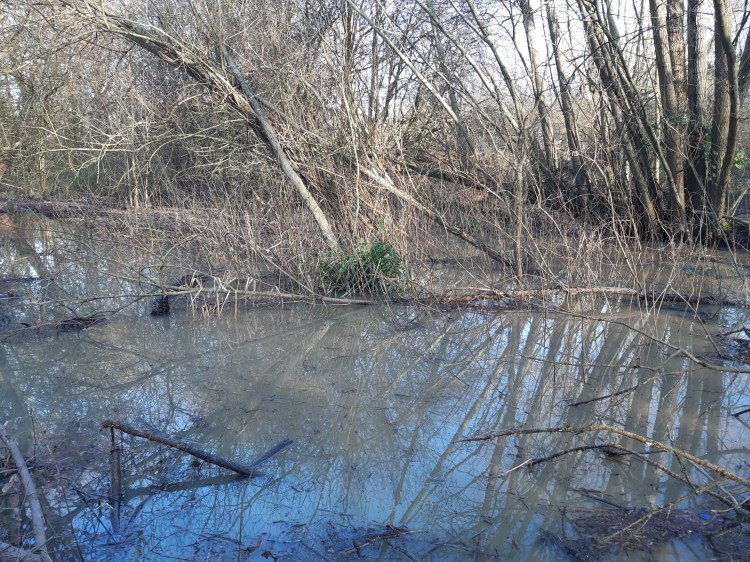
The 90s saw an even more dramatic change as a European project to naturalise rivers saw the Skerne’s passage through Rockwell change course as it was given some kinks and even a couple of backwaters. One of the functions of the backwaters was to provide a nursery area for fish. Whether they do I can’t say but the changes in fish populations on the river must rank among the best of conservation successes. Sticklebacks I knew about, they had re-colonised fairly early and hung about in the shallows. Other course fish were widely rumoured and not unexpected but the photograph of the licensed angler posing with the 10 inch Brown Trout that he had pulled from under the Five Arch Bridge drew a gasp of surprise from me. And following the fish has been that ultimate seal of conservation success, the Otter. When I was a child there might not have been one closer than Northumberland, now they mark their territories in drains in Darlington town centre.
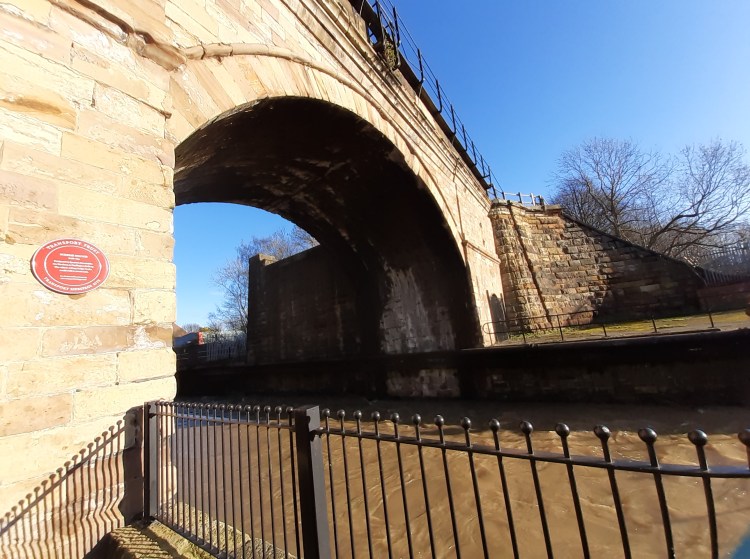
And as for our un-named bridge; hidden and neglected for years, it turns out that it was one of the most important features of North East history. This was the bridge that carried the first passenger railway, the crossing by the Locomotion, later immortalised on the five-pound note. Darlington Council has fairly recently created a cycle path running along the Skerne, under the “Five Pound Bridge” and into the town centre. Almost two centuries on, I can now stand where the crowds stood in John Dobbin’s famous picture. Just think what Sting could be writing musicals about if he’d lived down our street.
 Raven on the Wing