Usually the first day of the year involves a visit to RSPB Saltholme, a place where my listing of things appears perfectly normal. The café is a twitcher’s waterhole with bird spotters of all descriptions jostling for a seat so that they can re-fuel with tea and Victoria sponge before heading back to the chase. I say of all descriptions, actually they are nearly all male, over sixty and dressed head to toe in clothes that range from greenish-beige to beigy-green. There is the occasional female but neither sex is of reproductive age and I fear they may soon go extinct. Given the similarity, it can be a struggle to tell them apart and I don’t want to stare too closely so I invoke Rule 3b. And when I say that I appear perfectly normal, in this company I am somewhat the odd one out, content as I am with a wander round the grounds and happy with whatever flies across my path to kick off my year. My companions at the waterhole are a lot more focused and have spent the morning flitting like bees in a meadow between one likely birdwatching spot and another. Still we are all there with one purpose, even if the level of obsession differs and it’s good to be among it, listening to the air humming with the swapping of tales of birds spied and feeling slightly smug because I don’t share the compulsion to down the sponge and dash off to where a lesser spotted was last spotted.
The Covid restrictions on New Year’s day 2021 being of that most transient of states that was termed Tier 4, RSPB Saltholme was actually allowed to be open but even if I’d been prepared to risk a bit more chance of Covid transmission it wouldn’t have been the same. Instead we opted for a short circular walk from our house to Drinkfield Marsh and back through North Cemetery. A Mandarin drake had been at Drinkfield for almost two weeks; its rare beauty making it something of a celebrity. I had just seen it on Boxing Day, but that was last year’s list and anyway Mandarins are genuinely uncommon and always spectacular and I often go a year without seeing one anywhere, so it seemed like a good way to start the list.
Birds are never going to get me far on my list though; I generally only see 130 birds species in a good year; its plants that I need. As I’m sure I don’t need to tell anybody over the age of three, most plants exist in winter either as a few green leaves or as dead but for my purposes, possibly still identifiable, stems. So I wandered through the streets a few yards behind my family, head down making disjointed conversation, my obsession proving amusing enough for them not to be too annoyed at me.
Drinkfield was soggy with a slight thaw that had turned the snow into mush, but the lake was still nine tenths frozen and the Mandarin and the septet of Tufted Ducks that shared it had left for parts more liquid. Still I had the very pleasant surprise of bumping into my brother and his family, so unexpected that I didn’t recognise him at first. He’d taken my great-nieces there to also not see the Mandarin, so we had a socially distanced catch up before leaving them to throw some crumbs to the gulls, which had gathered on the ice, obligingly in three different species.

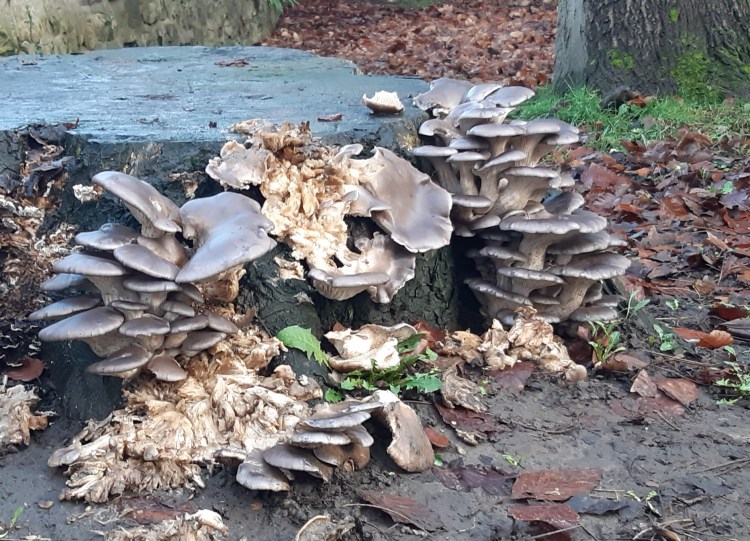
Despite the slight setback I’d reckoned on North Cemetery as a bit of a banker. Its rows of street trees mixed with conifers provide good winter shelter for birds and it’s the most reliable place I know for Goldcrest and Nuthatch. Not only that but I’d found a stunning example of Grey Oyster Mushroom on a tree stump just before Christmas. Grey Oyster Mushrooms are one of the few fungi that I trust myself to reliably identify with their shiny, lilac grey caps growing out of dead hardwood trees. Maybe the weather had driven away the Goldcrests and Nuthatches as well, as there were no animals to be seen, except the odd Blackbird and some squirrels which were dancing round a regular feeding spot and gorging themselves to Gopher size. Even the Oyster mushroom had been kicked to pieces but there was just enough of its grey cap showing for me to be able to convince myself that I could have identified it if that’s all I’d ever seen of it (I know it’s a little sad, but my game, my rules). Still the Snowdrops were starting to protrude and the Lesser Celandines will be vying with them for the earliest flower and lawn moss around my family’s grave was luxuriant, its stems living up to its scientific name of “squarrosus” meaning square. There was a young conifer growing as a weed between some graves, like a Yew but not a Yew. I took the end of a frond and looked it up when I got home, comparing it to each of the possible candidates. It turned out to be a Coast Redwood, the world’s tallest conifer. I don’t know if it will be left to grow there but I would love to be able to come back in another 100 years if it is.
Continuing the theme of plants in cracks and wishing to avoid contact with people coming the other way on a fairly busy pavement, we did a detour down the China Street back alley. A small cranesbill that I would have probably dismissed in the past as Herb Robert struck me as being particularly shiny. I put a leaf in my pocket. Usually leaves that go into my pocket stay there until they are dust and unidentifiable but if I’m not going to be diligent on the first day of the quest, when will I be, so this one got looked up as well. It turned out to be Shining Cranesbill, the first time I’ve definitely seen this plant, ever. In fact the alley proved to be quite productive with Ivy-leaved Toadflax and Harts Tongue Fern growing in the walls and a dead rat on the cobbles (if the plants don’t have to be alive, the animals don’t have to be either).
So as dusk fell and I tallied up, I’d identified 76 different species on my first day, including one that I’d never seen before. I would have been quite happy with that but then my wife shouted me to evict a Daddy Long-legs Spider from the kitchen; 77 it is then.
Fascinating facts
Grey Oyster Mushrooms are edible and even contain statins which could lower cholesterol. They are also one of the few carnivorous mushrooms; trapping and digesting nematodes, which are tiny roundworms. Edible, but I think I’ll pass.
Neither part of the popular belief, that the poison of Daddy Long-legs Spiders is deadly to humans, it’s just that they can’t penetrate our skin, is true. They can just to say penetrate our skin, in extreme cases, but even then are no more than slightly irritating rather than deadly. They do, however eat other, venomous spiders. A friend of mine who kept Black Widow spiders in a spare bedroom used to encourage Daddy Long-legs Spiders in the room, on the basis that if a Black Widow got out a Daddy Long-legs would hopefully get the Black Widow before the Black Widow got him.
 Raven on the Wing